
1400 种血浆代谢物在胃癌中的作用:一项双向孟德尔随机化研究和代谢途径分析。
The role of 1400 plasma metabolites in gastric cancer: A bidirectional Mendelian randomization study and metabolic pathway analysis.
机构信息
Nanjing Medical University, Nanjing, China.
Department of Gastroenterology, The First Affiliated Hospital of Nanjing Medical University, Nanjing, China.
出版信息
Medicine (Baltimore). 2024 Nov 29;103(48):e40612. doi: 10.1097/MD.0000000000040612.
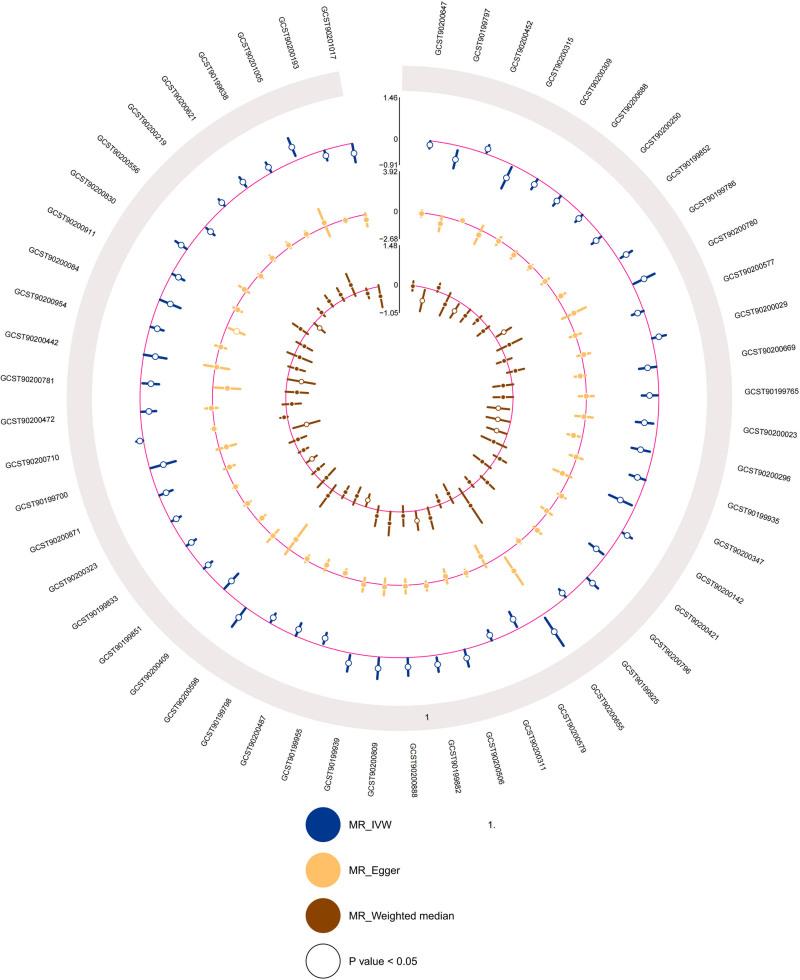
While observational studies have illustrated correlations between plasma metabolites and gastric cancer (GC), the causal association between the 2 is still unclear. Our study aims to delineate the bidirectional relationship between plasma metabolites and GC and find potential metabolic pathways. We undertook a bidirectional 2-sample Mendelian randomization (MR) analysis to investigate the causal relationship, specificity, and direction of association between 1400 plasma metabolites and GC. The GWAS data for metabolites was obtained from a cohort of 8299 European individuals. And the GC's GWAS data was from FinnGen Consortium with 2384 European individuals, and the GWAS catalog with 1029 European ancestry cases for validation. Causal estimates were primarily calculated by the inverse-variance weighted (IVW) method. To ensure robustness, we performed comprehensive sensitivity analyses to assess heterogeneity and address concerns regarding horizontal pleiotropy. We validated the forward relationship between metabolites and GC from another database and implemented meta-analysis. Furthermore, we conducted metabolic enrichment and pathway analysis of these causal metabolites using MetaboAnalyst5.0/6.0 with the database of Kyoto Encyclopedia of Genes and Genomes. All statistical analysis was carried out using R software. Metabolites like 2s, 3R-dihydroxybutyrate, 4-acetamidobutanoate, ferulic acid 4-sulfate and methyl indole-3-acetate was proven positively linked with the development of GC. Asparagine, glucose to maltose ratio, glycohyocholate, Gulonate levels, linoleoyl ethanolamide and Spermidine to (N(1) + N(8))-acetylspermidine ratio was proven to be negatively associated with GC. Moreover, linoleic acid, histidine, glutamine, bilirubin, Succinate to proline ratio were found to be potentially linked to the development of GC. Furthermore, our analysis identified 18 significant metabolic pathways, including Arginine and proline metabolism (P < .009) and Valine, leucine, and isoleucine biosynthesis (P < .031). Our findings offer evidence supporting potential casual relations between multiple plasma metabolites and GC. These findings may offer great potential for future application of these biomarkers in GC screening and clinical prevention strategies.
虽然观察性研究已经说明了血浆代谢物与胃癌(GC)之间的相关性,但两者之间的因果关系仍不清楚。我们的研究旨在描绘血浆代谢物与 GC 之间的双向关系,并发现潜在的代谢途径。我们进行了双向 2 样本 Mendelian 随机化(MR)分析,以研究 1400 种血浆代谢物与 GC 之间的因果关系、特异性和关联方向。代谢物的 GWAS 数据来自 8299 名欧洲个体的队列。GC 的 GWAS 数据来自 FinnGen 联盟的 2384 名欧洲个体,GWAS 目录的 1029 名欧洲血统病例用于验证。因果估计主要通过逆方差加权(IVW)方法计算。为了确保稳健性,我们进行了全面的敏感性分析,以评估异质性和解决水平多效性的问题。我们使用另一个数据库验证了代谢物与 GC 之间的正向关系,并进行了荟萃分析。此外,我们使用 MetaboAnalyst5.0/6.0 对这些因果代谢物进行了代谢物富集和途径分析,使用京都基因与基因组百科全书数据库。所有的统计分析都是使用 R 软件进行的。像 2s、3R-二羟基丁酸、4-乙酰氨基丁酸、阿魏酸 4-硫酸盐和甲基吲哚-3-乙酸这样的代谢物被证明与 GC 的发展呈正相关。天冬酰胺、葡萄糖与麦芽糖的比值、甘氨胆酸、古洛糖酸水平、亚油酸乙醇酰胺和精脒与(N(1)+N(8))-乙酰精脒的比值与 GC 呈负相关。此外,我们发现亚油酸、组氨酸、谷氨酰胺、胆红素、琥珀酸与脯氨酸的比值可能与 GC 的发展有关。此外,我们的分析确定了 18 个显著的代谢途径,包括精氨酸和脯氨酸代谢(P<0.009)和缬氨酸、亮氨酸和异亮氨酸生物合成(P<0.031)。我们的研究结果提供了支持多种血浆代谢物与 GC 之间潜在因果关系的证据。这些发现可能为未来将这些生物标志物应用于 GC 筛查和临床预防策略提供巨大潜力。




 Zotero 插件