
中国老年 2 型糖尿病患者肌少症风险预测模型的开发与验证
Development and Validation of a Risk Prediction Model for Sarcopenia in Chinese Older Patients with Type 2 Diabetes Mellitus.
作者信息
Wang Xinming, Gao Shengnan
机构信息
Department of the Endoscope Center, The First Affiliated Hospital of China Medical University, Shenyang City, Liaoning Province, People's Republic of China.
Hunnan International Department VIP Ward Section, The First Affiliated Hospital of China Medical University, Shenyang City, Liaoning Province, People's Republic of China.
出版信息
Diabetes Metab Syndr Obes. 2024 Nov 30;17:4611-4626. doi: 10.2147/DMSO.S493903. eCollection 2024.
PURPOSE
Sarcopenia is a common prevalent age-related disorder among older patients with type 2 diabetes mellitus (T2DM). This study aimed to develop and validate a nomogram model to assess the risk of incident sarcopenia among older patients with T2DM.
PATIENTS AND METHODS
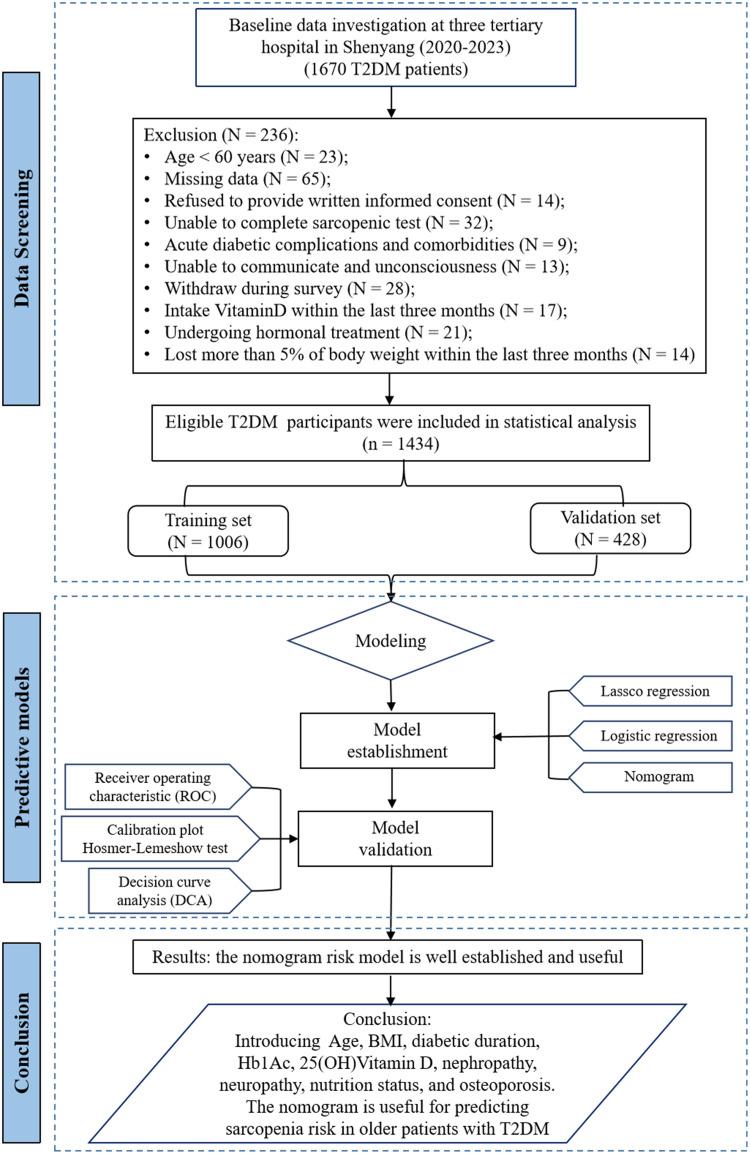
A total of 1434 older patients (≥ 60 years) diagnosed with T2DM between May 2020 and November 2023 were recruited. The study cohort was randomly divided into a training set (n = 1006) and a validation set (n = 428) at the ratio of 7:3. The best-matching predictors of sarcopenia were incorporated into the nomogram model. The accuracy and applicability of the nomogram model were measured by using the area under the receiver operating characteristic curve (AUC), calibration curve, Hosmer-Lemeshow test, and decision curve analysis (DCA).
RESULTS
571 out of 1434 participants (39.8%) had sarcopenia. Nine best-matching factors, including age, body mass index (BMI), diabetic duration, glycated hemoglobin A1c (HbA1c), 25 (OH)Vitamin D, nephropathy, neuropathy, nutrition status, and osteoporosis were selected to construct the nomogram prediction model. The AUC values for training and validation sets were 0.800 (95% CI = 0.773-0.828) and 0.796 (95% CI = 0.755-0.838), respectively. Furthermore, the agreement between predicted and actual clinical probability of sarcopenia was demonstrated by calibration curves, the Hosmer-Lemeshow test ( > 0.05), and DCA.
CONCLUSION
Sarcopenia was prevalent among older patients with T2DM. A visual nomogram prediction model was verified effectively to evaluate incident sarcopenia in older patients with T2DM, allowing targeted interventions to be implemented timely to combat sarcopenia in geriatric population with T2DM.
目的
肌肉减少症是老年2型糖尿病(T2DM)患者中常见的与年龄相关的疾病。本研究旨在建立并验证一种列线图模型,以评估老年T2DM患者发生肌肉减少症的风险。
患者与方法
共纳入2020年5月至2023年11月期间诊断为T2DM的1434例老年患者(≥60岁)。研究队列以7:3的比例随机分为训练集(n = 1006)和验证集(n = 428)。将与肌肉减少症最匹配的预测因素纳入列线图模型。通过受试者操作特征曲线(AUC)下面积、校准曲线、Hosmer-Lemeshow检验和决策曲线分析(DCA)来衡量列线图模型的准确性和适用性。
结果
1434名参与者中有571名(39.8%)患有肌肉减少症。选择九个最匹配的因素,包括年龄、体重指数(BMI)、糖尿病病程、糖化血红蛋白A1c(HbA1c)、25(OH)维生素D、肾病、神经病变、营养状况和骨质疏松症,构建列线图预测模型。训练集和验证集的AUC值分别为0.800(95%CI = 0.773 - 0.828)和0.796(95%CI = 0.755 - 0.838)。此外,校准曲线、Hosmer-Lemeshow检验(>0.05)和DCA证明了肌肉减少症预测临床概率与实际临床概率之间的一致性。
结论
肌肉减少症在老年T2DM患者中普遍存在。一种直观的列线图预测模型被有效验证,可用于评估老年T2DM患者发生肌肉减少症的情况,从而能够及时实施针对性干预措施,以对抗老年T2DM患者群体中的肌肉减少症。



 Zotero 插件