
印度贾坎德邦兰契奥尔曼吉街区2至5岁儿童含麻疹疫苗第二剂(MCV-2)和日本脑炎疫苗第二剂(JE-2)的接种覆盖率及其影响因素:一项混合方法研究
Coverage of Second Dose of Measles-Containing Vaccine (MCV-2) and Japanese Encephalitis Vaccine (JE-2) and Its Predictors Among Children 2-5 Years Old in the Ormanjhi Block of Ranchi, Jharkhand, India: A Mixed Method Study.
作者信息
Mukul Ankita, Singh Shashi B, Sagar Vidya, Paswan Dilip K, Narain Smiti, Kumar Dewesh
机构信息
Department of Community Medicine, Rajendra Institute of Medical Sciences, Ranchi, IND.
Department of Community Medicine/Preventive and Social Medicine, Rajendra Institute of Medical Sciences, Ranchi, IND.
出版信息
Cureus. 2024 Nov 4;16(11):e73004. doi: 10.7759/cureus.73004. eCollection 2024 Nov.
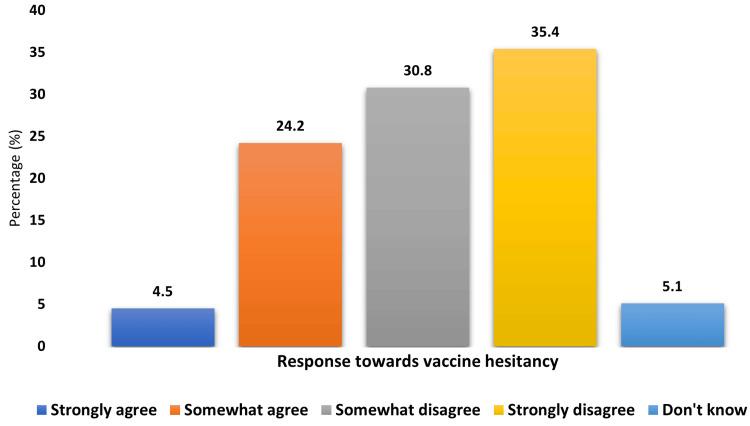
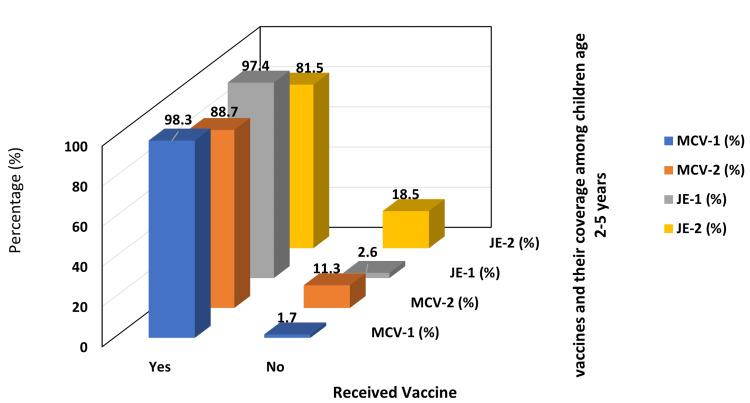
Introduction Administering the measles vaccine at an appropriate age and dosage in children is important for India to eliminate measles, a potentially deadly vaccine-preventable disease. Similarly, the Japanese encephalitis (JE) vaccine, particularly in endemic regions is important to prevent morbidity and high-case fatality from the disease. The study attempts to evaluate the coverage of measles and JE vaccines and their predictors. Materials and methods A mixed method study design, incorporating a three-stage cluster random sampling process was used in the cross-sectional survey conducted among 604 children aged 2-5 years in the Ormanjhi block of Ranchi, Jharkhand, from April 2023 to June 2024. The parents/caregivers of the eligible children were interviewed using a predesigned, pretested semi-structured questionnaire, and the immunization status of children was taken from vaccination cards. A focused group discussion (FGD) and an in-depth interview (IDI) with healthcare providers formed the qualitative component. We conducted descriptive, and logistic regression analysis using the IBM SPSS Statistics for Windows, Version 26 (Released 2019; IBM Corp., Armonk, New York, United States). The association between the coverage of the vaccine and sociodemographic variables was done using the Chi-square test. Logistic regression was used to study the predictors, and a p-value of <0.05 was considered statistically significant. Results In the household survey, the coverage of the measles-containing vaccine first dose (MCV-1) was 594 (98.3%), while the second dose (MCV-2) was 536 (88.7%) out of 604 participants. For the JE vaccine, the coverage of the first dose (JE-1) was 588 (97.4%), while the second dose (JE-2) coverage was 492 (81.5%). In the multivariate logistic regression, religion and the lack of parental knowledge about measles were significant predictors for lower MCV-2 uptake, while the for JE vaccine, religion, father's education, and household head's occupation remained statistically significant factors (p ≤ 0.05). Vaccine hesitancy had mixed perceptions with the child's unavailability being the most significant reason for hesitancy in both MCV and JE vaccinations. In the FGD, child's unavailability at times of vaccination and parent's fear of side effects post vaccination were major factors for missing doses of the vaccine. Conclusion While the initial coverage of MCV and JE vaccines is commendable, the substantial drop in the second dose coverage and the delays in administration present significant challenges.
引言 在印度,给儿童在适当年龄接种适当剂量的麻疹疫苗对于消除麻疹这一致命但可通过疫苗预防的疾病至关重要。同样,日本脑炎(乙脑)疫苗,特别是在流行地区,对于预防该疾病的发病和高病死率也很重要。本研究旨在评估麻疹疫苗和乙脑疫苗的接种覆盖率及其预测因素。
材料与方法 在2023年4月至2024年6月期间,对贾坎德邦兰契的奥尔曼吉街区604名2至5岁儿童进行了横断面调查,采用了混合方法研究设计,包括三阶段整群随机抽样过程。使用预先设计、预先测试的半结构化问卷对符合条件儿童的父母/照顾者进行访谈,并从疫苗接种卡获取儿童的免疫接种状况。与医疗服务提供者进行的焦点小组讨论(FGD)和深入访谈(IDI)构成了定性部分。我们使用IBM SPSS Statistics for Windows,版本26(2019年发布;IBM公司,美国纽约州阿蒙克)进行描述性和逻辑回归分析。使用卡方检验分析疫苗接种覆盖率与社会人口统计学变量之间的关联。使用逻辑回归研究预测因素,p值<0.05被认为具有统计学意义。
结果 在家庭调查中,604名参与者中,含麻疹疫苗第一剂(MCV-1)的接种覆盖率为594人(98.3%),而第二剂(MCV-2)为536人(88.7%)。对于乙脑疫苗,第一剂(JE-1)的接种覆盖率为588人(97.4%),而第二剂(JE-2)的接种覆盖率为492人(81.5%)。在多变量逻辑回归中,宗教信仰以及父母对麻疹缺乏了解是MCV-2接种率较低的重要预测因素,而对于乙脑疫苗,宗教信仰、父亲的教育程度和户主的职业仍然是具有统计学意义的因素(p≤0.05)。疫苗犹豫存在不同看法,儿童无法接种是麻疹疫苗和乙脑疫苗接种犹豫的最主要原因。在焦点小组讨论中,接种疫苗时儿童无法接种以及父母对接种后副作用的恐惧是错过疫苗接种剂量的主要因素。
结论 虽然麻疹疫苗和乙脑疫苗的初始接种覆盖率值得称赞,但第二剂接种覆盖率大幅下降以及接种延迟带来了重大挑战。
 Zotero 插件