
变革癌症治疗:自体加工嵌合抗原受体(CAR)细胞疗法的新兴潜力与潜在挑战
Revolutionizing cancer treatment: the emerging potential and potential challenges of self-processed CAR cell therapy.
作者信息
Lv Ruijie, Guo Yanting, Liu Weici, Dong Guangjian, Liu Xiangyin, Li Caihui, Ren Yi, Zhang Zipeng, Neo Shi-Yong, Mao Wenjun, Wu Jing
机构信息
Department of Pharmacy, The First Affiliated Hospital of Shandong First Medical University & Shandong Provincial Qianfoshan Hospital; Jinan 250014, China; School of Pharmacy, Shandong First Medical University & Shandong Academy of Medical Sciences, Jinan, Shandong 250117, China.
Department of Thoracic Surgery, The Affiliated Wuxi People's Hospital of Nanjing Medical University, Wuxi People's Hospital, Wuxi Medical Center, Nanjing Medical University, Wuxi, Jiangsu 214023, China.
出版信息
Theranostics. 2024 Oct 28;14(19):7424-7447. doi: 10.7150/thno.101941. eCollection 2024.
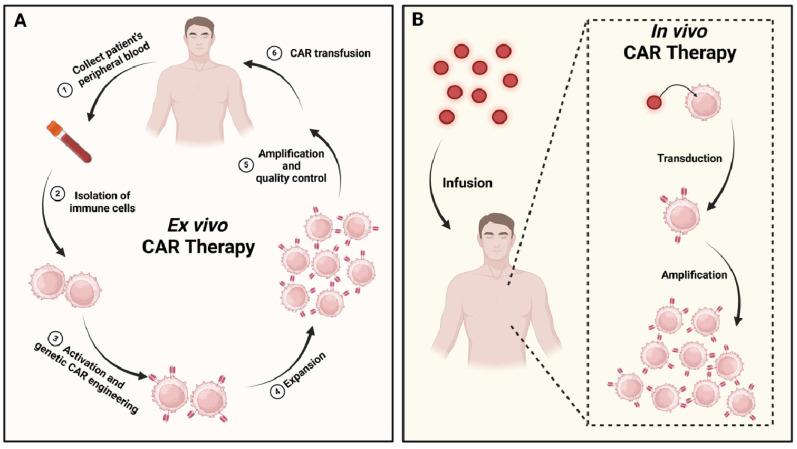
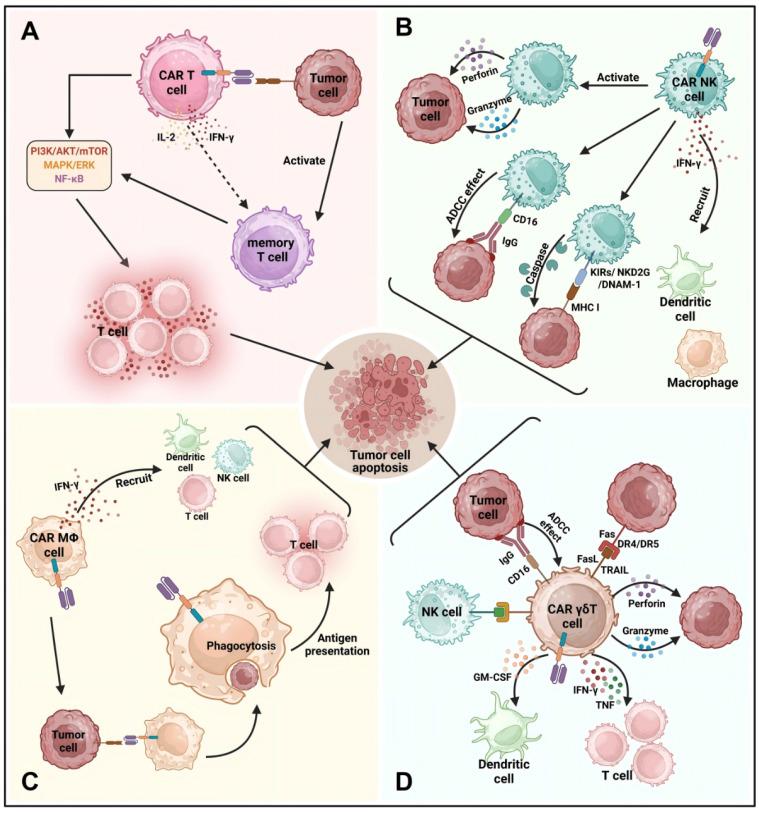
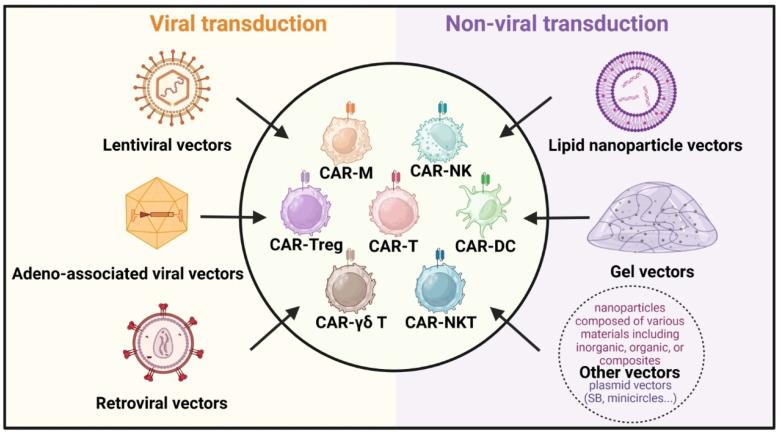
Chimeric antigen receptor (CAR) cell immunotherapies, including CAR-T, CAR-Macrophages, CAR-Natural Killer, CAR-γδ T, etc., have demonstrated significant advancements in the treatment of both hematologic malignancies and solid tumors. Despite the notable successes of traditional CAR cell manufacturing, its application remains constrained by the complicated production process and expensive costs. Consequently, efforts are focused on streamlining CAR cell production to enhance efficacy and accessibility. Among numerous proposed strategies, direct generation of CAR cells represents the most substantial technical challenge, yet holding great promise for achieving clinical efficacy. Herein, we outlined the current state-of-the-art CAR therapy, including CAR technology development, transfection vectors, and influence factors of construction of CAR . We also reviewed the types and characteristics of different delivery systems and summarized the advantages of CAR cell therapy, such as rapid preparation and cost-effectiveness. Finally, we discussed the limitations, including technical issues, challenges in target and signal design, and cell-related constraints. Meanwhile, strategies have correspondingly been proposed to advance the development of CAR cell therapy, in order to open the new horizons on cancer treatment.
嵌合抗原受体(CAR)细胞免疫疗法,包括CAR-T、CAR-巨噬细胞、CAR-自然杀伤细胞、CAR-γδT等,在血液系统恶性肿瘤和实体瘤的治疗方面都取得了显著进展。尽管传统CAR细胞制造取得了显著成功,但其应用仍受到生产过程复杂和成本高昂的限制。因此,人们致力于简化CAR细胞生产,以提高疗效和可及性。在众多提出的策略中,直接生成CAR细胞是最大的技术挑战,但对实现临床疗效具有巨大潜力。在此,我们概述了当前CAR治疗的最新进展,包括CAR技术发展、转染载体以及CAR构建的影响因素。我们还回顾了不同递送系统的类型和特点,并总结了CAR细胞疗法的优势,如制备快速和性价比高。最后,我们讨论了其局限性,包括技术问题、靶点和信号设计方面的挑战以及细胞相关限制。同时,相应地提出了推进CAR细胞疗法发展的策略,以便开拓癌症治疗的新视野。




 Zotero 插件