
结核病生物标志物的进展:揭示风险因素、活动性疾病及治疗成功情况
Advances in tuberculosis biomarkers: unravelling risk factors, active disease and treatment success.
作者信息
Schildkraut Jodie A, Köhler Niklas, Lange Christoph, Duarte Raquel, Gillespie Stephen H
机构信息
Department of Pulmonary Disease, Radboudumc Center for Infectious Diseases, Radboud University Medical Center, Nijmegen, The Netherlands.
J.A. Schildkraut and N. Köhler contributed equally as first authors.
出版信息
Breathe (Sheff). 2024 Dec 10;20(3):240003. doi: 10.1183/20734735.0003-2024. eCollection 2024 Oct.
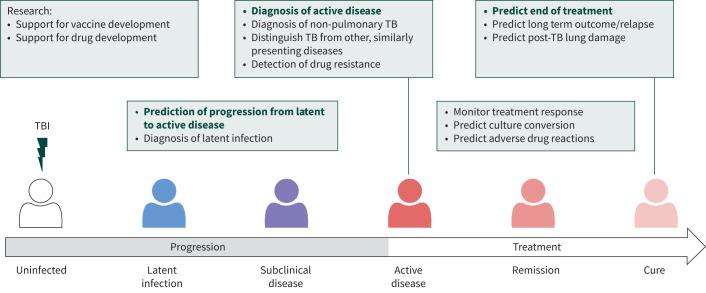
Tuberculosis (TB) is a major global health threat and demands improved diagnostic and treatment monitoring methods. Conventional diagnostics, such as sputum smear microscopy and culture, are limited by slow results and low sensitivity, particularly in certain patient groups. Recent advances in biomarker research offer promising solutions in three key areas: risk of disease, diagnosis of active disease and monitoring of treatment response. For risk assessment, novel genetic signatures and metabolites show potential in predicting the progression from TB infection to active TB. A 16-gene signature, for example, predicts this progression with significant accuracy. In diagnosing active TB, RNA-based transcriptomic signatures provide higher diagnostic accuracy than traditional methods. These signatures, such as a three-gene RNA sequence, effectively differentiate active TB from other diseases and infections, addressing issues of specificity and sensitivity. Monitoring treatment response is crucial, given the varying response rates in treating TB. Emerging biomarkers focus on bacterial burden and host response. They offer more precise and timely assessments of treatment efficacy, enhance personalised treatment approaches and potentially improve patient outcomes. These advancements in biomarkers for TB risk, diagnosis and treatment response represent significant steps towards more effective TB management and control, aligning with global efforts to decrease the burden of TB. Here we aim to highlight several promising biomarkers used to predict risk of disease progression, active TB disease and treatment success.
结核病是全球主要的健康威胁,需要改进诊断和治疗监测方法。传统诊断方法,如痰涂片显微镜检查和培养,受限于结果缓慢和灵敏度低,尤其是在某些患者群体中。生物标志物研究的最新进展在三个关键领域提供了有前景的解决方案:疾病风险、活动性疾病诊断和治疗反应监测。对于风险评估,新型基因特征和代谢物在预测从结核感染进展到活动性结核病方面显示出潜力。例如,一种16基因特征能以较高的准确性预测这种进展。在诊断活动性结核病时,基于RNA的转录组特征比传统方法具有更高的诊断准确性。这些特征,如一个三基因RNA序列,能有效地区分活动性结核病与其他疾病和感染,解决了特异性和灵敏度问题。鉴于治疗结核病时反应率各不相同,监测治疗反应至关重要。新兴生物标志物关注细菌负荷和宿主反应。它们能提供更精确和及时的治疗效果评估,加强个性化治疗方法,并有可能改善患者预后。结核病风险、诊断和治疗反应方面生物标志物的这些进展代表了朝着更有效管理和控制结核病迈出的重要一步,与全球减轻结核病负担的努力相一致。在此,我们旨在突出几种用于预测疾病进展风险、活动性结核病和治疗成功的有前景的生物标志物。
 Zotero 插件