
灼口综合征的潜在因素:基于网络视角的路线图
Burning Mouth Syndrome Underlying Factors: A Roadmap From a Network Perspective.
作者信息
Castaño-Joaqui Oscar Gabriel, Jiménez Ortega Laura, Cerero Lapiedra Rocío, Domínguez Gordillo Adelaida África
机构信息
Department of Conservative Dentistry and Bucofacial Prosthesis, Faculty of Odontology, Complutense University of Madrid, Madrid, Spain.
Department of Psychobiology and Behavioral Sciences Methods, Faculty of Odontology, Complutense University of Madrid, Madrid, Spain.
出版信息
Oral Dis. 2025 Jun;31(6):1861-1875. doi: 10.1111/odi.15219. Epub 2024 Dec 13.
OBJECTIVE
To investigate the relationship between biological, psychological, and social factors underlying Burning Mouth Syndrome (BMS).
SUBJECTS AND METHODS
A case (n = 40) and control (n = 42) study containing 80 variables was examined using two network models based on regularized partial correlations (n = 82).
RESULTS
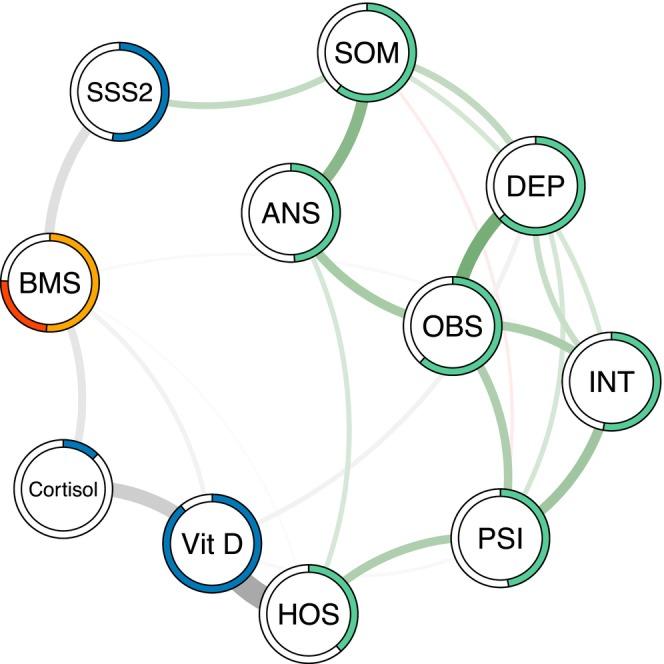
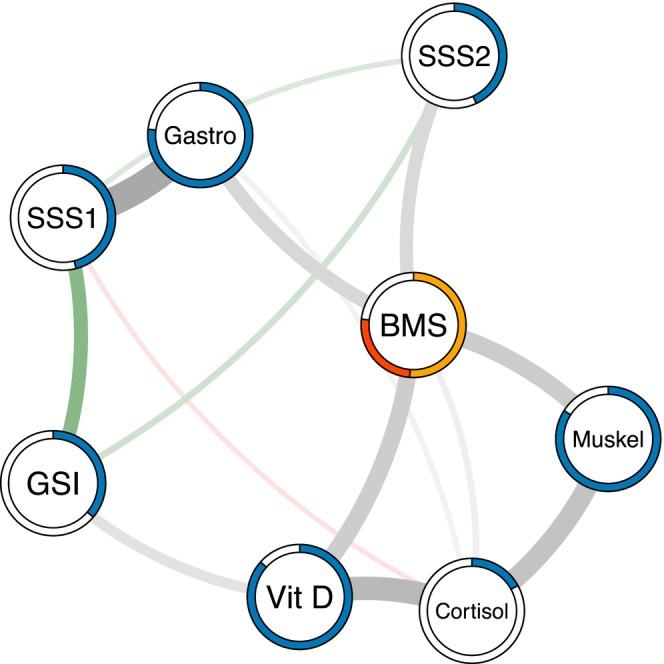
The structure of the associative pathways with the BMS was revealed. Direct associations involved Gastrointestinal Alterations (0.23), Vitamin D Deficiency (0.29), Musculoskeletal Alterations (0.29), Symptom Severity Score 2 (SSS2) (0.22), Cortisol Variation (0.10), Interpersonal Sensitivity (0.04), Hostility (0.03). Global Severity Index, Symptom Severity Score 1, Psychoticism, Obsession-Compulsion, Depression, Anxiety, and Somatization were indirectly related. The SSS2 was the most influential on BMS accuracy.
CONCLUSIONS
Gastrointestinal alterations and vitamin D deficiency show a significant influence on BMS while cortisol mediates in multiple associative pathways between musculoskeletal alterations, gastrointestinal alterations, vitamin D deficiency, non-restorative sleep, fatigue, and cognitive problems. In addition to anxiety and depression, psychoticism, interpersonal sensitivity, and hostility stand out as psychological factors that seem to be related to a lack of vitamin D. None of the factors studied seem to have a relevant predictive potential for BMS, except for nonspecific symptoms of central sensitization.
目的
探讨灼口综合征(BMS)潜在的生物学、心理学和社会因素之间的关系。
对象与方法
采用基于正则化偏相关的两种网络模型(n = 82)对一项包含80个变量的病例(n = 40)对照(n = 42)研究进行分析。
结果
揭示了与BMS相关的关联路径结构。直接关联涉及胃肠道改变(0.23)、维生素D缺乏(0.29)、肌肉骨骼改变(0.29)、症状严重程度评分2(SSS2)(0.22)、皮质醇变化(0.10)、人际敏感性(0.04)、敌对性(0.03)。总体严重程度指数、症状严重程度评分1、精神质、强迫观念与强迫行为、抑郁、焦虑和躯体化呈间接相关。SSS2对BMS准确性的影响最大。
结论
胃肠道改变和维生素D缺乏对BMS有显著影响,而皮质醇在肌肉骨骼改变、胃肠道改变、维生素D缺乏、非恢复性睡眠、疲劳和认知问题之间的多个关联路径中起中介作用。除焦虑和抑郁外,精神质、人际敏感性和敌对性作为心理因素似乎与维生素D缺乏有关。除中枢敏化的非特异性症状外,所研究的因素似乎均对BMS没有相关的预测潜力。
 Zotero 插件