
KRAS 突变型非小细胞肺癌的一线治疗:现状与未来展望
First-line treatments for KRAS-mutant non-small cell lung cancer: current state and future perspectives.
作者信息
He Qi, Liu Xiaoyan, Jiang Liyan, Liu Ping, Xuan Weixia, Wang Yudong, Meng Rui, Feng Huijing, Lv Shuang, Miao Qian, Zheng Di, Xu Yan, Wang Mengzhao
机构信息
Department of Respiratory and Critical Care Medicine, Peking Union Medical College Hospital, Chinese Academy of Medical Sciences and Peking Union Medical College, Beijing, China.
Department of Respiratory Medicine, Shanghai Chest Hospital, Shanghai Jiao Tong University, Shanghai, China.
出版信息
Cancer Biol Ther. 2025 Dec;26(1):2441499. doi: 10.1080/15384047.2024.2441499. Epub 2024 Dec 16.
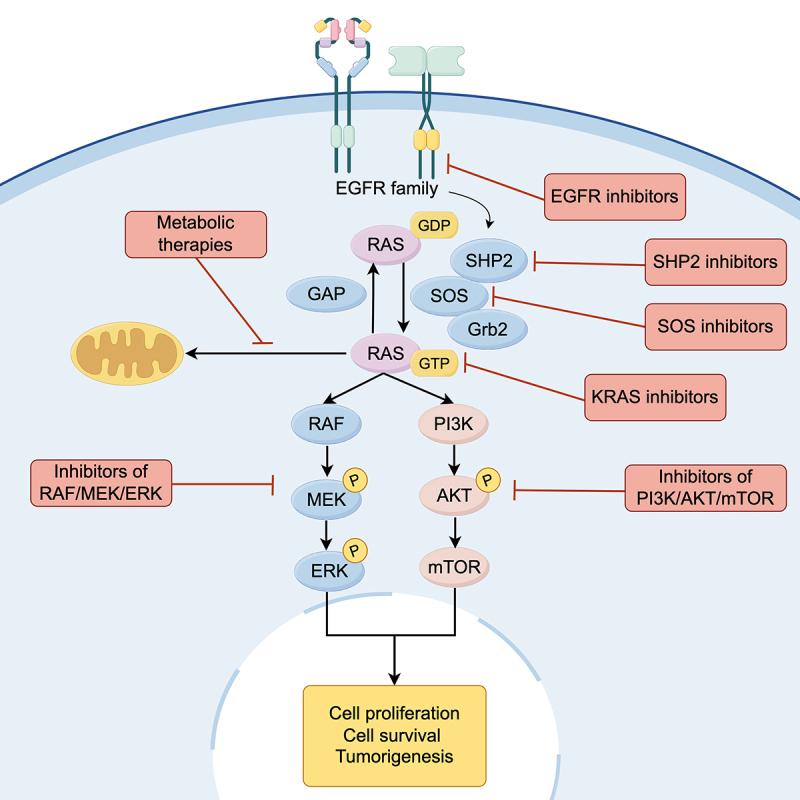
mutations are common in non-small cell lung cancer (NSCLC) and are associated with patient prognosis; however, targeting has faced various difficulties. Currently, immunotherapy, chemotherapy, and chemoimmunotherapy play pivotal roles in the first-line treatment of -mutated NSCLC. Here, we summarize the current evidence on first-line therapies and compare the treatment outcomes and biomarkers for different regimens. KRAS inhibitors and other emerging alternative treatments are also discussed, as combining these drugs with immunotherapy may serve as a promising first-line treatment for -mutated NSCLC in the future. We hope that this review will assist in first-line treatment choices and shed light on the development of novel agents for -mutated NSCLC.
突变在非小细胞肺癌(NSCLC)中很常见,且与患者预后相关;然而,靶向治疗面临着各种困难。目前,免疫疗法、化疗和化疗免疫疗法在KRAS突变型NSCLC的一线治疗中发挥着关键作用。在此,我们总结了关于一线治疗的当前证据,并比较了不同治疗方案的治疗结果和生物标志物。还讨论了KRAS抑制剂和其他新兴的替代治疗方法,因为将这些药物与免疫疗法联合使用可能在未来成为KRAS突变型NSCLC有前景的一线治疗方案。我们希望这篇综述将有助于一线治疗选择,并为KRAS突变型NSCLC新型药物的开发提供思路。
 Zotero 插件