
胰腺癌中的可塑性与肿瘤微环境:遗传学、代谢及免疫视角
Plasticity and Tumor Microenvironment in Pancreatic Cancer: Genetic, Metabolic, and Immune Perspectives.
作者信息
Hashimoto Ari, Hashimoto Shigeru
机构信息
Department of Molecular Biology, Graduate School of Medicine, Hokkaido University, Sapporo 060-8638, Japan.
Division of Molecular Psychoimmunology, Institute for Genetic Medicine, Hokkaido University, Sapporo 060-0818, Japan.
出版信息
Cancers (Basel). 2024 Dec 6;16(23):4094. doi: 10.3390/cancers16234094.
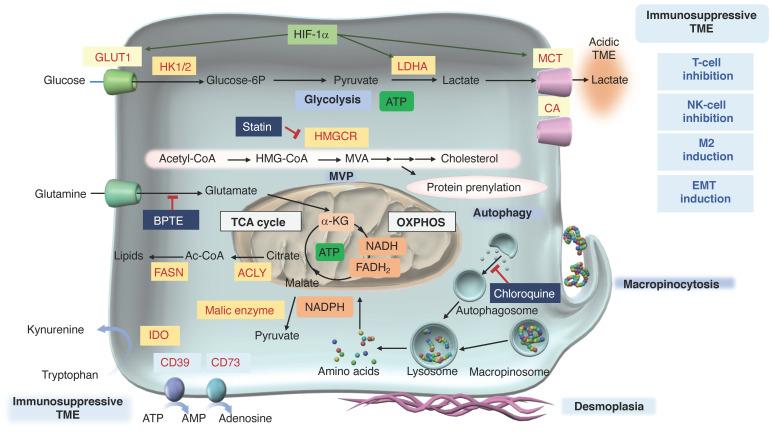
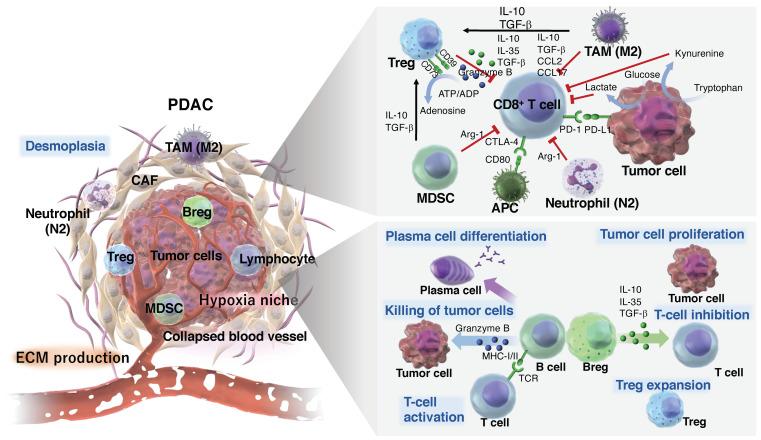
Cancer has long been believed to be a genetic disease caused by the accumulation of mutations in key genes involved in cellular processes. However, recent advances in sequencing technology have demonstrated that cells with cancer driver mutations are also present in normal tissues in response to aging, environmental damage, and chronic inflammation, suggesting that not only intrinsic factors within cancer cells, but also environmental alterations are important key factors in cancer development and progression. Pancreatic cancer tissue is mostly comprised of stromal cells and immune cells. The desmoplasmic microenvironment characteristic of pancreatic cancer is hypoxic and hypotrophic. Pancreatic cancer cells may adapt to this environment by rewiring their metabolism through epigenomic changes, enhancing intrinsic plasticity, creating an acidic and immunosuppressive tumor microenvironment, and inducing noncancerous cells to become tumor-promoting. In addition, pancreatic cancer has often metastasized to local and distant sites by the time of diagnosis, suggesting that a similar mechanism is operating from the precancerous stage. Here, we review key recent findings on how pancreatic cancers acquire plasticity, undergo metabolic reprogramming, and promote immunosuppressive microenvironment formation during their evolution. Furthermore, we present the following two signaling pathways that we have identified: one based on the small G-protein ARF6 driven by mutations, and the other based on the RNA-binding protein Arid5a mediated by inflammatory cytokines, which promote both metabolic reprogramming and immune evasion in pancreatic cancer. Finally, the striking diversity among pancreatic cancers in the relative importance of mutational burden and the tumor microenvironment, their clinical relevance, and the potential for novel therapeutic strategies will be discussed.
长期以来,癌症一直被认为是一种由参与细胞过程的关键基因发生突变积累所引起的遗传疾病。然而,测序技术的最新进展表明,具有癌症驱动突变的细胞也存在于正常组织中,这是对衰老、环境损伤和慢性炎症的反应,这表明不仅癌细胞内的内在因素,而且环境改变也是癌症发生和发展的重要关键因素。胰腺癌组织主要由基质细胞和免疫细胞组成。胰腺癌特有的促纤维增生微环境是缺氧和营养不足的。胰腺癌细胞可能通过表观基因组变化重新调整其代谢、增强内在可塑性、创造酸性和免疫抑制性肿瘤微环境以及诱导非癌细胞成为肿瘤促进细胞来适应这种环境。此外,胰腺癌在诊断时常常已经转移到局部和远处部位,这表明在癌前阶段就存在类似的机制。在这里,我们综述了关于胰腺癌在其演变过程中如何获得可塑性、进行代谢重编程以及促进免疫抑制性微环境形成的近期关键发现。此外,我们介绍了我们已经确定的以下两种信号通路:一种基于由突变驱动的小G蛋白ARF6,另一种基于由炎性细胞因子介导的RNA结合蛋白Arid5a,它们在胰腺癌中促进代谢重编程和免疫逃逸。最后,将讨论胰腺癌在突变负担和肿瘤微环境的相对重要性、它们的临床相关性以及新治疗策略的潜力方面的显著多样性。


 Zotero 插件