
基于电沉积技术的无针孔薄膜制备研究综述:理论、方法与进展
A Review of the Fabrication of Pinhole-Free Thin Films Based on Electrodeposition Technology: Theory, Methods and Progress.
作者信息
Gao Zike, Jiang Yuze, Meng Yao, Du Minshu, Liu Feng
机构信息
School of Materials Science and Engineering, Northwestern Polytechnical University, Xi'an 710072, China.
Queen Mary University of London Engineering School, Northwestern Polytechnical University, Xi'an 710072, China.
出版信息
Molecules. 2024 Nov 27;29(23):5615. doi: 10.3390/molecules29235615.
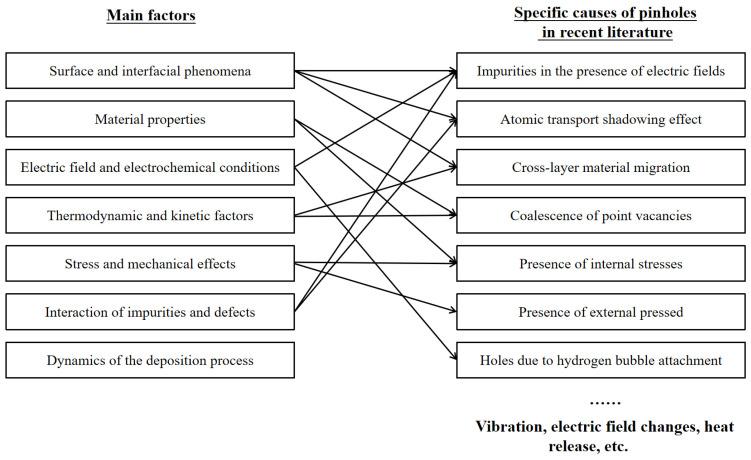
Pinhole defects in thin films can significantly degrade their physical and chemical properties and act as sites for electrochemical corrosion. Therefore, the development of methods for the preparation of pinhole-free films is crucial. Electrodeposition, recognised for its efficiency and cost-effectiveness, shows great potential for applications in electrochemistry, biosensors, solar cells and electronic device fabrication. This review aims to elucidate the role of nucleation and growth models in understanding and optimising the electrodeposition process. Key parameters, such as crystal structure, orientation, surface morphology and defect control, are highlighted. In addition, the causes of pinhole defects, the effects of impurities and the potential and electrolyte composition on the deposited films are discussed. In particular, methods for minimising pinhole defects and two exemplary cases for a compact layer in relatively large-scale perovskite solar cells and nano-scale ultramicroelectrodes are discussed, exploring the influence of surface morphology, thickness and fabrication size under current common film preparation experiments. Finally, the critical aspects of controlled preparation, theoretical and technological advances, and the ongoing challenges in the field are provided.
薄膜中的针孔缺陷会显著降低其物理和化学性质,并成为电化学腐蚀的位点。因此,开发制备无针孔薄膜的方法至关重要。电沉积因其效率和成本效益而受到认可,在电化学、生物传感器、太阳能电池和电子器件制造等领域具有巨大的应用潜力。本综述旨在阐明成核和生长模型在理解和优化电沉积过程中的作用。重点介绍了晶体结构、取向、表面形貌和缺陷控制等关键参数。此外,还讨论了针孔缺陷的成因、杂质的影响以及电势和电解质组成对沉积薄膜的影响。特别讨论了最小化针孔缺陷的方法,以及相对大规模钙钛矿太阳能电池中的致密层和纳米级超微电极的两个示例案例,探讨了当前常见薄膜制备实验中表面形貌、厚度和制造尺寸的影响。最后,介绍了可控制备的关键方面、理论和技术进展以及该领域当前面临的挑战。



 Zotero 插件