
伪狂犬病病毒对先天性抗病毒免疫的逃避
Evasion of the Antiviral Innate Immunity by PRV.
作者信息
Wang Chenlong, Li Longxi, Zhai Xinyu, Chang Hongtao, Liu Huimin
机构信息
College of Life Sciences, Henan Agricultural University, Zhengzhou 450046, China.
College of Veterinary Medicine, Henan Agricultural University, Zhengzhou 450046, China.
出版信息
Int J Mol Sci. 2024 Dec 6;25(23):13140. doi: 10.3390/ijms252313140.
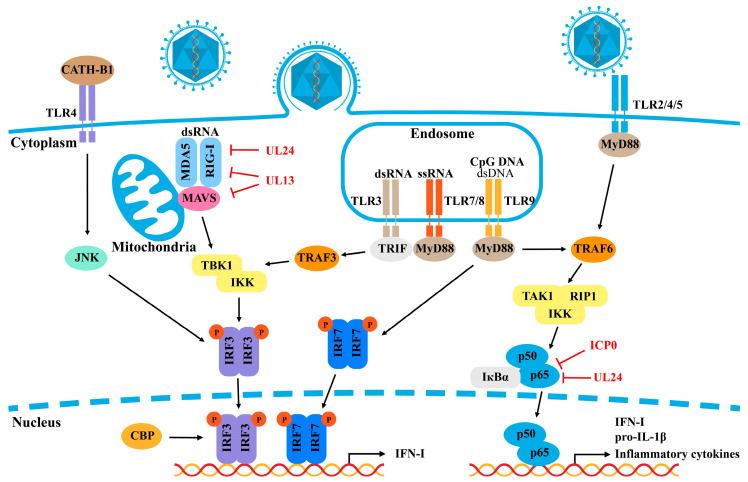
Pseudorabies virus (PRV) establishes persistent latent infections by effectively evading the host's antiviral innate immune response. PRV has developed sophisticated strategies to bypass immune surveillance through coevolution with its host. Currently, no effective vaccine exists to prevent or treat infections caused by emerging PRV variants, and the interactions between PRV and the host's innate immune defenses remain incompletely understood. Nevertheless, ongoing research is uncovering insights that may lead to novel treatments and preventive approaches for herpesvirus-related diseases. This review summarizes recent advances in understanding how PRV disrupts key adaptors in immune signaling pathways to evade antiviral immunity. Additionally, we explored the intrinsic cellular defenses that play crucial roles in combating viral invasion. A deeper understanding of the immune evasion strategies of PRV could inform the development of new therapeutic targets and vaccines.
伪狂犬病病毒(PRV)通过有效逃避宿主的抗病毒先天免疫反应建立持续性潜伏感染。PRV通过与其宿主共同进化,已形成了复杂的策略来绕过免疫监视。目前,尚无有效的疫苗来预防或治疗由新出现的PRV变异株引起的感染,并且PRV与宿主先天免疫防御之间的相互作用仍未完全了解。尽管如此,正在进行的研究正在揭示一些见解,这些见解可能会带来针对疱疹病毒相关疾病的新治疗方法和预防措施。本综述总结了在理解PRV如何破坏免疫信号通路中的关键衔接子以逃避抗病毒免疫方面的最新进展。此外,我们探讨了在对抗病毒入侵中起关键作用的内在细胞防御机制。对PRV免疫逃逸策略的更深入理解可为新治疗靶点和疫苗的开发提供依据。




 Zotero 插件