
危重症患者血液吸附的内皮保护及改善微循环和大循环作用
Endothelial Protection and Improved Micro- and Macrocirculation with Hemoadsorption in Critically Ill Patients.
作者信息
Papp Marton, Ince Can, Bakker Jan, Molnar Zsolt
机构信息
Department of Anesthesiology and Intensive Therapy, Semmelweis University, 78 Üllői St., 1082 Budapest, Hungary.
Centre for Translational Medicine, Semmelweis University, 22 Baross St., 1085 Budapest, Hungary.
出版信息
J Clin Med. 2024 Nov 22;13(23):7044. doi: 10.3390/jcm13237044.
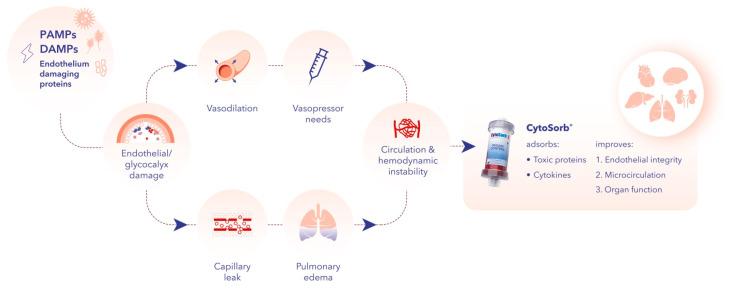
A dysregulated immune response is associated with an excessive release of cytokines that can lead to systemic vasoplegia and vasoplegic shock with the development of multiorgan failure that is associated with an increased risk of dying. Under physiological circumstances, the endothelium and the glycocalyx are responsible for maintaining vascular tone, capillary permeability, and hemostasis, and controlling inflammation. In hyperinflammation, the endothelium and glycocalyx become damaged due to the excessive production of certain toxic proteins, along with an overwhelming release of cytokines. It has been shown in both in vitro animal experiments and in humans that extracorporeal hemoadsorption can reduce circulating levels of cytokines and may also remove toxic proteins that directly take part in endothelium and glycocalyx damage. The current review aims to summarize current knowledge, put recent findings into context, and introduce the hypothesis of "endothelial protection with hemoadsorption" in critically ill patients.
免疫反应失调与细胞因子的过度释放有关,这可能导致全身血管麻痹和血管麻痹性休克,并发展为多器官功能衰竭,进而增加死亡风险。在生理情况下,内皮细胞和糖萼负责维持血管张力、毛细血管通透性和止血,并控制炎症。在炎症反应过度时,内皮细胞和糖萼会因某些毒性蛋白的过度产生以及细胞因子的大量释放而受损。体外动物实验和人体实验均表明,体外血液吸附可降低细胞因子的循环水平,还可能清除直接参与内皮细胞和糖萼损伤的毒性蛋白。本综述旨在总结当前的知识,将近期的研究结果置于背景中,并介绍重症患者“血液吸附内皮保护”的假说。
 Zotero 插件