
从日本医保支付方角度看非奈利酮治疗2型糖尿病合并慢性肾脏病的成本效益分析
Cost-Effectiveness Analysis of Finerenone for Treatment of Chronic Kidney Disease in Patients with Type 2 Diabetes from Japanese Payer Perspective.
作者信息
Igarashi Ataru, Ohara Kenichi, Matsuda Hiroyuki, Morii Junko, Jagannathan Suchitra, Filomeno Ronald
机构信息
Unit of Public Health and Preventive Medicine, Yokohama City University, Yokohama, Japan.
Department of Health Economics and Outcomes Research, Graduate School of Pharmaceutical Sciences, The University of Tokyo, Tokyo, Japan.
出版信息
Adv Ther. 2025 Feb;42(2):995-1008. doi: 10.1007/s12325-024-03084-5. Epub 2024 Dec 17.
INTRODUCTION
Type 2 diabetes (T2D) is a major cause of chronic kidney disease (CKD) in Japan, and there is an increasing treatment need for first- and second-line care in these patients. The addition of finerenone to current treatment modalities lowers the risk of CKD progression and cardiovascular events in patients with CKD and T2D from the Japanese payer perspective. This study investigated the cost-effectiveness analysis of adding finerenone to standard of care (SoC) versus SoC alone for the treatment of CKD in patients with T2D.
METHODS
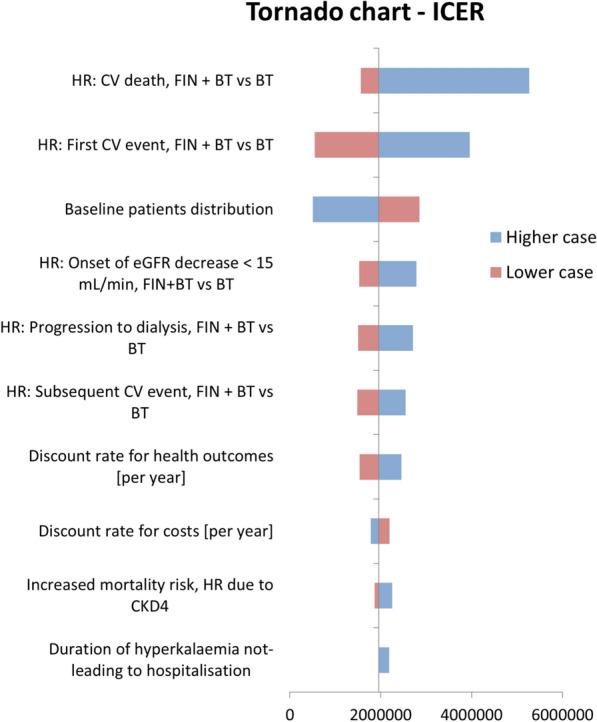
The FINE-CKD model validated to estimate the cost-effectiveness of finerenone uses the Markov model to simulate the disease pathway of patients over a lifetime horizon. The model was adapted to reflect the Japanese payer perspective and estimated incremental costs, utilities, and incremental cost-effectiveness ratios (ICERs). Sensitivity and scenario analyses were performed to evaluate the effect of the uncertainty of each parameter using a robust model.
RESULTS
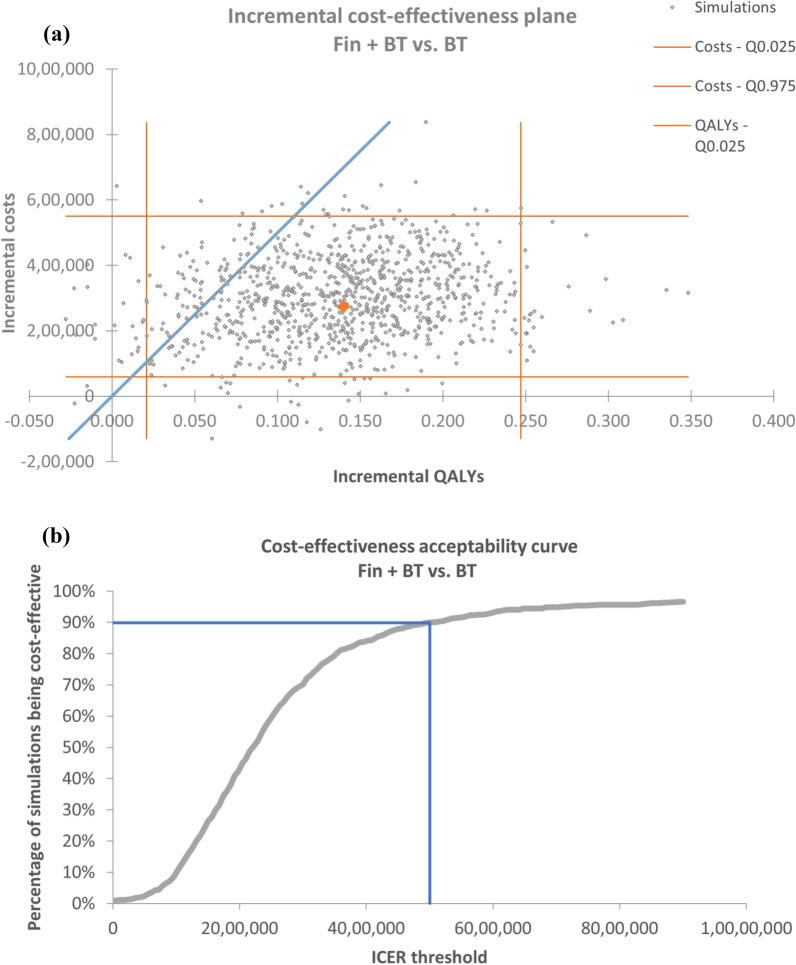
The quality-adjusted life years (QALYs) for finerenone and SoC were estimated at 9.39 and 9.25, respectively, with an incremental QALY for finerenone for SoC of 0.14. The total cost of finerenone was estimated at ¥ 8,912,601, at an incremental cost of ¥ 274,052, leading to an ICER of ¥ 1,959,516 per QALY gained compared with SoC alone.
CONCLUSION
Finerenone in conjunction with SoC is a more cost-effective treatment alternative to SoC alone for adult patients with CKD and T2D from a Japanese healthcare payer perspective.
引言
2型糖尿病(T2D)是日本慢性肾脏病(CKD)的主要病因,对这些患者的一线和二线治疗需求不断增加。从日本医保支付方的角度来看,在当前治疗方案中添加非奈利酮可降低CKD合并T2D患者的CKD进展风险和心血管事件风险。本研究调查了在标准治疗(SoC)基础上加用非奈利酮与单纯SoC治疗T2D合并CKD患者的成本效益分析。
方法
用于评估非奈利酮成本效益的FINE-CKD模型采用马尔可夫模型模拟患者一生的疾病发展路径。该模型经过调整以反映日本医保支付方的观点,并估计了增量成本、效用和增量成本效益比(ICER)。使用稳健模型进行敏感性和情景分析,以评估每个参数不确定性的影响。
结果
非奈利酮组和SoC组的质量调整生命年(QALY)分别估计为9.39和9.25,非奈利酮相对于SoC的增量QALY为0.14。非奈利酮的总成本估计为8912601日元,增量成本为274052日元,与单纯SoC相比,每获得一个QALY的ICER为1959516日元。
结论
从日本医疗保健支付方的角度来看,对于患有CKD和T2D的成年患者,非奈利酮联合SoC比单纯SoC是一种更具成本效益的治疗选择。

 Zotero 插件