
全球、区域和国家慢性肾脏病负担,1990-2017 年:2017 年全球疾病负担研究的系统分析。
Global, regional, and national burden of chronic kidney disease, 1990-2017: a systematic analysis for the Global Burden of Disease Study 2017.
出版信息
Lancet. 2020 Feb 29;395(10225):709-733. doi: 10.1016/S0140-6736(20)30045-3. Epub 2020 Feb 13.
BACKGROUND
Health system planning requires careful assessment of chronic kidney disease (CKD) epidemiology, but data for morbidity and mortality of this disease are scarce or non-existent in many countries. We estimated the global, regional, and national burden of CKD, as well as the burden of cardiovascular disease and gout attributable to impaired kidney function, for the Global Burden of Diseases, Injuries, and Risk Factors Study 2017. We use the term CKD to refer to the morbidity and mortality that can be directly attributed to all stages of CKD, and we use the term impaired kidney function to refer to the additional risk of CKD from cardiovascular disease and gout.
METHODS
The main data sources we used were published literature, vital registration systems, end-stage kidney disease registries, and household surveys. Estimates of CKD burden were produced using a Cause of Death Ensemble model and a Bayesian meta-regression analytical tool, and included incidence, prevalence, years lived with disability, mortality, years of life lost, and disability-adjusted life-years (DALYs). A comparative risk assessment approach was used to estimate the proportion of cardiovascular diseases and gout burden attributable to impaired kidney function.
FINDINGS
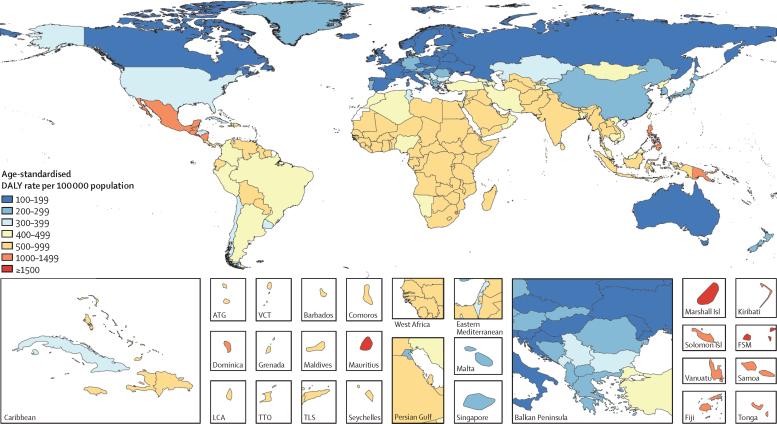
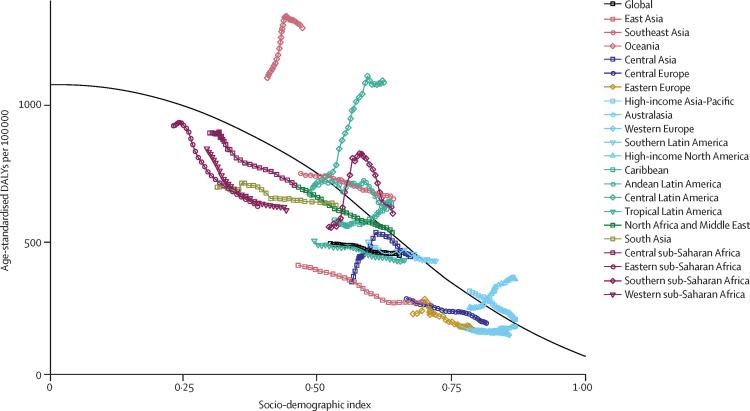
Globally, in 2017, 1·2 million (95% uncertainty interval [UI] 1·2 to 1·3) people died from CKD. The global all-age mortality rate from CKD increased 41·5% (95% UI 35·2 to 46·5) between 1990 and 2017, although there was no significant change in the age-standardised mortality rate (2·8%, -1·5 to 6·3). In 2017, 697·5 million (95% UI 649·2 to 752·0) cases of all-stage CKD were recorded, for a global prevalence of 9·1% (8·5 to 9·8). The global all-age prevalence of CKD increased 29·3% (95% UI 26·4 to 32·6) since 1990, whereas the age-standardised prevalence remained stable (1·2%, -1·1 to 3·5). CKD resulted in 35·8 million (95% UI 33·7 to 38·0) DALYs in 2017, with diabetic nephropathy accounting for almost a third of DALYs. Most of the burden of CKD was concentrated in the three lowest quintiles of Socio-demographic Index (SDI). In several regions, particularly Oceania, sub-Saharan Africa, and Latin America, the burden of CKD was much higher than expected for the level of development, whereas the disease burden in western, eastern, and central sub-Saharan Africa, east Asia, south Asia, central and eastern Europe, Australasia, and western Europe was lower than expected. 1·4 million (95% UI 1·2 to 1·6) cardiovascular disease-related deaths and 25·3 million (22·2 to 28·9) cardiovascular disease DALYs were attributable to impaired kidney function.
INTERPRETATION
Kidney disease has a major effect on global health, both as a direct cause of global morbidity and mortality and as an important risk factor for cardiovascular disease. CKD is largely preventable and treatable and deserves greater attention in global health policy decision making, particularly in locations with low and middle SDI.
FUNDING
Bill & Melinda Gates Foundation.
背景
卫生系统规划需要仔细评估慢性肾脏病(CKD)的流行病学情况,但许多国家的发病率和死亡率数据要么非常有限,要么根本不存在。我们估算了全球、各区域和各国的 CKD 负担,以及因肾功能障碍导致的心血管疾病和痛风所致的心血管疾病和痛风负担。这项研究是全球疾病、伤害和危险因素研究 2017 年的一部分。我们使用术语 CKD 来指代可以直接归因于 CKD 所有阶段的发病率和死亡率,并用术语肾功能障碍来指代心血管疾病和痛风所致的 CKD 额外风险。
方法
我们主要使用的数据源包括已发表的文献、人口动态登记系统、终末期肾病登记处和家庭调查。CKD 负担的估算使用死因综合模型和贝叶斯荟萃回归分析工具得出,包括发病率、患病率、残疾生存年数、死亡率、寿命损失年数和伤残调整生命年(DALY)。使用比较风险评估方法来估算归因于肾功能障碍的心血管疾病和痛风负担比例。
结果
全球范围内,2017 年有 120 万人(95%置信区间 [UI] 120 万至 130 万)死于 CKD。1990 年至 2017 年,全球 CKD 全年龄段死亡率上升了 41.5%(95% UI 35.2%至 46.5%),尽管年龄标准化死亡率没有显著变化(2.8%,-1.5%至 6.3%)。2017 年,记录了 6975 万例所有阶段的 CKD,全球患病率为 9.1%(8.5%至 9.8%)。自 1990 年以来,全球 CKD 全年龄段患病率上升了 29.3%(95% UI 26.4%至 32.6%),而年龄标准化患病率保持稳定(1.2%,-1.1%至 3.5%)。2017 年,CKD 导致 3580 万 DALY,其中糖尿病肾病占 DALY 的近三分之一。CKD 负担主要集中在社会人口指数(SDI)最低的三个五分位数中。在一些地区,特别是大洋洲、撒哈拉以南非洲和拉丁美洲,CKD 的负担远远超过了发展水平,而在撒哈拉以南非洲西部、东部和中部、东亚、南亚、中东欧、澳大拉西亚和西欧,疾病负担则低于预期。140 万(95% UI 120 万至 160 万)例与心血管疾病相关的死亡和 2530 万(2220 万至 2890 万)例心血管疾病 DALY 归因于肾功能障碍。
解释
肾脏疾病对全球健康有重大影响,既是全球发病率和死亡率的直接原因,也是心血管疾病的重要危险因素。CKD 在很大程度上是可以预防和治疗的,在全球卫生政策决策中应给予更多关注,特别是在 SDI 较低和中等的地区。
资金
比尔及梅琳达·盖茨基金会。



 Zotero 插件