
莫桑比克马普托市家禽微生物群和耐药基因组从农场到餐桌的变化。
Farm-to-fork changes in poultry microbiomes and resistomes in Maputo City, Mozambique.
作者信息
Olson Natalie, Lamar Frederica, Mucache Hermógenes, Fafetine José, Saíde Joaquim, Milisse Amélia, Brito Denise R A, Jesser Kelsey J, Levy Karen, Freeman Matthew C, Nadimpalli Maya L
机构信息
Gangarosa Department of Environmental Health, Rollins School of Public Health, Emory University, Atlanta, Georgia, USA.
Veterinary Faculty, Universidade Eduardo Mondlane, Maputo, Mozambique.
出版信息
mSystems. 2025 Jan 21;10(1):e0103724. doi: 10.1128/msystems.01037-24. Epub 2024 Dec 19.
UNLABELLED
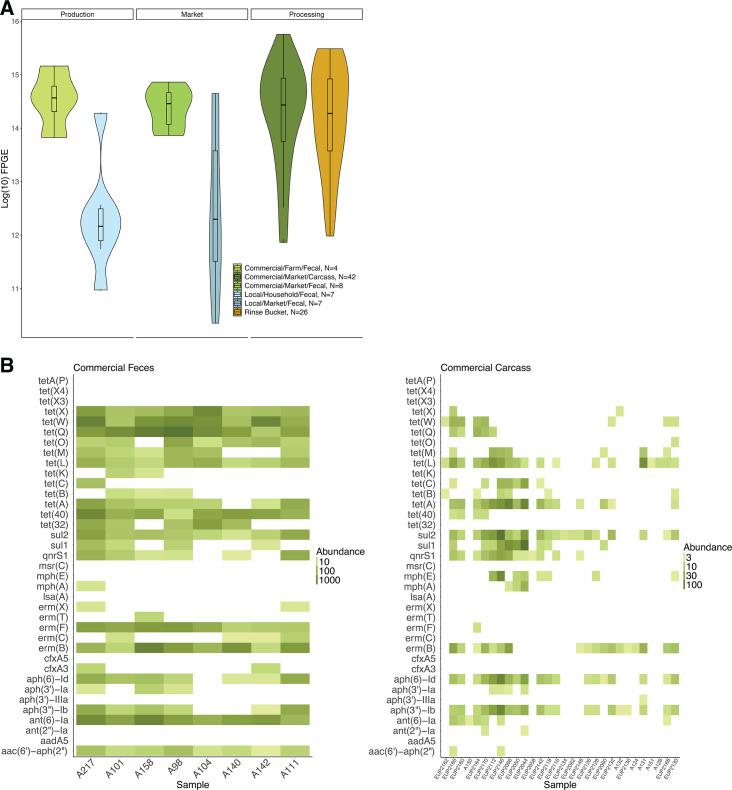
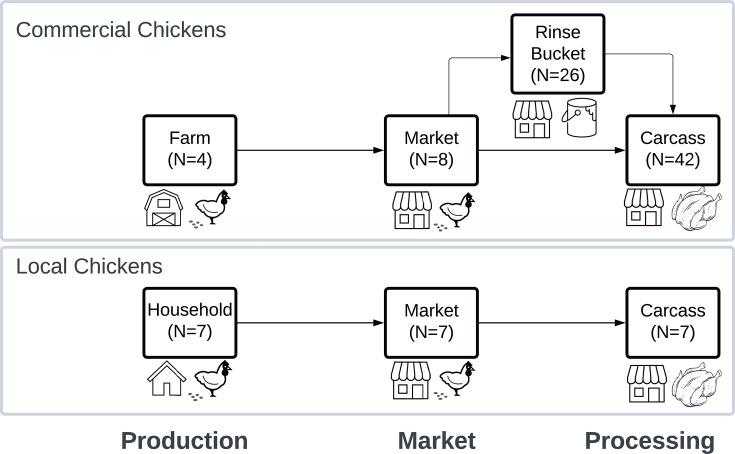
Increasing demand for poultry has spurred poultry production in low- and middle-income countries like Mozambique. Poultry may be an important source of foodborne, antimicrobial-resistant bacteria to consumers in settings with limited water, sanitation, and hygiene infrastructure. The Chicken Exposures and Enteric Pathogens in Children Exposed through Environmental Pathways (ChEEP ChEEP) study was conducted in Maputo City, Mozambique from 2019 to 2021 to quantify enteric pathogen exposures along the supply chain for commercial and local (i.e., scavenger) chicken breeds. Here, we performed metagenomic sequencing of total DNA from banked ChEEP ChEEP samples to characterize fecal and carcass microbiomes and resistome diversity between chicken breeds and along the supply chain. Fecal samples ( = 26) were collected from commercial and local chickens at production sites and markets and carcass ( = 49) and rinse bucket samples ( = 26) from markets. We conducted taxonomic profiling and identified antimicrobial resistance genes (ARGs) from metagenomic sequence data, focusing especially on potential human pathogens and "high-risk" ARGs. We estimated alpha diversity for each sample and compared by site and breed. We estimated Bray-Curtis dissimilarity between samples and examined clustering. We found that commercial and local chickens harbored distinct fecal potential pathogens and resistomes at production and market sites. Many potentially pathogenic bacteria and ARGs present in chicken fecal samples are also present on carcasses sold to consumers. Finally, commercial chicken carcasses contain high-risk ARGs that are not necessarily introduced from chicken feces. These results indicate markets are an important site of exposure to potentially pathogenic bacteria and high-risk ARGs.
IMPORTANCE
While chicken eggs and meat are a critical protein source in low-income settings, antibiotics are routinely fed to chickens with consequences for selection of antimicrobial resistance. Evaluating how poultry gut bacterial communities, including potential human pathogens and high-risk antimicrobial resistance genes, differ from farm to market could help identify where to target interventions to minimize transmission risks to human populations. In this study in Maputo City, Mozambique, we found compositional differences between commercial and local chicken breeds at production and market sites. We also found that while all potentially pathogenic bacteria and many high-risk antimicrobial resistance genes persisted from production and market through processing, some resistance genes were detected on carcass samples only after processing, suggesting human or environmental contamination is occurring within markets. Overall, our findings indicate that open-air markets may represent a critical juncture for human exposures to pathogens and antimicrobial resistance genes from poultry and poultry products.
未标注
对家禽需求的不断增加刺激了莫桑比克等低收入和中等收入国家的家禽生产。在水、环境卫生和个人卫生基础设施有限的环境中,家禽可能是消费者食源性病原体和耐抗菌药物细菌的重要来源。“通过环境途径接触鸡肉的儿童中的鸡肉暴露与肠道病原体(ChEEP)”研究于2019年至2021年在莫桑比克马普托市开展,旨在量化商业鸡和本地(即 scavenger)鸡品种供应链中肠道病原体的暴露情况。在此,我们对ChEEP样本库中的总DNA进行了宏基因组测序,以表征鸡品种之间以及供应链中粪便和胴体微生物组及耐药组的多样性。在生产场所和市场采集了商业鸡和本地鸡的粪便样本(n = 26),并在市场采集了胴体样本(n = 49)和冲洗桶样本(n = 26)。我们进行了分类学分析,并从宏基因组序列数据中鉴定了抗菌药物耐药基因(ARG),特别关注潜在的人类病原体和“高风险”ARG。我们估计了每个样本的α多样性,并按地点和品种进行比较。我们估计了样本之间的布雷-柯蒂斯差异,并检查了聚类情况。我们发现,商业鸡和本地鸡在生产场所和市场的粪便中携带不同的潜在病原体和耐药组。鸡粪便样本中存在的许多潜在致病细菌和ARG也存在于售给消费者的胴体上。最后,商业鸡胴体含有不一定从鸡粪便中引入的高风险ARG。这些结果表明,市场是接触潜在致病细菌和高风险ARG的重要场所。
重要性
虽然鸡蛋和鸡肉是低收入环境中的关键蛋白质来源,但抗生素通常会喂给鸡,这会导致抗菌药物耐药性的产生。评估家禽肠道细菌群落,包括潜在的人类病原体和高风险抗菌药物耐药基因,从农场到市场如何不同,有助于确定在何处进行干预以将对人群的传播风险降至最低。在莫桑比克马普托市的这项研究中,我们发现生产场所和市场的商业鸡和本地鸡品种之间存在组成差异。我们还发现,虽然所有潜在致病细菌和许多高风险抗菌药物耐药基因从生产到市场再到加工过程中都持续存在,但一些耐药基因仅在加工后的胴体样本中被检测到,这表明市场内发生了人为或环境污染。总体而言,我们的研究结果表明,露天市场可能是人类接触来自家禽及家禽产品的病原体和抗菌药物耐药基因的关键节点。


 Zotero 插件