
情绪波动对心血管疾病风险的不良影响:来自孟德尔随机化分析的证据。
The adverse effect of mood swings on the risk of cardiovascular diseases: Evidence from Mendelian randomization analysis.
作者信息
Dai Yuanhui, Hao Yuqi
机构信息
Department of Cardiovascular Center, The First Affiliated Hospital, Key Laboratory of High Incidence Disease Research in Xinjiang, Ministry of Education, Xinjiang Medical University, Urumqi, China.
出版信息
Medicine (Baltimore). 2024 Dec 20;103(51):e41003. doi: 10.1097/MD.0000000000041003.
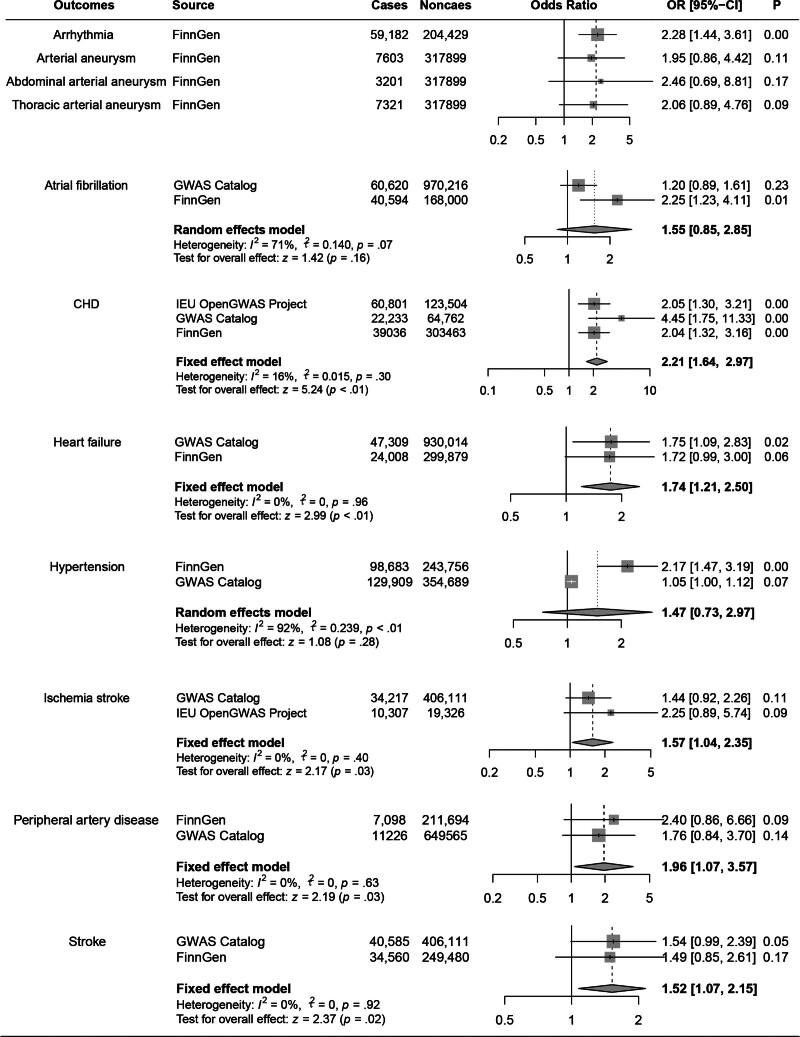
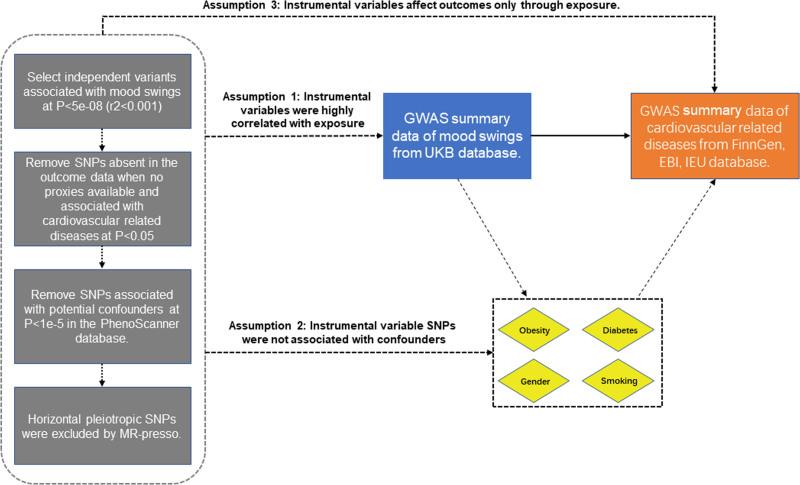
Recent studies have explored the impact of personality traits, including mood swings, on physical health. However, it remains unclear whether there is a direct cause-and-effect link between mood swings and cardiovascular diseases (CVDs). A STROBE-compliant cross-sectional observational study was conducted and analyzed using a two-sample Mendelian randomization (MR) approach to examine the potential causal relationship between mood swings and a range of CVDs, such as arrhythmia, artery aneurysm, coronary heart disease (CHD), heart failure, hypertension, stroke, ischemic stroke, and peripheral artery disease. We sourced genome-wide association studies (GWAS) summary data for mood swings from the UK Biobank, and for CVDs from the GWAS Catalog and FinnGen databases. We excluded single-nucleotide polymorphisms (SNPs) linked to potential confounders such as obesity, smoking, sex, diabetes, as well as SNPs suspected of horizontal pleiotropy, as identified by MR-PRESSO and the MR-pleiotropy method, prior to the final analysis. Sensitivity analyses were conducted using the MR-Egger, inverse variance weighted, and leave-one-out methods. After screening, 57 SNPs were identified as instrumental variables for mood swings, and 9 SNPs related to confounding factors were excluded. An increase in mood swing frequency is correlated with a significant increase in the likelihood of various conditions. Notably, arrhythmia in the FinnGen dataset showed an odds ratio (OR: 2.28, 95% confidence interval [CI]: 1.44-3.61, P < .001), and atrial fibrillation had an OR (OR: 2.25, 95% CI: 1.23-4.11, P = .01). CHD risk was elevated in both the IEU OpenGWAS project (OR: 2.05, 95% CI: 1.30-3.21, P < .001) and GWAS Catalog (OR: 4.45, 95% CI: 1.75-11.33, P < .001). Increased risks were also noted for heart failure (GWAS Catalog: OR: 1.75, 95% CI: 1.09-2.83, P = .02) and hypertension (FinnGen: OR, 2.17; 95% CI: 1.47-3.19, P < .001). However, no significant associations were found for conditions such as arterial aneurysms or ischemic stroke. In combined analyses, mood swings were associated with a higher risk of CHD (OR: 2.21, 95% CI: 1.64-2.97, P < .01), heart failure (OR: 1.74, 95% CI: 1.21-2.50, P < .01), and other CVDs. This study revealed a causal link between mood swings and various CVDs, highlighting intriguing findings. This suggests that implementing proper psychological interventions to stabilize mood may be beneficial for preventing negative cardiovascular events.
近期研究探讨了包括情绪波动在内的人格特质对身体健康的影响。然而,情绪波动与心血管疾病(CVDs)之间是否存在直接的因果关系仍不明确。本研究采用符合STROBE标准的横断面观察性研究,并运用两样本孟德尔随机化(MR)方法进行分析,以检验情绪波动与一系列心血管疾病之间的潜在因果关系,这些疾病包括心律失常、动脉动脉瘤、冠心病(CHD)、心力衰竭、高血压、中风、缺血性中风和外周动脉疾病。我们从英国生物银行获取了情绪波动的全基因组关联研究(GWAS)汇总数据,从GWAS Catalog和芬兰基因数据库获取了心血管疾病的相关数据。在最终分析之前,我们排除了与肥胖、吸烟、性别、糖尿病等潜在混杂因素相关的单核苷酸多态性(SNPs),以及通过MR-PRESSO和MR-多效性方法鉴定出的疑似水平多效性的SNPs。使用MR-Egger、逆方差加权和留一法进行敏感性分析。筛选后,确定了57个SNPs作为情绪波动的工具变量,并排除了9个与混杂因素相关的SNPs。情绪波动频率的增加与多种疾病发生可能性的显著增加相关。值得注意的是,芬兰基因数据集中的心律失常显示比值比(OR:2.28,95%置信区间[CI]:1.44 - 3.61,P <.001),心房颤动的OR为(OR:2.25,95% CI:1.23 - 4.11,P = 0.01)。在IEU OpenGWAS项目(OR:2.05,95% CI:1.30 - (此处原文有误,应是3.21),P <.001)和GWAS Catalog(OR:4.45,95% CI:1.75 - 11.33,P <.001)中,冠心病风险均升高。心力衰竭(GWAS Catalog:OR:1.75,95% CI:1.09 - 2.83,P = 0.02)和高血压(芬兰基因:OR,2.17;95% CI:1.47 - 3.19,P <.001)的风险也有所增加。然而,未发现与动脉动脉瘤或缺血性中风等疾病有显著关联。在综合分析中,情绪波动与冠心病(OR:2.21,95% CI:1.64 - 2.97,P <.01)、心力衰竭(OR:1.74,95% CI:1.21 - 2.50,P <.01)及其他心血管疾病的风险较高相关。本研究揭示了情绪波动与多种心血管疾病之间的因果关系,突出了有趣的发现。这表明实施适当的心理干预以稳定情绪可能有助于预防负面心血管事件。

 Zotero 插件