
生物衰老的速度部分解释了社会经济地位与慢性下腰痛结局之间的关系。
The Pace of Biological Aging Partially Explains the Relationship Between Socioeconomic Status and Chronic Low Back Pain Outcomes.
作者信息
Aroke Edwin N, Nagidi Jai Ganesh, Srinivasasainagendra Vinodh, Quinn Tammie L, Agbor Fiona B A T, Kinnie Kiari R, Tiwari Hemant K, Goodin Burel R
机构信息
Department of Acute, Chronic, and Continuing Care, School of Nursing, University of Alabama at Birmingham, Birmingham, AL, USA.
Department of Computer Science, College of Arts and Sciences, University of Alabama at Birmingham, Birmingham, AL, USA.
出版信息
J Pain Res. 2024 Dec 17;17:4317-4329. doi: 10.2147/JPR.S481452. eCollection 2024.
INTRODUCTION
Having a lower socioeconomic status (SES) is a predictor of age-related chronic conditions, including chronic low back pain (cLBP). We aimed to examine whether the pace of biological aging mediates the relationship between SES and cLBP outcomes - pain intensity, pain interference, and physical performance.
METHODS
We used the Dunedin Pace of Aging Calculated from the Epigenome (DunedinPACE) software to determine the pace of biological aging in adults ages 18 to 85 years with no cLBP (n = 74), low-impact pain (n = 56), and high-impact pain (n = 77).
RESULTS
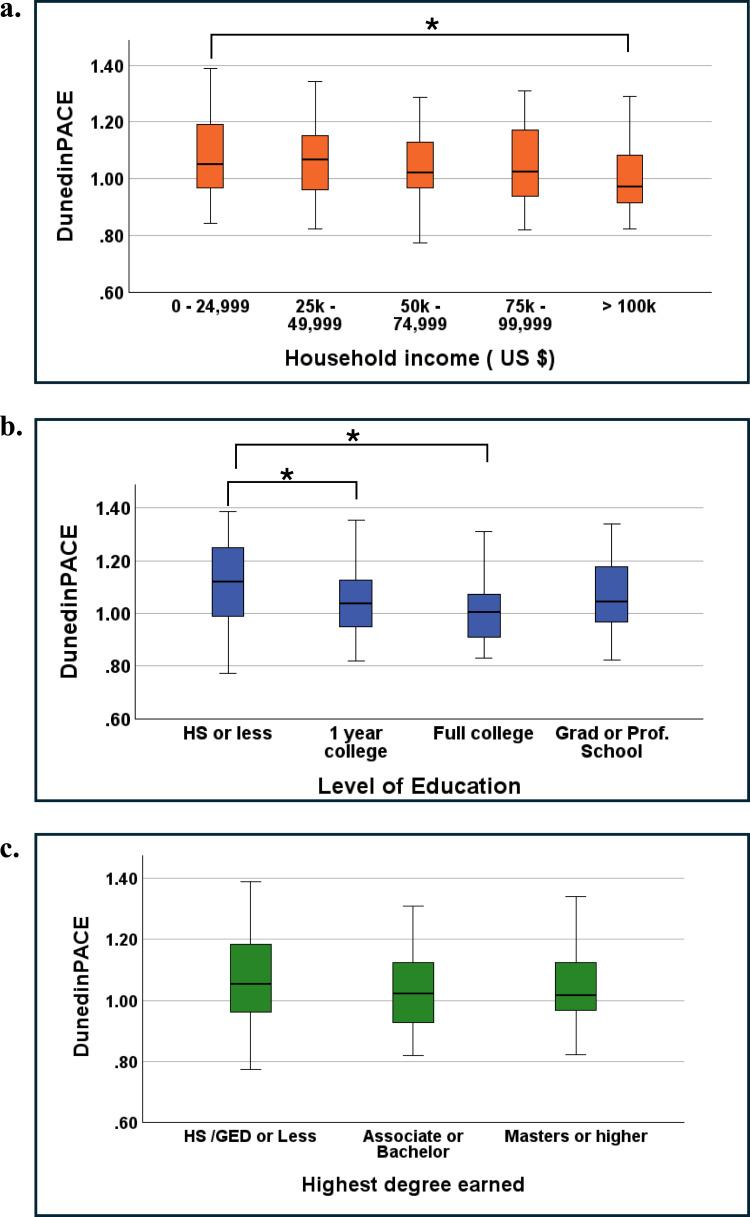
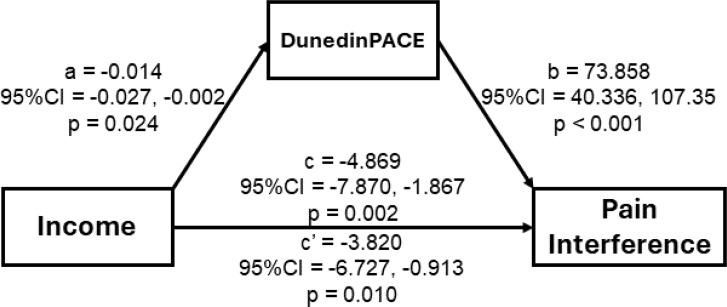
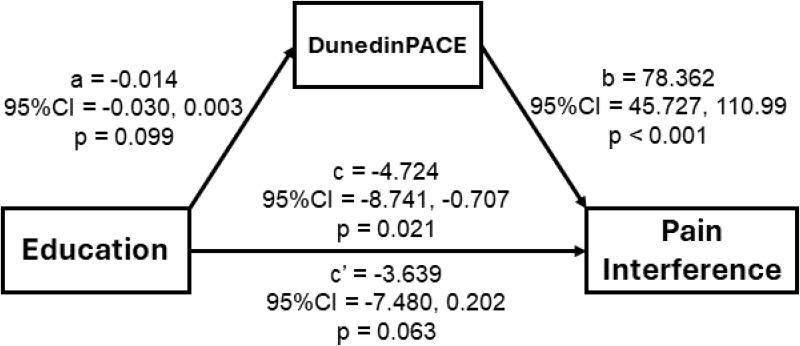
The mean chronological age of the participants was 40.9 years (SD= 15.1); 107 (51.7%) were female, and 108 (52.2%) were Black. On average, the pace of biological aging was 5% faster [DunedinPACE = 1.05 (SD = 0.14)] in the sample (DunedinPACE value of 1 = normal pace of aging). Individuals with higher levels of education had a significantly slower pace of biological aging than those with lower education levels (F = 5.546, p = 0.001). After adjusting for sex and race, household income level significantly correlated with the pace of biological aging (r = -0.17, p = 0.02), pain intensity (r = -0.21, p = 0.003), pain interference (r = -0.21, p = 0.003), and physical performance (r = 0.20, p = 0.005). In mediation analyses adjusting for sex, race, and body mass index (BMI), the pace of biological aging mediates the relationship between household income (but not education) level and cLBP intensity, interference, as well as physical performance.
DISCUSSION
Results indicate that lower SES contributes to faster biological aging, possibly contributing to greater pain intensity and interference, as well as lower physical performance. Future interventions slowing the pace of biological aging may improve cLBP outcomes.
引言
社会经济地位较低是包括慢性下腰痛(cLBP)在内的与年龄相关的慢性疾病的一个预测因素。我们旨在研究生物衰老速度是否介导了社会经济地位与cLBP结局(疼痛强度、疼痛干扰和身体机能)之间的关系。
方法
我们使用从表观基因组计算得出的达尼丁衰老速度(DunedinPACE)软件来确定18至85岁无cLBP(n = 74)、低影响疼痛(n = 56)和高影响疼痛(n = 77)的成年人的生物衰老速度。
结果
参与者的平均实际年龄为40.9岁(标准差 = 15.1);107名(51.7%)为女性,108名(52.2%)为黑人。样本中生物衰老速度平均快5%[达尼丁衰老速度 = 1.05(标准差 = 0.14)](达尼丁衰老速度值为1表示正常衰老速度)。受教育程度较高的个体的生物衰老速度明显低于受教育程度较低的个体(F = 5.546,p = 0.001)。在对性别和种族进行调整后,家庭收入水平与生物衰老速度(r = -0.17,p = 0.02)、疼痛强度(r = -0.21,p = 0.003)、疼痛干扰(r = -0.21,p = 0.003)和身体机能(r = 0.20,p = 0.005)显著相关。在对性别、种族和体重指数(BMI)进行调整的中介分析中,生物衰老速度介导了家庭收入(而非教育程度)水平与cLBP强度、干扰以及身体机能之间的关系。
讨论
结果表明,较低的社会经济地位导致更快的生物衰老,这可能导致更大的疼痛强度和干扰,以及更低的身体机能。未来减缓生物衰老速度的干预措施可能会改善cLBP结局。




 Zotero 插件