
基于Simoa平台的神经退行性疾病超敏蛋白质聚集体定量检测方法
Ultrasensitive Protein Aggregate Quantification Assays for Neurodegenerative Diseases on the Simoa Platform.
作者信息
Böken Dorothea, Xia Zengjie, Lam Jeff Y L, Fertan Emre, Wu Yunzhao, English Elizabeth A, Konc Juraj, Layburn Florence, Bernardes Gonçalo J L, Zetterberg Henrik, Cheetham Matthew R, Klenerman David
机构信息
Yusuf Hamied Department of Chemistry, University of Cambridge, Cambridge CB2 1EW, U.K.
UK Dementia Research Institute at University of Cambridge, Cambridge CB2 0XY, U.K.
出版信息
Anal Chem. 2025 Jan 14;97(1):290-299. doi: 10.1021/acs.analchem.4c04188. Epub 2024 Dec 24.
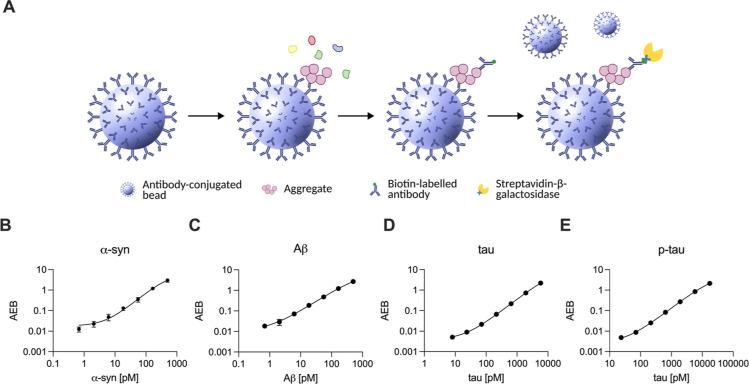
Nanoscale aggregates play a key role in the pathogenesis of neurodegenerative disorders such as Alzheimer's and Parkinson's disease. However, quantifying these aggregates in complex biological samples, such as biofluids and postmortem brain tissue, has been challenging due to their low concentration and small size, necessitating the development of methods with high sensitivity and specificity. Here, we have developed ultrasensitive assays utilizing the Quanterix Simoa platform to detect α-synuclein, β-amyloid and tau aggregates, including those with common posttranslational modifications such as truncation of α-synuclein and AT8 phosphorylation of tau aggregates. All assays had a detection limit in the low pM range. As a part of this work, we developed silica-nanoparticle calibrators, allowing for the quantification of all aggregates. These assays were validated for aggregate and target specificity through denaturation and cross-reactivity experiments. We then applied these assays to brain homogenate samples from Alzheimer's disease and control samples, demonstrating their applicability to postmortem tissue. Lastly, we explored the potential of these assays for blood-based diagnostics by detecting aggregates in serum samples from early Alzheimer's disease patients.
纳米级聚集体在阿尔茨海默病和帕金森病等神经退行性疾病的发病机制中起关键作用。然而,由于其浓度低和尺寸小,在复杂生物样品(如生物流体和死后脑组织)中对这些聚集体进行定量一直具有挑战性,因此需要开发具有高灵敏度和特异性的方法。在这里,我们开发了利用Quanterix Simoa平台的超灵敏检测方法,以检测α-突触核蛋白、β-淀粉样蛋白和tau聚集体,包括那些具有常见翻译后修饰的聚集体,如α-突触核蛋白的截断和tau聚集体的AT8磷酸化。所有检测方法的检测限均在低皮摩尔范围内。作为这项工作的一部分,我们开发了二氧化硅纳米颗粒校准物,用于对所有聚集体进行定量。通过变性和交叉反应实验对这些检测方法的聚集体和靶点特异性进行了验证。然后,我们将这些检测方法应用于阿尔茨海默病患者的脑匀浆样品和对照样品,证明了它们在死后组织中的适用性。最后,我们通过检测早期阿尔茨海默病患者血清样品中的聚集体,探索了这些检测方法用于基于血液的诊断的潜力。



 Zotero 插件