
超灵敏检测法可检测血浆β淀粉样蛋白的不同构象。
Ultrasensitive Assays Detect Different Conformations of Plasma β Amyloids.
作者信息
Li Chia-Yu, Fan Ling-Yun, Lin Chin-Hsien, Hu Chaur-Jong, Chiu Ming-Jang
机构信息
Department of Neurology, National Taiwan University Hospital, College of Medicine, National Taiwan University, Taipei 100, Taiwan.
Departments of Neurology, National Taiwan University Hospital Bei-Hu Branch, Taipei 108, Taiwan.
出版信息
ACS Omega. 2025 Feb 11;10(7):7256-7263. doi: 10.1021/acsomega.4c10879. eCollection 2025 Feb 25.
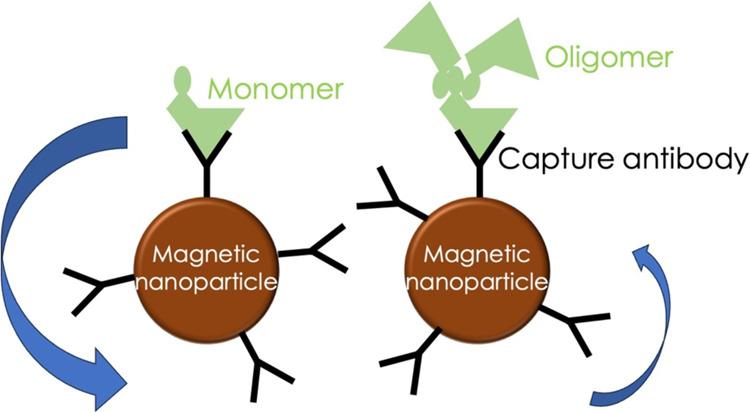
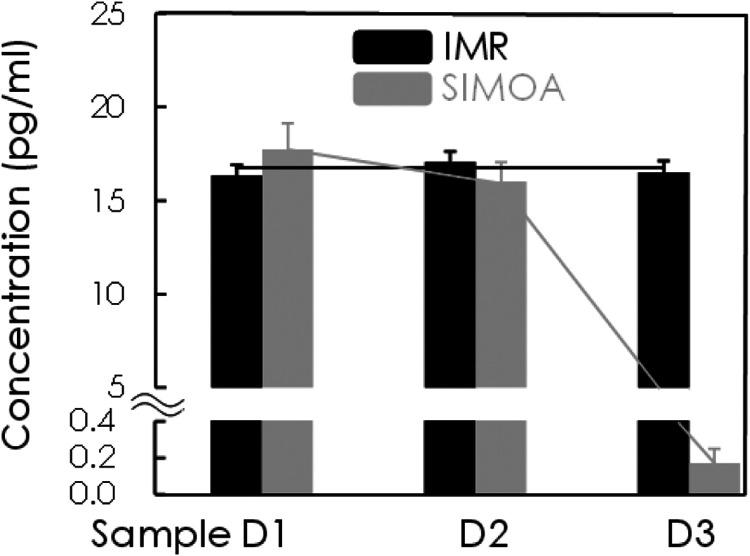
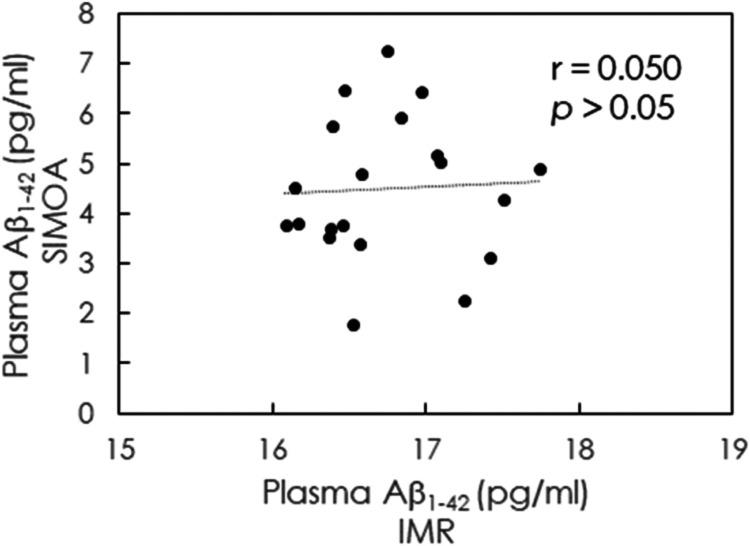
With the developments of ultrasensitive technologies such as immunomagnetic reduction (IMR) assay, single molecule array (SIMOA) assay, electrochemiluminescence immunoassay (ECLIA), the assay of blood-based amyloid 1-42 (Aβ) becomes possible. However, the changes in measured plasma Aβ concentrations in Alzheimer's disease (AD) compared to cognitively unimpaired subjects (CU) are inconsistent. A possible reason for the inconsistency regarding various conformations of Aβ in plasma is explored in this study. Three samples with equal amounts of Aβ but different proportions of monomers and oligomers of Aβ were prepared. The Aβ composition of monomers and oligomers in samples was analyzed with Western blot. Identically diluted versions of these three samples were assayed with IMR and SIMOA for Aβ concentrations. The three diluted samples showed similar levels of Aβ assayed with IMR, whereas much lower levels for samples with more oligomers assayed with SIOMA. The results imply that IMR detects both monomers and oligomers of Aβ. The measured levels of Aβ are independent of the proportions of monomer or oligomer Aβ but depend on the total amounts of Aβ. In the case of SIMOA, monomers of Aβ are the primary target measured. By comparing Aβ concentrations of the plasma using IMR and SIMOA, the significant difference in plasma Aβ levels using IMR in AD compared to CU is mainly due to the formations of oligomeric Aβ. Therefore, if the target molecules are monomers of Aβ, SIMOA is the method of choice. Still, if the target molecules should include monomers, small and large oligomers, IMR would be an optimal consideration. In the future, the clinical implications of the proportion of oligomeric Aβ need to be elucidated.
随着免疫磁珠还原(IMR)分析、单分子阵列(SIMOA)分析、电化学发光免疫分析(ECLIA)等超灵敏技术的发展,基于血液的淀粉样蛋白1-42(Aβ)分析成为可能。然而,与认知未受损受试者(CU)相比,阿尔茨海默病(AD)患者血浆Aβ浓度的测量变化并不一致。本研究探讨了血浆中Aβ各种构象不一致的可能原因。制备了三个含有等量Aβ但Aβ单体和寡聚体比例不同的样品。用蛋白质免疫印迹法分析样品中Aβ单体和寡聚体的组成。用IMR和SIMOA对这三个样品的相同稀释版本进行Aβ浓度检测。用IMR检测时,这三个稀释样品的Aβ水平相似,而用SIMOA检测时,寡聚体含量较高的样品Aβ水平低得多。结果表明,IMR能检测Aβ的单体和寡聚体。检测到的Aβ水平与Aβ单体或寡聚体的比例无关,而取决于Aβ的总量。在SIMOA检测中,Aβ单体是主要检测目标。通过比较IMR和SIMOA检测的血浆Aβ浓度,AD患者血浆Aβ水平与CU相比,IMR检测的显著差异主要是由于寡聚体Aβ的形成。因此,如果目标分子是Aβ单体,SIMOA是首选方法。然而,如果目标分子应包括单体、小寡聚体和大寡聚体,IMR将是一个最佳选择。未来,寡聚体Aβ比例的临床意义需要阐明。

 Zotero 插件