
内分泌干扰物与膀胱功能:邻苯二甲酸盐在膀胱过度活动症中的作用
Endocrine disruptors and bladder function: the role of phthalates in overactive bladder.
作者信息
Liu Li, Li Xia, Hao Xuexue, Xu Zhunan, Wang Qihua, Ren Congzhe, Li Muwei, Liu Xiaoqiang
机构信息
Department of Urology, Tianjin Medical University General Hospital, Tianjin, China.
出版信息
Front Public Health. 2024 Dec 11;12:1493794. doi: 10.3389/fpubh.2024.1493794. eCollection 2024.
BACKGROUND
Phthalates, widely used as plasticizers, are pervasive environmental contaminants and endocrine disruptors. Their potential role in overactive bladder (OAB) pathogenesis is underexplored, necessitating further investigation into their impact on OAB using large-scale epidemiological data.
METHODS
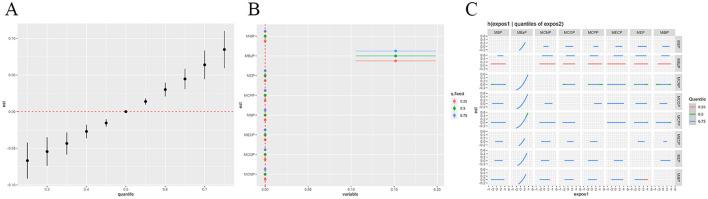
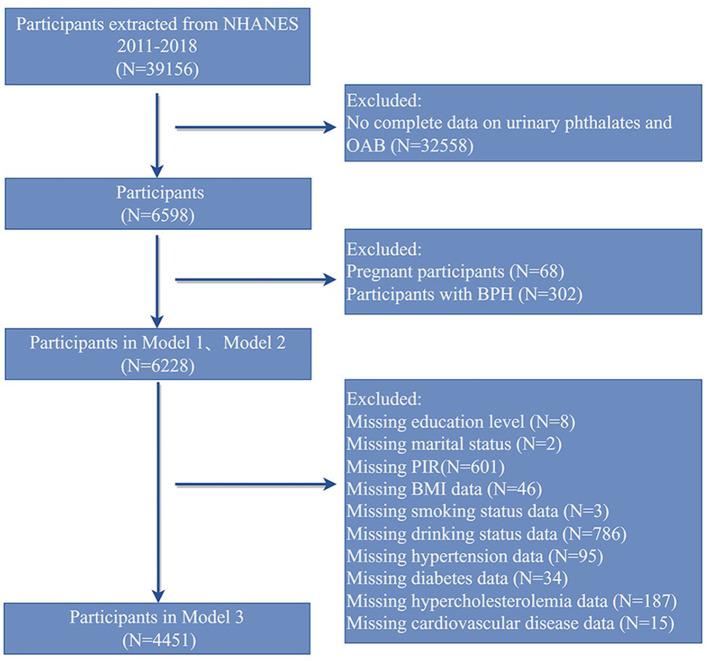
This study utilized data from the National Health and Nutrition Examination Survey (NHANES) spanning from 2011 to 2018. A weighted multivariable logistic regression model was employed to examine the relationship between urinary phthalate concentrations and OAB. Subgroup analyses were conducted to explore differences in associations across various subgroups. Restricted cubic spline (RCS) analysis was used to investigate the potential non-linear relationship between urinary phthalate concentrations and OAB. Additionally, Bayesian Kernel Machine Regression (BKMR) analysis was performed to explore the overall effects and interactions of phthalate mixtures.
RESULTS
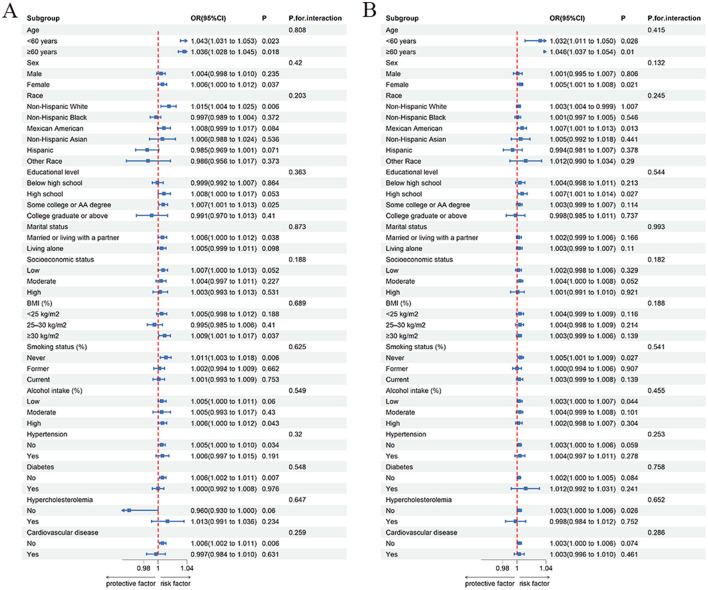
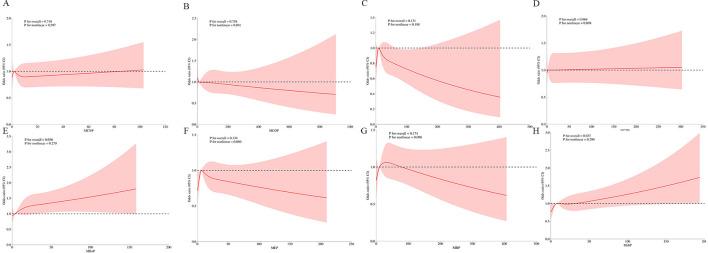
In the multivariable logistic regression model fully adjusted for confounding variables, higher concentrations of MBzP and MiBP were associated with an increased risk of OAB, particularly in the highest tertiles (MBzP: OR = 1.401, 95% CI: 1.108-1.771; MiBP: OR = 1.050, 95% CI: 1.045-1.056). Subgroup analysis found that subgroup characteristics did not have a significant moderating effect on the association between phthalates and OAB. RCS analysis revealed a linear relationship between both MBzP and MiBP and OAB. BKMR analysis confirmed a positive overall effect of phthalate mixtures on OAB risk, with MBzP identified as the major contributing factor.
CONCLUSION
In our study cohort, a positive correlation between urinary phthalate concentrations and OAB was observed, necessitating further research to validate and refine this conclusion.
背景
邻苯二甲酸盐作为广泛使用的增塑剂,是普遍存在的环境污染物和内分泌干扰物。它们在膀胱过度活动症(OAB)发病机制中的潜在作用尚未得到充分研究,因此有必要利用大规模流行病学数据进一步调查它们对OAB的影响。
方法
本研究使用了2011年至2018年美国国家健康与营养检查调查(NHANES)的数据。采用加权多变量逻辑回归模型来研究尿中邻苯二甲酸盐浓度与OAB之间的关系。进行亚组分析以探讨不同亚组之间关联的差异。使用受限立方样条(RCS)分析来研究尿中邻苯二甲酸盐浓度与OAB之间潜在的非线性关系。此外,进行贝叶斯核机器回归(BKMR)分析以探讨邻苯二甲酸盐混合物的总体效应和相互作用。
结果
在对混杂变量进行充分调整的多变量逻辑回归模型中,较高浓度的单丁基邻苯二甲酸酯(MBzP)和单异丁基邻苯二甲酸酯(MiBP)与OAB风险增加相关,尤其是在最高三分位数中(MBzP:比值比[OR]=1.401,95%置信区间[CI]:1.108 - 1.771;MiBP:OR = 1.050,95% CI:1.045 - 1.056)。亚组分析发现亚组特征对邻苯二甲酸盐与OAB之间的关联没有显著的调节作用。RCS分析显示MBzP和MiBP与OAB之间均呈线性关系。BKMR分析证实邻苯二甲酸盐混合物对OAB风险有正向总体效应,其中MBzP被确定为主要促成因素。
结论
在我们的研究队列中,观察到尿中邻苯二甲酸盐浓度与OAB之间存在正相关,需要进一步研究以验证和完善这一结论。
 Zotero 插件