
KRAS抑制剂耐药机制:癌细胞对正常细胞机制的策略性利用以实现适应
Mechanisms of Resistance to KRAS Inhibitors: Cancer Cells' Strategic Use of Normal Cellular Mechanisms to Adapt.
作者信息
Tanaka Noritaka, Ebi Hiromichi
机构信息
Division of Molecular Therapeutics, Aichi Cancer Center Research Institute, Nagoya, Japan.
Division of Advanced Cancer Therapeutics, Nagoya University Graduate School of Medicine, Nagoya, Aichi, Japan.
出版信息
Cancer Sci. 2025 Mar;116(3):600-612. doi: 10.1111/cas.16441. Epub 2024 Dec 27.
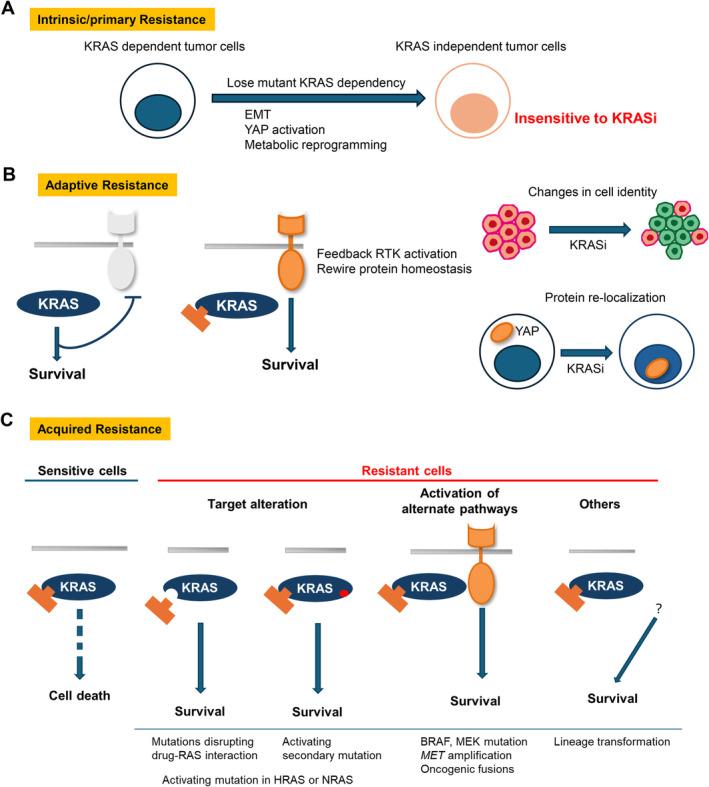
KRAS was long deemed undruggable until the discovery of the switch-II pocket facilitated the development of specific KRAS inhibitors. Despite their introduction into clinical practice, resistance mechanisms can limit their effectiveness. Initially, tumors rely on mutant KRAS, but as they progress, they may shift to alternative pathways, resulting in intrinsic resistance. This resistance can stem from mechanisms like epithelial-to-mesenchymal transition (EMT), YAP activation, or KEAP1 mutations. KRAS inhibition often triggers cellular rewiring to counteract therapeutic pressure. For instance, feedback reactivation of signaling pathways such as MAPK, mediated by receptor tyrosine kinases, supports tumor cell survival. Inhibiting KRAS disrupts protein homeostasis, but reactivation of MAPK or AKT can restore it, aiding tumor cell survival. KRAS inhibition also causes metabolic reprogramming and protein re-localization. The re-localization of E-cadherin and Scribble from the membrane to the cytosol causes YAP to translocate to the nucleus, where it drives MRAS transcription, leading to MAPK reactivation. Emerging evidence indicates that changes in cell identity, such as mucinous differentiation, shifts from alveolar type 2 to type 1 cells, or lineage switching from adenocarcinoma to squamous cell carcinoma, also contribute to resistance. In addition to these nongenetic mechanisms, secondary mutations in KRAS or alterations in upstream/downstream signaling proteins can cause acquired resistance. Secondary mutations in the switch-II pocket disrupt drug binding, and known oncogenic mutations affect drug efficacy. Overcoming these resistance mechanisms involves enhancing the efficacy of drugs targeting mutant KRAS, developing broad-spectrum inhibitors, combining therapies targeting multiple pathways, and integrating immune checkpoint inhibitors.
在发现开关-II口袋促进了特定KRAS抑制剂的开发之前,KRAS长期以来被认为是不可成药的。尽管它们已被引入临床实践,但耐药机制可能会限制其有效性。最初,肿瘤依赖于突变型KRAS,但随着病情进展,它们可能会转向替代途径,从而导致内在耐药性。这种耐药性可能源于上皮-间质转化(EMT)、YAP激活或KEAP1突变等机制。KRAS抑制通常会触发细胞重编程以对抗治疗压力。例如,由受体酪氨酸激酶介导的MAPK等信号通路的反馈重新激活支持肿瘤细胞存活。抑制KRAS会破坏蛋白质稳态,但MAPK或AKT的重新激活可以恢复它,有助于肿瘤细胞存活。KRAS抑制还会导致代谢重编程和蛋白质重新定位。E-钙黏蛋白和Scribble从膜转移到细胞质中会导致YAP转移到细胞核,在那里它驱动MRAS转录,导致MAPK重新激活。新出现的证据表明,细胞身份的变化,如黏液样分化、从肺泡2型细胞向1型细胞的转变,或从腺癌向鳞状细胞癌的谱系转换,也会导致耐药性。除了这些非遗传机制外,KRAS的二次突变或上游/下游信号蛋白的改变也会导致获得性耐药。开关-II口袋中的二次突变会破坏药物结合,已知的致癌突变会影响药物疗效。克服这些耐药机制包括提高针对突变型KRAS的药物疗效、开发广谱抑制剂、联合针对多种途径的疗法以及整合免疫检查点抑制剂。



 Zotero 插件