
1990年至2021年中国因高红肉饮食导致的结直肠癌伤残调整生命年和死亡率的时间趋势:全球疾病负担研究2021分析
Temporal trends in disability adjusted life year and mortality for colorectal cancer attributable to a high red meat diet in China from 1990 to 2021: an analysis of the global burden of disease study 2021.
作者信息
Liu Yuxin, Zhu Chaofu, Song Haonan, Che Mengqi, Xu Beijia, An Baiping
机构信息
Hospital of Chengdu University of Traditional Chinese Medicine, No. 39 Shi-er-Qiao Road, Chengdu, 610072, Sichuan, P.R. China.
Chengdu University of Traditional Chinese Medicine, No.37, Shi-er-Qiao Road, Chengdu, 610072, Sichuan, P.R. China.
出版信息
BMC Gastroenterol. 2024 Dec 27;24(1):476. doi: 10.1186/s12876-024-03563-7.
BACKGROUND
High red meat consumption is a main modifiable risk factor for colorectal cancer mortality (CRC), but its attributable disease burden remains unclear in China. We aimed to analyze the temporal trends in CRC deaths and disability-adjusted life years (DALYs) attributable to high red meat consumption in China from 1990 to 2021 and to predict the disease burden in the next 15 years.
METHODS
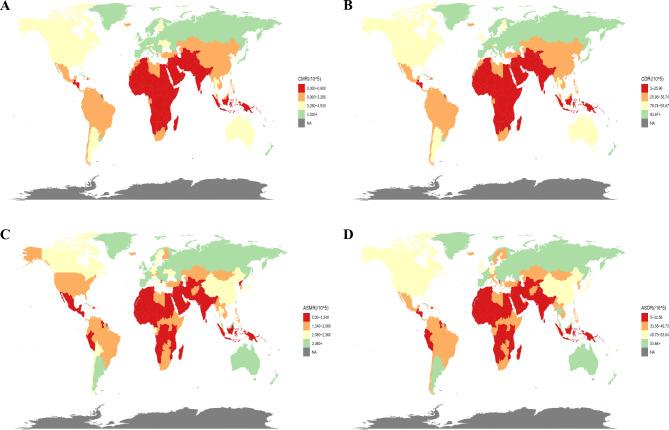
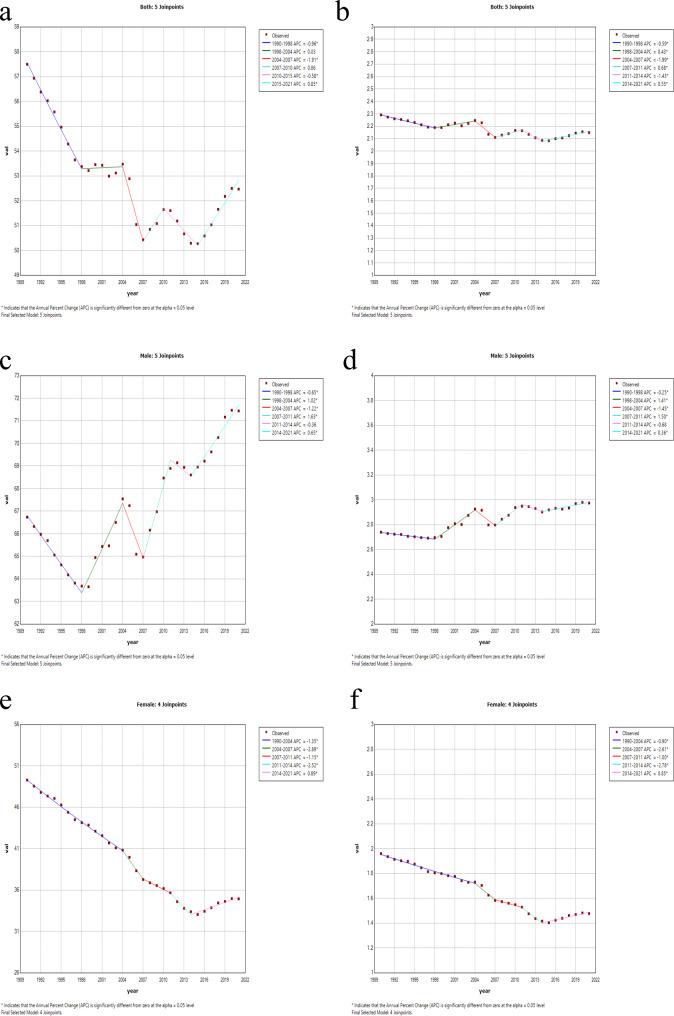
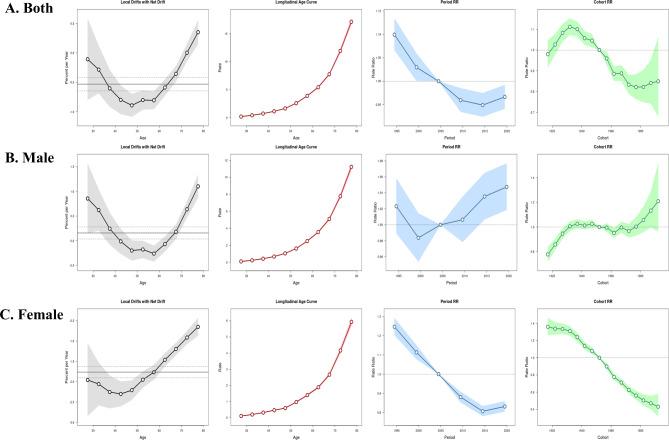
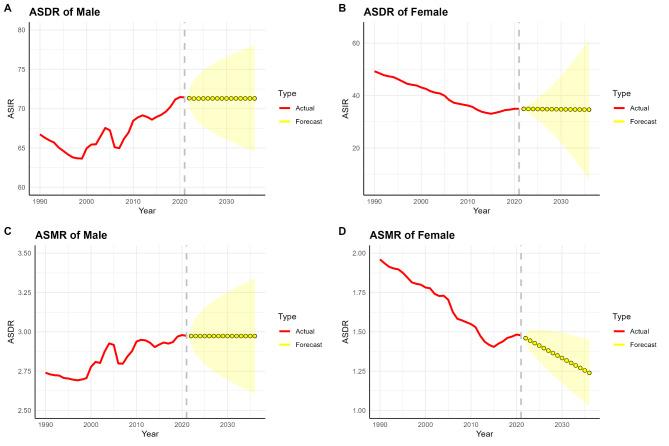
Data was obtained from the Global Burden of Disease (GBD) 2021 study. The Joinpoint regression model was used to calculate the annual percentage change (APC) and the average annual percentage change (AAPC). In addition, the age-period-cohort (APC) model was employed to explore the effects of age, period, and cohort on CRC mortality. The autoregressive integrated moving average (ARIMA) model was utilized to predict the disease burden in 2022-2036. We also compared the CRC burden attributed to high red meat in China with 204 countries worldwide.
RESULTS
The results showed that the number of CRC deaths in China due to high red meat consumption increased nearly 2.5 times, from 17,608 (95% UI: -3 to 36,613) in 1990 to 43,580 (95% UI: -16 to 92,083) in 2021. Male CRC deaths exhibited a more pronounced increase, rising from 9,800 in 1990 to 27,600 in 2021. Additionally, the number of DALYs increased from 518,213 (95% UI: -105,107 to 1,074,174) in 1990 to 1,091,788 (95% UI: -509 to 2,295,779) in 2021. Joinpoint regression analysis confirmed that the AAPC in ASDR and ASMR was - 0.20 (95% CI: -0.40 ∼ 0.00) and - 0.30 (95% CI: -0.40 ~ -0.10). When age, period, and cohort effects were examined as the reference group, the risk of CRC was found to increase with age. However, women experienced a marked decline in both period and cohort effects compared to men.
CONCLUSIONS
Compared to global levels, the burden in China is heavier. In terms of mortality or DALY standardized rates, Chinese women show a similar downward trend to the overall trend, while Chinese men show a striking upward trend. This study provides valuable insights into enhancing CRC prevention and improving dietary patterns in China.
背景
高红肉摄入量是结直肠癌死亡率(CRC)的一个主要可改变风险因素,但在中国,其可归因的疾病负担仍不明确。我们旨在分析1990年至2021年中国因高红肉摄入量导致的结直肠癌死亡和伤残调整生命年(DALYs)的时间趋势,并预测未来15年的疾病负担。
方法
数据来自《2021年全球疾病负担》(GBD)研究。采用Joinpoint回归模型计算年度百分比变化(APC)和平均年度百分比变化(AAPC)。此外,采用年龄-时期-队列(APC)模型探讨年龄、时期和队列对结直肠癌死亡率的影响。利用自回归积分移动平均(ARIMA)模型预测2022 - 2036年的疾病负担。我们还将中国因高红肉摄入导致的结直肠癌负担与全球204个国家进行了比较。
结果
结果显示,中国因高红肉摄入导致的结直肠癌死亡人数增加了近2.5倍,从1990年的17608例(95%UI:-3至36613)增至2021年的43580例(95%UI:-16至92083)。男性结直肠癌死亡人数的增加更为明显,从1990年的9800例增至2021年的27600例。此外,伤残调整生命年数从1990年的518213例(95%UI:-105107至1074174)增至2021年的1091788例(95%UI:-509至2295779)。Joinpoint回归分析证实,年龄标准化死亡率(ASDR)和年龄标准化发病率(ASMR)的AAPC分别为-0.20(95%CI:-0.40 ∼ 0.00)和-0.30(95%CI:-0.40 ~ -0.10)。以年龄、时期和队列效应作为参照组时,发现结直肠癌风险随年龄增加。然而,与男性相比,女性在时期和队列效应方面均显著下降。
结论
与全球水平相比,中国的负担更重。在死亡率或DALY标准化率方面,中国女性呈现出与总体趋势相似的下降趋势,而中国男性则呈现出显著的上升趋势。本研究为加强中国结直肠癌预防和改善饮食模式提供了有价值的见解。


 Zotero 插件