
基于染色质的记忆对细胞身份的自我稳定影响。
Chromatin-based memory as a self-stabilizing influence on cell identity.
作者信息
Bell Charles C, Faulkner Geoffrey J, Gilan Omer
机构信息
Mater Research Institute, University of Queensland, TRI Building, Woolloongabba, QLD, 4102, Australia.
Queensland Brain Institute, University of Queensland, Brisbane, QLD, 4169, Australia.
出版信息
Genome Biol. 2024 Dec 30;25(1):320. doi: 10.1186/s13059-024-03461-x.
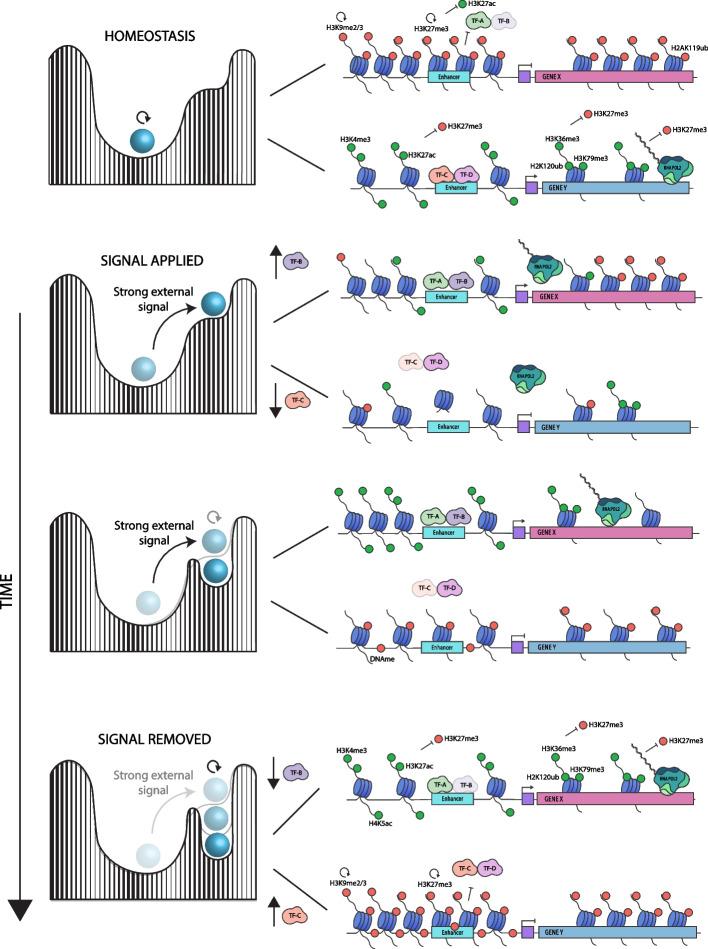
Cell types are traditionally thought to be specified and stabilized by gene regulatory networks. Here, we explore how chromatin memory contributes to the specification and stabilization of cell states. Through pervasive, local, feedback loops, chromatin memory enables cell states that were initially unstable to become stable. Deeper appreciation of this self-stabilizing role for chromatin broadens our perspective of Waddington's epigenetic landscape from a static surface with islands of stability shaped by evolution, to a plasticine surface molded by experience. With implications for the evolution of cell types, stabilization of resistant states in cancer, and the widespread plasticity of complex life.
传统上认为细胞类型是由基因调控网络确定并稳定下来的。在此,我们探讨染色质记忆如何促成细胞状态的确定和稳定。通过普遍存在的局部反馈回路,染色质记忆使原本不稳定的细胞状态变得稳定。对染色质这一自我稳定作用的更深入理解,将我们对沃丁顿表观遗传景观的认识从一个由进化塑造的具有稳定岛屿的静态表面,拓展到一个由经验塑造的橡皮泥表面。这对细胞类型的进化、癌症耐药状态的稳定以及复杂生命的广泛可塑性都有影响。
 Zotero 插件