
上尿路尿路上皮癌中肿瘤细胞和基质细胞G-CSF表达的分布及临床病理特征
Distribution and clinicopathological characteristics of G-CSF expression in tumor cells and stromal cells in upper tract urothelial carcinoma.
作者信息
Kobayashi Go, Sekino Yohei, Nakahara Hikaru, Kobatake Kohei, Goto Keisuke, Hayashi Tetsutaro, Sentani Kazuhiro, Hinata Nobuyuki
机构信息
Laboratory of Molecular Pathology, Department of Molecular Biosciences, Radiation Effects Research Foundation, Hiroshima, Japan.
Department of Molecular Pathology, Graduate School of Biomedical and Health Sciences, Hiroshima University, Hiroshima, Japan.
出版信息
J Cancer Res Clin Oncol. 2024 Dec 30;151(1):18. doi: 10.1007/s00432-024-06045-1.
BACKGROUND
Urothelial carcinoma (UC) is a common type of malignant disease; however, the diagnostic and prognostic markers of upper urinary tract urothelial cancer (UTUC) remain poorly understood because of its rarity.
METHODS
To clarify the clinicopathological significance of granulocyte-colony stimulating factor (G-CSF) in UTUC, we analyzed the expression and distribution of G-CSF in 112 upper tract urothelial carcinoma (UTUC) samples with immunohistochemistry.
RESULTS
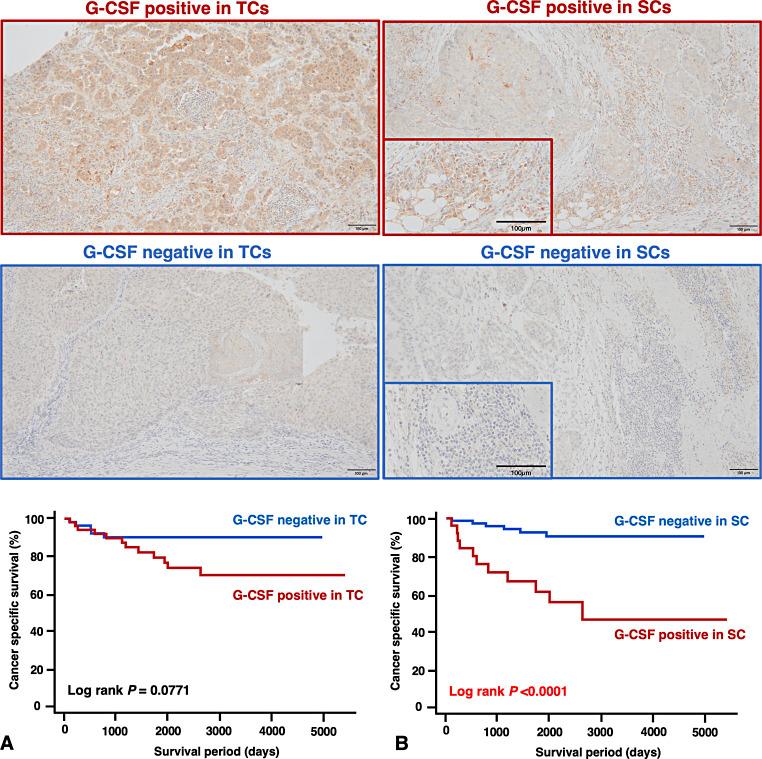
In normal urothelium, G-CSF expression was weak or absent, whereas high expression of G-CSF was observed in UTUC tissues, both in tumor cells (TCs) and stromal cells (SCs). G-CSF expression in the TCs and SCs was associated with nodular/flat morphology, high grade, advanced T stage, and lymphovascular invasion in UTUC. G-CSF expression in SCs was associated with poor prognosis and was an independent prognostic factor. Public data showed that G-CSF expression was also associated with decreased progression-free survival and disease-specific survival. A prognostic model was constructed by incorporating the presence or absence of G-CSF expression along with clinicopathologic factors, which allowed for a more accurate prediction of poor prognosis. We further showed that G-CSF expression was associated with a high Ki-67 labeling index and with PD-L1, HER2, and p53 expression in UTUC.
CONCLUSION
G-CSF expression in TCs and SCs may play a crucial role in UTUC tumor progression. Notably, stromal G-CSF expression showed significant prognostic value, even when compared to major clinicopathological factors, suggesting that the evaluation of G-CSF expression may contribute to clinical decision-making in patients with UTUC.
背景
尿路上皮癌(UC)是一种常见的恶性疾病;然而,由于上尿路尿路上皮癌(UTUC)较为罕见,其诊断和预后标志物仍未得到充分了解。
方法
为了阐明粒细胞集落刺激因子(G-CSF)在UTUC中的临床病理意义,我们采用免疫组织化学方法分析了112例上尿路尿路上皮癌(UTUC)样本中G-CSF的表达和分布。
结果
在正常尿路上皮中,G-CSF表达较弱或缺失,而在UTUC组织中,肿瘤细胞(TCs)和基质细胞(SCs)中均观察到G-CSF高表达。UTUC中TCs和SCs的G-CSF表达与结节状/扁平形态、高级别、T分期进展以及淋巴管浸润相关。SCs中的G-CSF表达与预后不良相关,并且是一个独立的预后因素。公开数据显示,G-CSF表达还与无进展生存期和疾病特异性生存期降低相关。通过纳入G-CSF表达的有无以及临床病理因素构建了一个预后模型,该模型能够更准确地预测不良预后。我们进一步表明,UTUC中G-CSF表达与高Ki-67标记指数以及PD-L1、HER2和p53表达相关。
结论
TCs和SCs中的G-CSF表达可能在UTUC肿瘤进展中起关键作用。值得注意的是,即使与主要临床病理因素相比,基质G-CSF表达也显示出显著的预后价值,这表明评估G-CSF表达可能有助于UTUC患者的临床决策。


 Zotero 插件