
老年急性髓系白血病患者的临床特征与结局:一项真实世界研究
The clinical features and outcomes of elderly patients with acute myeloid leukemia: a real word research.
作者信息
Han Xiao, Liu Xue, Wan Kai, Yan Hongju, Zhang Mengyun, Liu Hong, Gao Li, Gao Lei, Zhang Cheng, Wen Qin, Zhang Xi
机构信息
Medical Center of Hematology, Xinqiao Hospital of Army Medical University; Chongqing Key Laboratory of Hematology and Microenvironment; State Key Laboratory of Trauma and Chemical Poisoning, Army Medical University, Chongqing, No.83 Xinqiao Main Street, Shapingba District, 400037, China.
出版信息
Clin Exp Med. 2025 Jan 3;25(1):27. doi: 10.1007/s10238-024-01536-4.
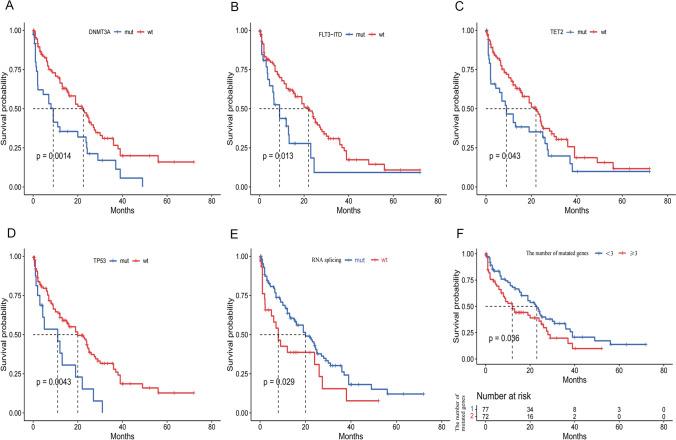
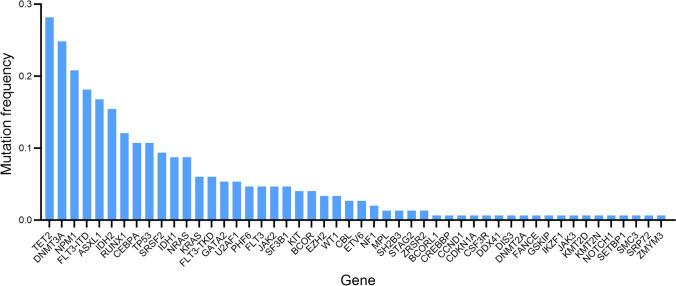
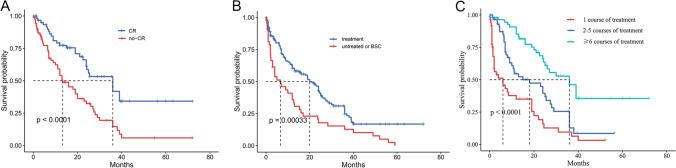
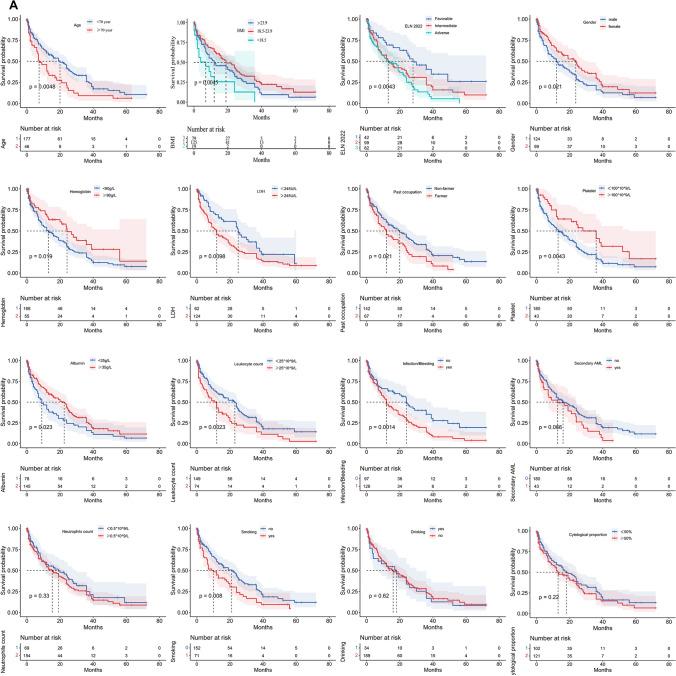
The aim of this study was to investigate the clinical features and outcomes of elderly patients with acute myeloid leukemia (AML) from a real word research. The clinical data of 223 consecutive elderly patients (aged ≥ 60 years) who were newly diagnosed with AML at our medical center between July 2017 and June 2022, including their clinical characteristics, genetic mutations, and survival outcomes, were retrospectively analyzed. Among the 223 patients (median age 67 years), 180 (80.7%) were diagnosed with de novo AML. Genetic mutations were identified in 138 of 149 patients tested (92.6%). The most commonly mutated genes included TET2, DNMT3A, NPM1, FLT3-ITD, ASXL1, IDH2, RUNX1, TP53, and CEBPA. Among these genes, TET2, DNMT3A, FLT3-ITD, and TP53 were associated with a poor outcome. Multivariate Cox's regression analysis revealed that age over 70 years, platelet count less than 100 × 10/L, albumin level less than 35 g/L, presence of infection or bleeding at diagnosis, untreated or best supportive care (BSC) treatment status, and adverse or intermediate ELN 2022 risk classification were independent prognostic factors for overall survival in elderly AML patients. Patients who received at least one induction cycle had longer overall survival times (20 months vs. 6.6 months, P < 0.001) than those who received best supportive care. Patients with ≥ 6 cycles of chemotherapy had longer overall survival times (89.2% vs. 78.5%, P = 0.007) than those with ≤ 5 cycles of therapy. The results of this study indicated that elderly AML patients had multiple genetic abnormalities and poor outcomes. Regular effective treatment can improve patient outcomes and survival. In addition to genetic abnormalities, several other clinical features can influence survival in elderly AML patients.
本研究旨在通过一项真实世界研究,调查老年急性髓系白血病(AML)患者的临床特征和预后。对2017年7月至2022年6月期间在我院医疗中心新诊断为AML的223例连续老年患者(年龄≥60岁)的临床资料进行回顾性分析,包括其临床特征、基因突变和生存结局。在这223例患者(中位年龄67岁)中,180例(80.7%)被诊断为初发性AML。在149例接受检测的患者中,有138例(92.6%)检测到基因突变。最常发生突变的基因包括TET2、DNMT3A、NPM1、FLT3-ITD、ASXL1、IDH2、RUNX1、TP53和CEBPA。在这些基因中,TET2、DNMT3A、FLT3-ITD和TP53与不良预后相关。多因素Cox回归分析显示,年龄超过70岁、血小板计数低于100×10⁹/L、白蛋白水平低于35g/L、诊断时存在感染或出血、未治疗或最佳支持治疗(BSC)状态以及不良或中等ELN 2022风险分类是老年AML患者总生存的独立预后因素。接受至少一个诱导周期治疗的患者总生存时间(20个月 vs. 6.6个月,P<0.001)比接受最佳支持治疗的患者更长。接受≥6周期化疗的患者总生存时间(89.2% vs. 78.5%,P=0.007)比接受≤5周期化疗的患者更长。本研究结果表明,老年AML患者存在多种基因异常且预后较差。规律有效的治疗可改善患者结局和生存。除基因异常外,其他一些临床特征也可影响老年AML患者的生存。

 Zotero 插件