
接受免疫检查点抑制剂治疗的错配修复缺陷或微卫星高度不稳定转移性结直肠癌患者的早期治疗中断
Early treatment discontinuation in patients with deficient mismatch repair or microsatellite instability high metastatic colorectal cancer receiving immune checkpoint inhibitors.
作者信息
Taieb Julien, Ambrosini Margherita, Alouani Emily, Lonardi Sara, Sinicrope Frank A, Decraecker Marie, Boileve Alice, Hafliger Emilie, Mazard Thibault, Pernot Simon, Parent Pauline, Ros Javier, Overman Michael J, Jayachandran Priya, Nasca Vincenzo, Salvatore Lisa, Guimbaud Rosine, Cremolini Chiara, Tougeron David, Pietrantonio Filippo
机构信息
Department of Gastroenterology and Digestive Oncology, European Georges Pompidou Hospital, AP-HP, Paris, France
Paris-Cité University, SIRIC CARPEM Comprehensive Cancer Center, Paris, France.
出版信息
J Immunother Cancer. 2025 Jan 4;13(1):e010424. doi: 10.1136/jitc-2024-010424.
BACKGROUND
Immune checkpoint inhibitors (ICIs) are recommended to treat patients with deficient mismatch repair/microsatellite instability high (dMMR/MSI-H) metastatic colorectal cancer (mCRC). Pivotal trials have fixed a maximum ICI duration of 2 years, without a compelling rationale. A shorter treatment duration has the potential to improve patients' quality of life and reduce both toxicity and cost without compromising efficacy. Here we examine whether early treatment discontinuation (ETD) before 13 months in patients without progressive disease (PD) can lead to similar long-term disease control compared with a longer treatment duration (LTD).
METHODS
To assess whether ETD is associated with similar outcomes compared with LTD, we assembled an international cohort of patients with dMMR/MSI-H mCRC treated with ICIs who stopped treatment for a reason other than PD within 395 days (ETD group) and compared them to those who continued for >395 days (LTD group). Outcomes were adjusted for patient/tumor characteristics. Primary endpoint was progression-free survival (PFS) and secondary endpoints were objective response rate (ORR), overall survival (OS) and safety.
RESULTS
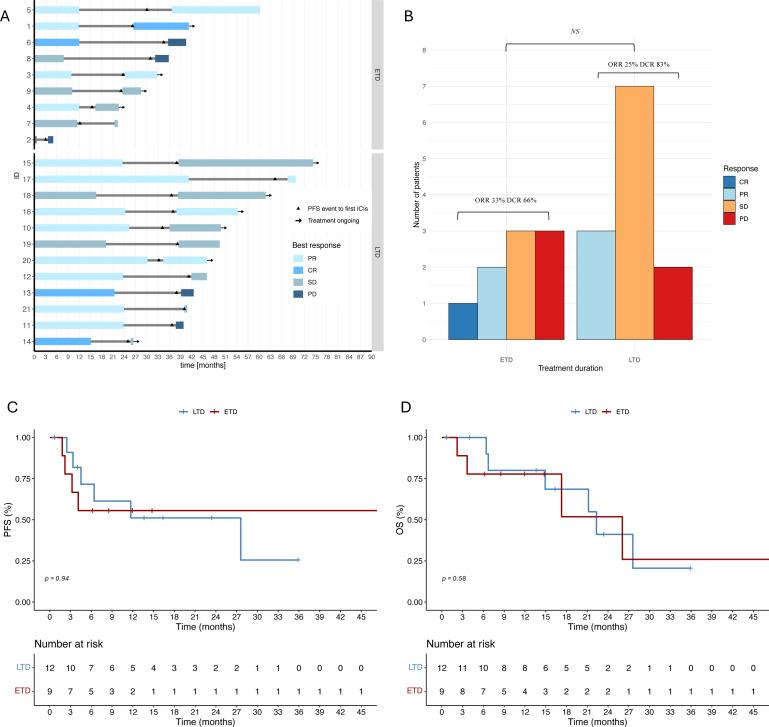
Of 976 patients, 137 and 394 were allocated to the ETD and LTD groups, respectively. In the ETD group, treatment was discontinued due to toxicity (n=56), objective response (n=43), surgery (n=28), patient decision (n=2) or other reasons (n=8). Baseline characteristics were well balanced between the two groups: 22% in both groups received both anti-programmed death-(ligand) 1 (anti-PD-(L)1) + anti-cytotoxic T-lymphocyte antigen-4 (anti-CTLA-4); all others received anti-PD-(L)1 monotherapy. ORR to ICIs was 81% in both groups. Median duration of treatment was ~7 months in the ETD and ~24 months in the LTD group. After a median follow-up of 44 months (IQR: 30-67), similar PFS (HR: 0.92, 95% CI: 0.60 to 1.40, p=0.69) and OS (HR: 1.15, 95% CI: 0.66 to 1.99, p=0.62) from the start of ICIs were observed in ETD and LTD patients. In the ETD group, 28 (20%) patients had a PFS event and 9 restarted ICIs with a disease control rate of 66%.
CONCLUSIONS
In our international series of dMMR/MSI-H mCRC, ETD of ICIs in the absence of PD did not seem detrimental in terms of PFS and OS compared with continuing treatment beyond 1 year. Randomized clinical trials to compare short and long treatment duration are now warranted.
背景
免疫检查点抑制剂(ICIs)被推荐用于治疗错配修复缺陷/微卫星高度不稳定(dMMR/MSI-H)的转移性结直肠癌(mCRC)患者。关键试验确定ICIs的最长治疗持续时间为2年,但缺乏令人信服的理由。较短的治疗持续时间有可能改善患者的生活质量,同时在不影响疗效的情况下降低毒性和成本。在此,我们研究在无疾病进展(PD)的患者中,13个月前提前停药(ETD)与较长治疗持续时间(LTD)相比,是否能带来相似的长期疾病控制效果。
方法
为评估ETD与LTD相比是否具有相似的结果,我们组建了一个国际队列,纳入接受ICIs治疗的dMMR/MSI-H mCRC患者,这些患者在395天内因非PD原因停止治疗(ETD组),并将其与持续治疗超过395天的患者(LTD组)进行比较。根据患者/肿瘤特征对结果进行调整。主要终点是无进展生存期(PFS),次要终点是客观缓解率(ORR)、总生存期(OS)和安全性。
结果
976例患者中,分别有137例和394例被分配至ETD组和LTD组。在ETD组中,治疗中断的原因包括毒性反应(n = 56)、客观缓解(n = 43)、手术(n = 28)、患者决定(n = 2)或其他原因(n = 8)。两组的基线特征平衡良好:两组均有22%的患者接受了抗程序性死亡-(配体)1(抗PD-(L)1)+抗细胞毒性T淋巴细胞抗原4(抗CTLA-4)联合治疗;其他所有患者接受抗PD-(L)1单药治疗。两组ICIs的ORR均为81%。ETD组的中位治疗持续时间约为7个月,LTD组约为24个月。中位随访44个月(四分位间距:30 - 67)后,ETD组和LTD组患者从开始使用ICIs起的PFS(风险比:0.92,95%置信区间:0.60至1.40,p = 0.69)和OS(风险比:1.15,95%置信区间:0.66至1.99,p = 0.62)相似。在ETD组中,28例(20%)患者发生PFS事件,9例重新开始使用ICIs,疾病控制率为66%。
结论
在我们的国际dMMR/MSI-H mCRC系列研究中,与超过1年的持续治疗相比,在无PD情况下提前停用ICIs在PFS和OS方面似乎并无不利影响。现在有必要进行随机临床试验来比较短疗程和长疗程治疗。


 Zotero 插件