
老年人停止训练后体育锻炼的残余效应:一项Meta分析和Meta回归的系统评价
Residual Effects of Physical Exercise After Periods of Training Cessation in Older Adults: A Systematic Review With Meta-Analysis and Meta-Regression.
作者信息
Buendía-Romero Ángel, Vetrovsky Tomas, Hernández-Belmonte Alejandro, Izquierdo Mikel, Courel-Ibáñez Javier
机构信息
GENUD Toledo Research Group, Faculty of Sports Sciences, University of Castilla-La Mancha, Toledo, Spain.
Centro de Investigación Biomédica en Red Fragilidad y Envejecimiento Saludable (CIBERFES), Instituto de Salud Carlos III, Madrid, Spain.
出版信息
Scand J Med Sci Sports. 2025 Jan;35(1):e70010. doi: 10.1111/sms.70010.
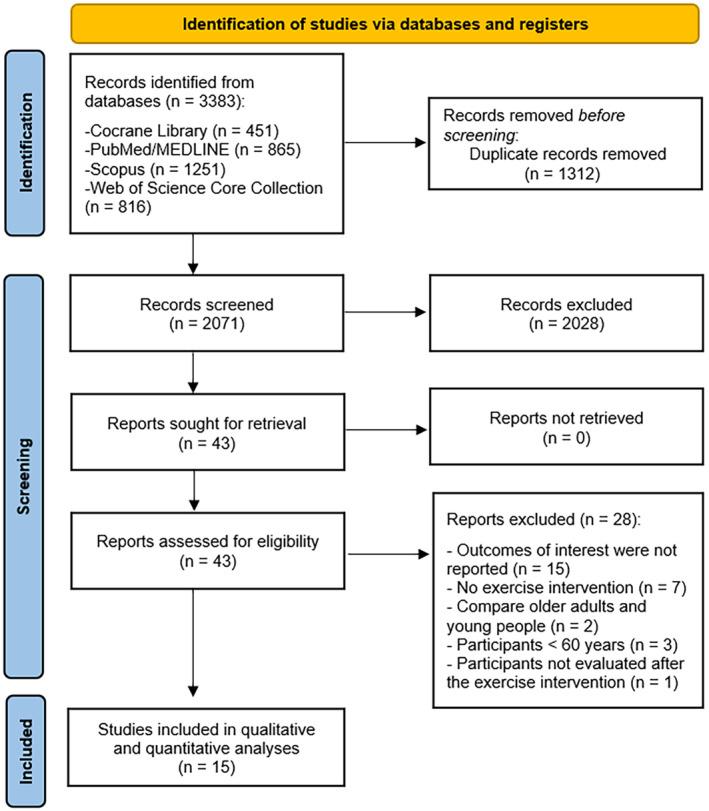
We aimed to determine the persisting effects of various exercise modalities and intensities on functional capacity after periods of training cessation in older adults. A comprehensive search was conducted across the Cochrane Library, PubMed/MEDLINE, Scopus, and Web of Science Core Collection up to March 2024 for randomized controlled trials examining residual effects of physical exercise on functional capacity in older adults ≥ 60 years. The analysis encompassed 15 studies and 21 intervention arms, involving 787 participants. The exercise and training cessation periods ranged from 8 to 43 weeks and 4 to 36 weeks, respectively. Meta-analyses were performed using change scores from before the physical exercise to after the training cessation. The effect sizes (ES) were calculated as the standardized mean differences between the intervention and control groups' change scores. Subgroup analyses and meta-regressions explored the influence of participant characteristics, the magnitude of the effect produced by the initial training program, various exercise modalities (resistance and multicomponent training) and intensities (high and low), and subdomains of functional capacity (agility, balance, standing ability, walking ability, and stair walking). The findings revealed that exercise interventions had a significant effect on preserving functional capacity after training cessation (ES = 0.87; p < 0.01). This protective effect was consistent across various exercise modalities and intensities (ES ≥ 0.67; p ≤ 0.04). The benefits obtained during the training program were positively associated with the residual effects observed after training cessation (β = 0.73; p < 0.01), while age negatively influenced the persisting adaptations (β = -0.07; p < 0.01). Current evidence suggests that exercise-based interventions, irrespective of modality and intensity, are highly effective in preventing functional declines after training cessation among older adults.
我们旨在确定在老年人停止训练一段时间后,各种运动方式和强度对功能能力的持续影响。截至2024年3月,我们在Cochrane图书馆、PubMed/MEDLINE、Scopus和Web of Science核心合集中进行了全面检索,以查找关于体育锻炼对60岁及以上老年人功能能力残余影响的随机对照试验。该分析涵盖了15项研究和21个干预组,涉及787名参与者。运动和训练停止期分别为8至43周和4至36周。使用体育锻炼前到训练停止后的变化分数进行荟萃分析。效应大小(ES)计算为干预组和对照组变化分数之间的标准化平均差异。亚组分析和荟萃回归探讨了参与者特征、初始训练计划产生的效应大小、各种运动方式(阻力训练和多组分训练)和强度(高和低)以及功能能力子领域(敏捷性、平衡能力、站立能力、行走能力和上下楼梯能力)的影响。研究结果表明,运动干预对训练停止后保持功能能力有显著影响(ES = 0.87;p < 0.01)。这种保护作用在各种运动方式和强度中是一致的(ES≥0.67;p≤0.04)。训练计划期间获得的益处与训练停止后观察到的残余效应呈正相关(β = 0.73;p < 0.01),而年龄对持续适应有负面影响(β = -0.07;p < 0.01)。目前的证据表明,无论运动方式和强度如何,基于运动的干预措施在预防老年人训练停止后的功能下降方面都非常有效。
 Zotero 插件