
用于再生医学的间充质干细胞永生化及其潜在的肿瘤发生风险
Immortalization of Mesenchymal Stem Cells for Application in Regenerative Medicine and Their Potential Risks of Tumorigenesis.
作者信息
Yamaguchi Natsuki, Horio Eri, Sonoda Jukito, Yamagishi Miu, Miyakawa Satomi, Murakami Fumihiro, Hasegawa Hideaki, Katahira Yasuhiro, Mizoguchi Izuru, Fujii Yasuyuki, Chikazu Daichi, Yoshimoto Takayuki
机构信息
Department of Immunoregulation, Institute of Medical Science, Tokyo Medical University, 6-1-1 Shinjuku, Shinjuku-ku, Tokyo 160-8402, Japan.
Department of Oral and Maxillofacial Surgery, Tokyo Medical University, 6-7-1 Nishishinjuku, Shinjuku-ku, Tokyo 160-0023, Japan.
出版信息
Int J Mol Sci. 2024 Dec 18;25(24):13562. doi: 10.3390/ijms252413562.
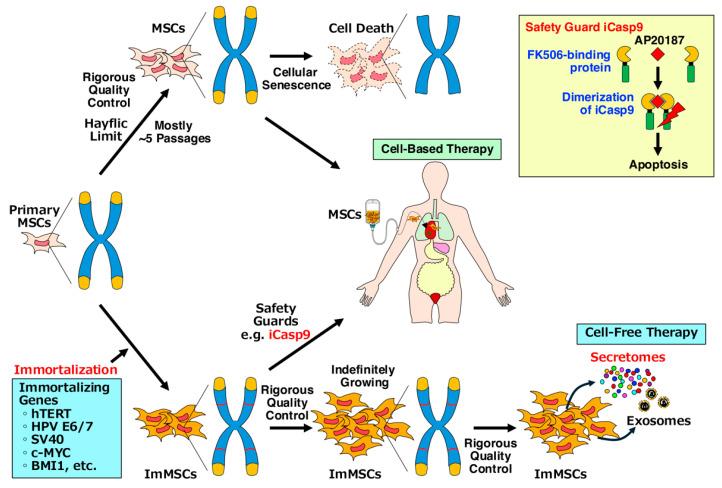
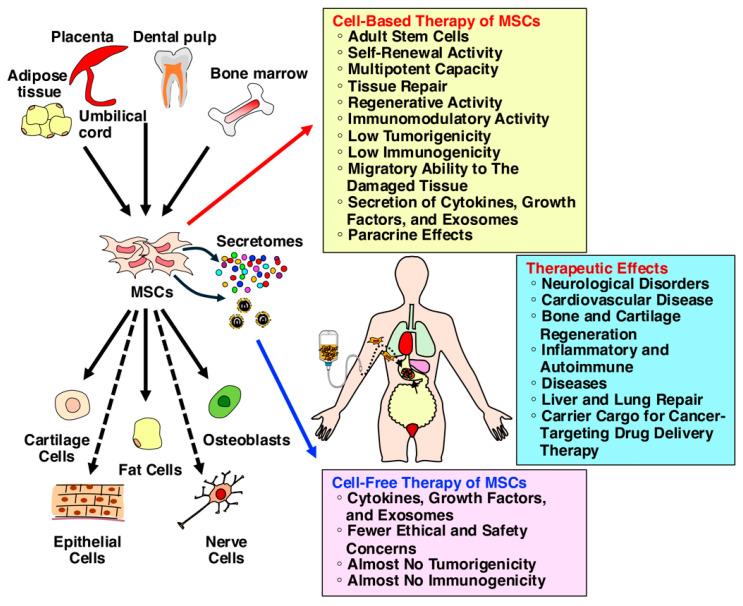
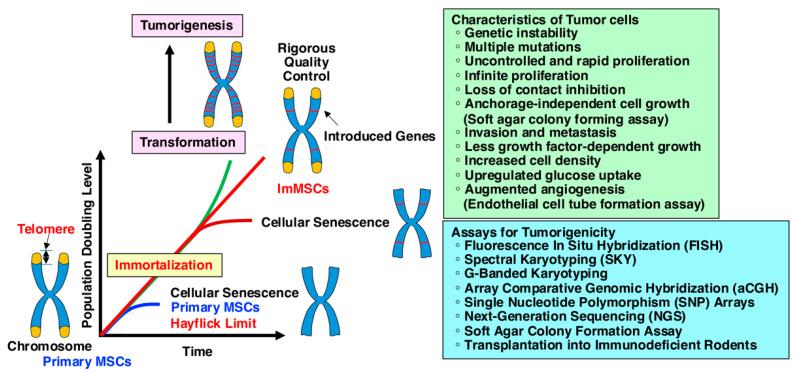
Regenerative medicine utilizes stem cells to repair damaged tissues by replacing them with their differentiated cells and activating the body's inherent regenerative abilities. Mesenchymal stem cells (MSCs) are adult stem cells that possess tissue repair and regenerative capabilities and immunomodulatory properties with a much lower risk of tumorigenicity, making them a focus of numerous clinical trials worldwide. MSCs primarily exert their therapeutic effects through paracrine effects via secreted factors, such as cytokines and exosomes. This has led to increasing interest in cell-free therapy, where only the conditioned medium (also called secretome) from MSC cultures is used for regenerative applications. However, MSCs face certain limitations, including cellular senescence, scarcity, donor heterogeneity, complexity, short survival post-implantation, and regulatory and ethics hurdles. To address these challenges, various types of immortalized MSCs (ImMSCs) capable of indefinite expansion have been developed. These cells offer significant promise and essential tools as a reliable source for both cell-based and cell-free therapies with the aim of translating them into practical medicine. However, the process of immortalization, often involving the transduction of immortalizing genes, poses potential risks of genetic instability and resultant malignant transformation. Cell-free therapy is particularly attractive, as it circumvents the risks of tumorigenicity and ethical concerns associated with live cell therapies. Rigorous safety tests, such as monitoring chromosomal abnormalities, are critical to ensure safety. Technologies like inducible or suicide genes may allow for the controlled proliferation of MSCs and induce apoptosis after their therapeutic task is completed. This review highlights recent advancements in the immortalization of MSCs and the associated risks of tumorigenesis.
再生医学利用干细胞通过用其分化细胞替代受损组织并激活身体固有的再生能力来修复受损组织。间充质干细胞(MSCs)是成体干细胞,具有组织修复和再生能力以及免疫调节特性,致瘤风险低得多,这使其成为全球众多临床试验的焦点。MSCs主要通过分泌细胞因子和外泌体等因子的旁分泌作用发挥其治疗效果。这导致人们对无细胞疗法越来越感兴趣,即仅使用MSCs培养物的条件培养基(也称为分泌组)进行再生应用。然而,MSCs面临某些局限性,包括细胞衰老、稀缺性、供体异质性、复杂性、植入后存活时间短以及监管和伦理障碍。为了应对这些挑战,已经开发出了能够无限扩增的各种类型的永生化MSCs(ImMSCs)。这些细胞作为基于细胞和无细胞疗法的可靠来源,有望成为将其转化为实用医学的重要工具。然而,永生化过程通常涉及永生化基因的转导,存在基因不稳定和由此导致恶性转化的潜在风险。无细胞疗法特别有吸引力,因为它规避了与活细胞疗法相关的致瘤风险和伦理问题。严格的安全测试,如监测染色体异常,对于确保安全至关重要。诱导型或自杀基因等技术可能允许对MSCs进行可控增殖,并在其治疗任务完成后诱导细胞凋亡。本综述重点介绍了MSCs永生化的最新进展以及相关的致瘤风险。


 Zotero 插件