
超加工食品摄入量与心血管代谢和心理健康结局发生率的关联超出特定亚组——巴西成人健康纵向研究
Associations of Ultra-Processed Food Intake with the Incidence of Cardiometabolic and Mental Health Outcomes Go Beyond Specific Subgroups-The Brazilian Longitudinal Study of Adult Health.
作者信息
Canhada Scheine Leite, Vigo Álvaro, Giatti Luana, Fonseca Maria de Jesus, Lopes Leidjaira Juvanhol, Cardoso Letícia de Oliveira, Monteiro Carlos Augusto, Schmidt Maria Inês, Duncan Bruce Bartholow
机构信息
Postgraduate Program in Epidemiology, Universidade Federal do Rio Grande do Sul, Porto Alegre 90035-003, RS, Brazil.
Department of Preventive and Social Medicine, School of Medicine & Clinical Hospital/EBSER, Universidade Federal de Minas Gerais, Belo Horizonte 30130-100, MG, Brazil.
出版信息
Nutrients. 2024 Dec 12;16(24):4291. doi: 10.3390/nu16244291.
: Avoidance of ultra-processed foods (UPFs) has been recommended to achieve a healthy diet, but whether it applies equally to all UPFs is uncertain. We evaluated individual UPF subgroups in the prediction of cardiometabolic and mental health outcomes. : The Brazilian Longitudinal Study of Adult Health (ELSA-Brasil) is an occupational cohort study of 15,105 adults (35-74 years) recruited in 2008-2010. We followed participants up to 2018 to ascertain elevated weight and waist gains and the onset of metabolic syndrome, hypertension, metabolic dysfunction-associated steatotic liver disease, diabetes, common mental disorders, depressive episodes, and anxiety disorders. : In adjusted robust Poisson regression, greater overall UPF intake at the baseline predicted all studied outcomes. Various subgroups of UPF, most frequently processed meat and sweetened beverages, individually conferred a greater risk, and nearly all predicted at least one studied outcome. Considering all subgroups and outcomes, a broad pattern of overall risk was present. When subgroups not individually predictive of these outcomes were aggregated, increased risk (for a one-standard deviation change) was observed for elevated weight (RR = 1.05; 95% CI 1.01-1.11) and waist (RR = 1.05; 95% CI 1.00-1.10) gains, and for the incidence of common mental (RR = 1.06; 95% CI 1.01-1.12), and anxiety (RR = 1.09; 95% CI 1.02-1.16) disorders. : UPFs overall and their subgroups predicted future cardiometabolic and mental health outcomes. The pattern of individual UPF subgroup associations varied across outcomes, and the aggregate of subgroups not individually predicting risk also predicted large gains in overall and central adiposity and the incidence of mental health disorders. While additional studies investigating other outcomes are needed, these findings justify avoidance of overall UPF intake in health promotion and disease prevention.
为实现健康饮食,人们建议避免食用超加工食品(UPF),但它是否对所有超加工食品都同样适用尚不确定。我们评估了各类超加工食品亚组对心血管代谢和心理健康结果的预测作用。
巴西成人健康纵向研究(ELSA - Brasil)是一项职业队列研究,于2008年至2010年招募了15105名成年人(35 - 74岁)。我们对参与者进行随访直至2018年,以确定体重增加、腰围增加以及代谢综合征、高血压、代谢功能障碍相关脂肪性肝病、糖尿病、常见精神障碍、抑郁发作和焦虑症的发病情况。
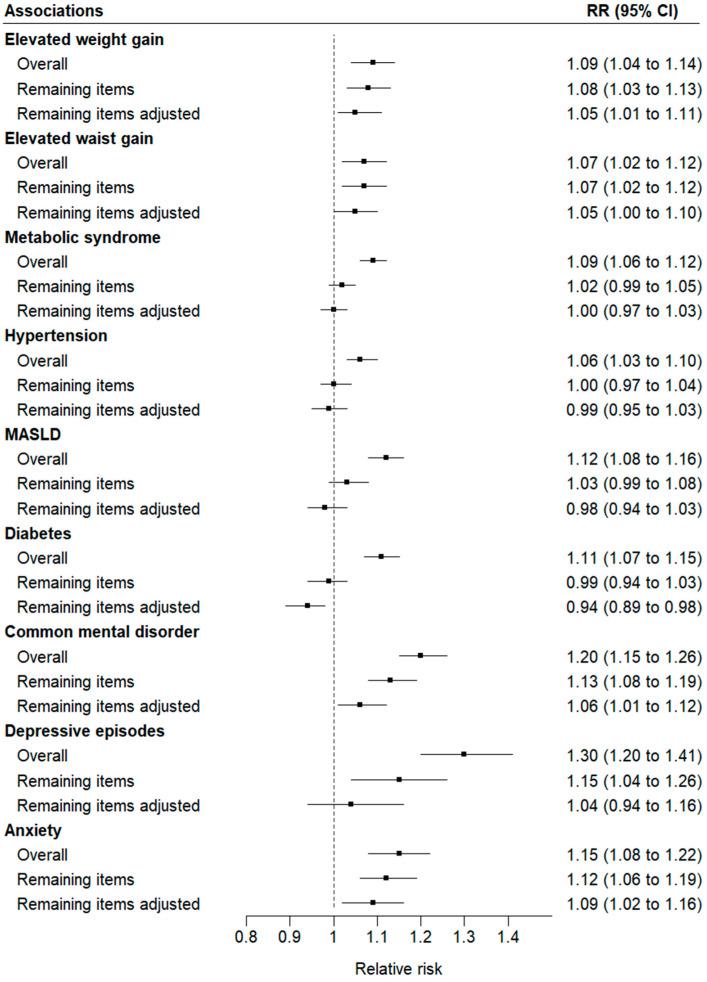
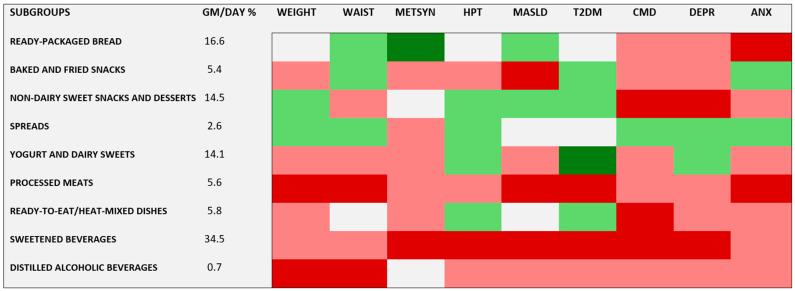
在调整后的稳健泊松回归分析中,基线时较高的总体超加工食品摄入量可预测所有研究结果。各类超加工食品亚组,最常见的是加工肉类和甜味饮料,各自带来了更高的风险,且几乎所有亚组都能预测至少一项研究结果。综合考虑所有亚组和结果,呈现出一种总体风险的广泛模式。当将那些不能单独预测这些结果的亚组汇总时,观察到体重增加(风险比 = 1.05;95%置信区间1.01 - 1.11)、腰围增加(风险比 = 1.05;95%置信区间1.00 - 1.10)以及常见精神障碍(风险比 = 1.06;95%置信区间1.01 - 1.12)和焦虑症(风险比 = 1.09;95%置信区间1.02 - 1.16)发病率的风险增加(标准差变化一次)。
总体超加工食品及其亚组可预测未来的心血管代谢和心理健康结果。各类超加工食品亚组的关联模式因结果而异,那些不能单独预测风险亚组的汇总也预示着总体和中心性肥胖的大幅增加以及心理健康障碍的发病率。虽然还需要进一步研究其他结果,但这些发现证明在健康促进和疾病预防中应避免总体超加工食品的摄入。
 Zotero 插件