
超加工食品消费与2型糖尿病发病率之间的关联:巴西成人健康纵向研究队列
Association between ultra-processed food consumption and the incidence of type 2 diabetes: the ELSA-Brasil cohort.
作者信息
Canhada Scheine L, Vigo Álvaro, Levy Renata, Luft Vivian C, da Fonseca Maria de Jesus M, Giatti Luana, Molina Maria Del Carmen B, Duncan Bruce B, Schmidt Maria Inês
机构信息
Postgraduate Program in Epidemiology, Universidade Federal do Rio Grande do Sul, Rua Ramiro Barcelos 2600 sala 519, Porto Alegre, RS, Brazil.
Department of Preventive Medicine, School of Medicine, Universidade de São Paulo, São Paulo, SP, Brazil.
出版信息
Diabetol Metab Syndr. 2023 Nov 15;15(1):233. doi: 10.1186/s13098-023-01162-2.
BACKGROUND
Ultra-processed food (UPF) consumption increases the risk of type 2 diabetes in various high-income countries, with some variation in the magnitude across studies. Our objective was to investigate the association of UPF consumption and specific subgroups with incident type 2 diabetes in Brazilian adults.
METHODS
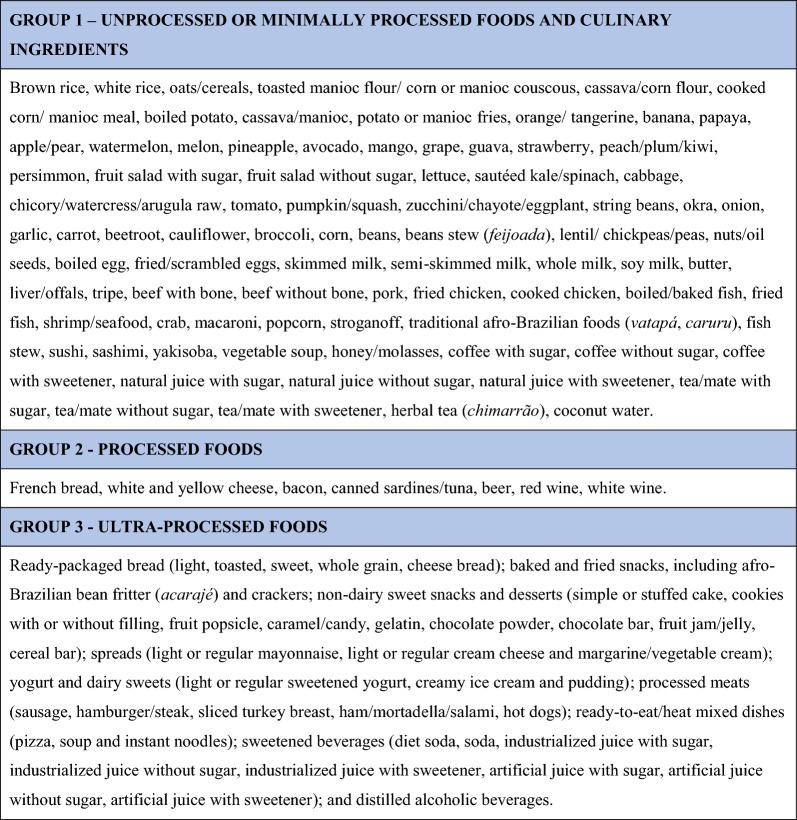
The Brazilian Longitudinal Study of Adult Health (ELSA-Brasil) is a multicenter cohort study of 15,105 adults (35-74 years) enrolled in public institutions in Brazil (2008-2010). We followed participants with two clinic visits (2012-2014; 2017-2019) and annual telephone surveillance. After excluding those with diabetes at baseline, who died or were lost in the follow-up, with missing data, with implausible energy food intake, or reporting bariatric surgery, there were 10,202 participants. We used the NOVA classification to assess UPF consumption based on a food frequency questionnaire. We defined type 2 diabetes by self-report, medication use, or comprehensive laboratory tests. We estimated relative risks (RR) and 95% confidence intervals (95% CI) using robust Poisson regression.
RESULTS
Median UPF consumption was 372 g/day. Over 8.2 (0.7) years of follow-up, we detected 1799 (17.6%) incident cases. After adjustment for socio-demographics, family history of diabetes, and behavioral risk factors, comparing the fourth (≥ 566 g/day) with the first (< 236 g/day) quartile of UPF distribution, RR was 1.24 (1.10-1.39); every 150 g/day increments in UPF consumption resulted in a RR of 1.05 (1.03-1.07). Reclassifying natural beverages with added sweeteners as UPF increased risk (RR 1.40; 1.25-1.58). Among UPF subgroupings, consumption of processed meats and sweetened beverages increased diabetes risk, while yogurt and dairy sweets decreased the risk (p < 0.05).
CONCLUSIONS
UPF consumption increased the incidence of type 2 diabetes in Brazilian adults, with heterogeneity across specific food items. These findings add to previous evidence for the role of UPFs in the development of diabetes and other chronic diseases, supporting recommendations to avoid their intake in diabetes prevention and management.
背景
在多个高收入国家,超加工食品(UPF)的消费增加了2型糖尿病的风险,不同研究中的风险程度存在一定差异。我们的目标是调查巴西成年人中UPF消费及其特定亚组与2型糖尿病发病之间的关联。
方法
巴西成人健康纵向研究(ELSA-Brasil)是一项针对巴西公共机构中15105名成年人(35 - 74岁)的多中心队列研究(2008 - 2010年)。我们对参与者进行了两次门诊随访(2012 - 2014年;2017 - 2019年)以及年度电话监测。在排除基线时患有糖尿病、在随访期间死亡或失访、有缺失数据、能量食物摄入量不合理或报告接受过减肥手术的参与者后,共有10202名参与者。我们使用NOVA分类法,根据食物频率问卷评估UPF的消费情况。我们通过自我报告、药物使用或综合实验室检查来定义2型糖尿病。我们使用稳健泊松回归估计相对风险(RR)和95%置信区间(95%CI)。
结果
UPF的中位消费量为每天372克。在8.2(0.7)年的随访中,我们检测到1799例(17.6%)新发病例。在对社会人口统计学、糖尿病家族史和行为风险因素进行调整后,将UPF分布的第四个四分位数(≥566克/天)与第一个四分位数(<236克/天)进行比较,RR为1.24(1.10 - 1.39);UPF消费量每增加150克/天,RR为1.05(1.03 - 1.07)。将添加甜味剂的天然饮料重新归类为UPF会增加风险(RR 1.40;1.25 - 1.58)。在UPF亚组中,加工肉类和甜味饮料的消费会增加糖尿病风险,而酸奶和奶类甜食则会降低风险(p < 0.05)。
结论
UPF的消费增加了巴西成年人2型糖尿病的发病率,不同特定食品之间存在异质性。这些发现为UPF在糖尿病及其他慢性疾病发展中的作用增添了新证据,支持在糖尿病预防和管理中避免摄入UPF的建议。

 Zotero 插件