
超加工食品与癌症风险:作用机制及对公共卫生的影响
Ultraprocessed Food and Risk of Cancer: Mechanistic Pathways and Public Health Implications.
作者信息
Menegassi Bruna, Vinciguerra Manlio
机构信息
Sociology and Communication Department, Social Sciences Faculty, Salamanca University, 37008 Salamanca, Spain.
Department of Translational Stem Cell Biology, Research Institute, Medical University of Varna, 9002 Varna, Bulgaria.
出版信息
Cancers (Basel). 2025 Jun 20;17(13):2064. doi: 10.3390/cancers17132064.
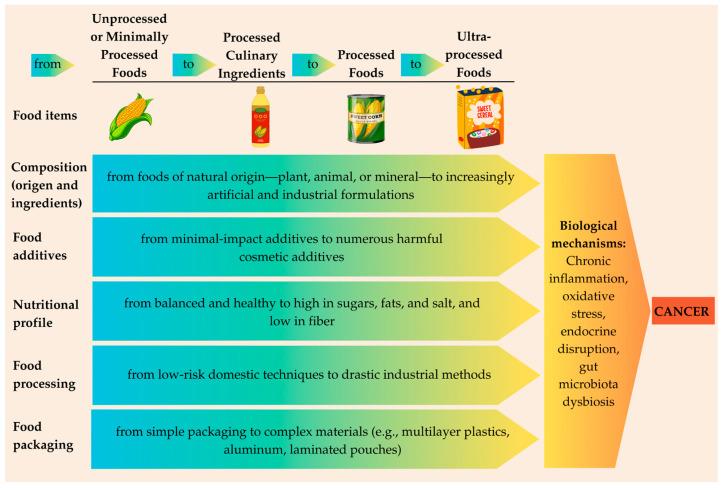
Ultraprocessed foods (UPFs), now dominant in global diets, pose health risks that go beyond poor nutrition due to the synergistic effects of compounds in their ultracomplex industrial formulations. This narrative review aims to provide researchers and health professionals in the field of cancer with updated and critical information, as they are often unaware of the complex and evolving evidence linking UPFs to carcinogenesis. The review discusses potential mechanisms through which UPFs may contribute to cancer development, including harmful additives, neo-formed contaminants, and packaging-derived substances, as well as the displacement of protective nutrients found in whole foods. Despite limitations in establishing direct causality, epidemiological studies consistently associate high UPF intake with increased incidence of various cancers, notably colorectal, breast, and pancreatic cancers. These findings reflect a broader paradigm shift in nutritional epidemiology, recognizing that food processing is an essential dimension of diet-related health risks. To mitigate the impact of UPFs, the review emphasizes the need for preventive strategies that integrate clear dietary guidelines, regulatory measures on food labeling and additives, and public education campaigns. Successful international experiences in regulating marketing and improving transparency serve as important references. Moreover, eliminating corporate influence and conflicts of interest is crucial to ensure that public health, rather than industry agendas, guides nutrition policy. As scientific research advances to clarify the mechanisms of action and synergistic effects of harmful compounds in UPFs, coordinated efforts are needed to reduce their consumption and ultimately alleviate the global cancer burden.
超加工食品(UPFs)如今在全球饮食中占据主导地位,因其超复杂工业配方中化合物的协同作用,带来了超出营养不良的健康风险。本叙述性综述旨在为癌症领域的研究人员和健康专业人士提供最新的关键信息,因为他们往往不了解将超加工食品与致癌作用联系起来的复杂且不断演变的证据。该综述讨论了超加工食品可能促进癌症发展的潜在机制,包括有害添加剂、新形成的污染物和包装衍生物质,以及全食物中保护性营养素的被取代。尽管在确立直接因果关系方面存在局限性,但流行病学研究一致表明,高摄入量的超加工食品与各种癌症(尤其是结直肠癌、乳腺癌和胰腺癌)发病率的增加有关。这些发现反映了营养流行病学中一个更广泛的范式转变——认识到食品加工是与饮食相关健康风险的一个重要方面。为减轻超加工食品的影响,该综述强调需要采取预防策略,这些策略应整合明确的饮食指南、食品标签和添加剂的监管措施以及公众教育活动。在规范营销和提高透明度方面成功的国际经验可作为重要参考。此外,消除企业影响和利益冲突对于确保以公共卫生而非行业议程来指导营养政策至关重要。随着科学研究不断推进以阐明超加工食品中有害化合物的作用机制和协同效应,需要各方协同努力减少其消费,最终减轻全球癌症负担。
 Zotero 插件