
PoachNet:使用基于本体的知识图谱预测偷猎行为
PoachNet: Predicting Poaching Using an Ontology-Based Knowledge Graph.
作者信息
Hamed Naeima, Rana Omer, Orozco-terWengel Pablo, Goossens Benoît, Perera Charith
机构信息
School of Computer Science and Informatics, Cardiff University, Cardiff CF24 4AG, UK.
School of Biosciences, Cardiff University, Cardiff CF10 3AX, UK.
出版信息
Sensors (Basel). 2024 Dec 20;24(24):8142. doi: 10.3390/s24248142.
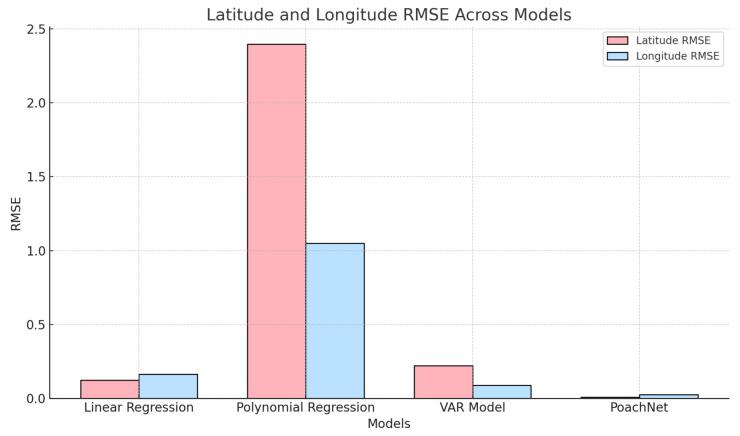
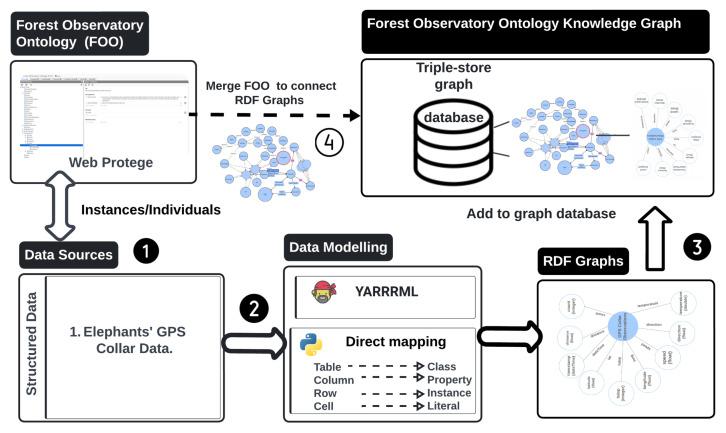
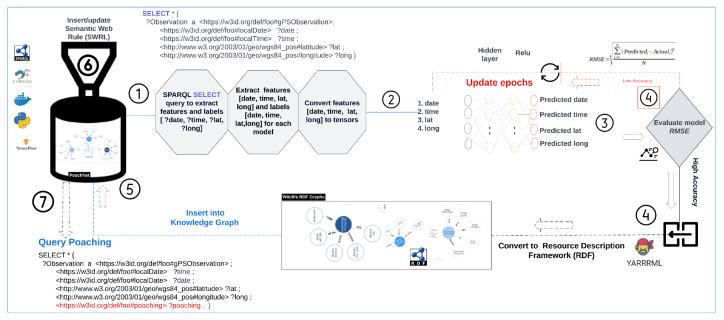
Poaching poses a significant threat to wildlife and their habitats, necessitating advanced tools for its prediction and prevention. Existing tools for poaching prediction face challenges such as inconsistent poaching data, spatiotemporal complexity, and translating predictions into actionable insights for conservation efforts. This paper presents PoachNet, a novel predictive system that integrates deep learning with Semantic Web reasoning to infer poaching likelihood. Using elephant GPS data extracted from an ontology-based knowledge graph, PoachNet employs a sequential neural network to predict future movements, which are semantically modelled and incorporated into the graph. Semantic Web Rule Language (SWRL) is applied to infer poaching risk based on these geo-location predictions and poaching rule-based logic. By addressing spatiotemporal complexity and integrating predictions into an actionable semantic rule, PoachNet advances the field, with its geo-location prediction model outperforming state-of-the-art approaches.
偷猎对野生动物及其栖息地构成了重大威胁,因此需要先进的工具来进行预测和预防。现有的偷猎预测工具面临着诸如偷猎数据不一致、时空复杂性以及将预测转化为可用于保护工作的可行见解等挑战。本文提出了PoachNet,这是一种新颖的预测系统,它将深度学习与语义网推理相结合以推断偷猎可能性。PoachNet使用从基于本体的知识图谱中提取的大象GPS数据,采用顺序神经网络来预测未来的移动,这些移动在语义上进行建模并纳入到知识图谱中。语义网规则语言(SWRL)被应用于基于这些地理位置预测和基于偷猎规则的逻辑来推断偷猎风险。通过解决时空复杂性并将预测整合到可操作的语义规则中,PoachNet推动了该领域的发展,其地理位置预测模型优于当前的先进方法。

 Zotero 插件