
233纳米和275纳米波长的紫外线C的杀病毒效果研究
Studies on the Virucidal Effects of UV-C of 233 nm and 275 nm Wavelengths.
作者信息
Kohs Jessica, Lichtenthäler Tom, Gouma Carolyn, Cho Hyun Kyong, Reith Andreas, Kramer Axel, Reiche Sven, Zwicker Paula
机构信息
Department of Experimental Animal Facilities and Biorisk Management (ATB), Friedrich-Loeffler-Institut, Federal Research Institute for Animal Health, Südufer 10, 17493 Greifswald Insel Riems, Germany.
Institute of Hygiene and Environmental Medicine, University Medicine Greifswald, Ferdinand-Sauerbruch-Str., 17475 Greifswald, Germany.
出版信息
Viruses. 2024 Dec 11;16(12):1904. doi: 10.3390/v16121904.
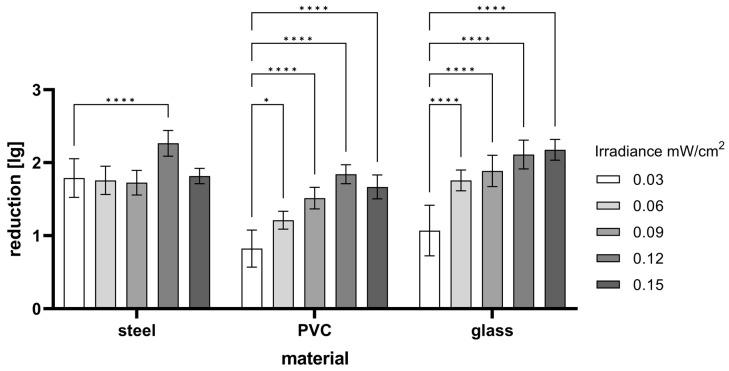
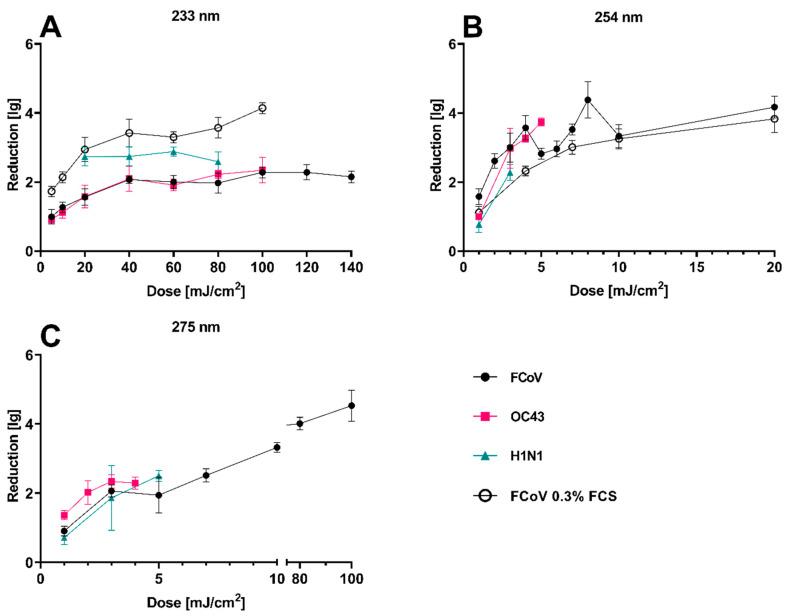
Among the physical decontamination methods, treatment with ultraviolet (UV) radiation is a suitable means of preventing viral infections. Mercury vapor lamps (254 nm) used for room decontamination are potentially damaging to human skin (radiation) and harmful to the environment (mercury). Therefore, other UV-C wavelengths (100-280 nm) may be effective for virus inactivation on skin without damaging it, e.g., far-UV-C radiation with a wavelength of 233 nm, which is absorbed in the outer layer of the skin and thus does not reach the deeper layers of the skin. For room disinfection, 275 nm UV-C LED lamps could be a more environmentally friendly alternative, since toxic mercury is avoided. A carrier test using multiple viruses was used to determine the TCID/mL value on stainless steel, PVC, and glass carriers. In addition to the inactivation kinetics (233 nm), the necessary UV-C dose for 4 lg inactivation (275 nm) was investigated. The impact of irradiance on the inactivation efficacy was also assessed. The inactivation of the viruses was a function of the radiation dose. UV-C-radiation at 233 nm (80 mJ/cm) inactivated from 1.49 ± 0.08 to 4.28 ± 0.18 lg depending on the virus used. To achieve a 4 lg inactivation (275 nm) for enveloped viruses, doses of up to 70 mJ/cm (SuHV-1) were sufficient. For non-enveloped viruses, a maximum dose of 600 mJ/cm (MS2) was necessary. Enveloped viruses were inactivated with lower doses compared to non-enveloped viruses. Higher radiation doses were required for inactivation at 275 nm in comparison to 254 nm. A more environmentally friendly alternative to mercury vapor lamps is available with 275 nm LED emitters. Radiation at 233 nm could serve as an additional prophylactic or therapeutic measure for virus inactivation in direct contact with human skin.
在物理去污方法中,用紫外线(UV)辐射进行处理是预防病毒感染的一种合适手段。用于房间去污的汞蒸气灯(254纳米)可能会对人体皮肤造成损害(辐射),并对环境有害(汞)。因此,其他UV-C波长(100 - 280纳米)可能对皮肤表面的病毒灭活有效且不会造成损害,例如,波长为233纳米的远UV-C辐射,它被皮肤外层吸收,因此不会到达皮肤深层。对于房间消毒,275纳米的UV-C发光二极管灯可能是一种更环保的选择,因为避免了有毒汞的使用。使用多种病毒进行的载体测试用于确定不锈钢、聚氯乙烯和玻璃载体上的半数组织培养感染剂量(TCID/mL)值。除了灭活动力学(233纳米)外,还研究了4对数灭活(275纳米)所需的UV-C剂量。还评估了辐照度对灭活效果的影响。病毒的灭活是辐射剂量的函数。根据所使用的病毒不同,233纳米的UV-C辐射(80毫焦/平方厘米)可使1.49±0.08至4.28±0.18对数的病毒失活。对于包膜病毒,要实现4对数灭活(275纳米),高达70毫焦/平方厘米的剂量(牛疱疹病毒1型)就足够了。对于非包膜病毒,最大剂量为600毫焦/平方厘米(MS2噬菌体)是必要的。与非包膜病毒相比,包膜病毒在较低剂量下就可被灭活。与254纳米相比,275纳米灭活需要更高的辐射剂量。275纳米发光二极管发射器提供了一种比汞蒸气灯更环保的选择。233纳米的辐射可作为直接接触人体皮肤时病毒灭活的额外预防或治疗措施。

 Zotero 插件