
红参在二乙基亚硝胺和硫代乙酰胺诱导的小鼠肝癌模型中的治疗潜力
Therapeutic Potential of Hongjam in A Diethylnitrosamine and Thioacetamide-induced Hepatocellular Carcinoma Mouse Model.
作者信息
Han Young-Min, Ahn Hye-Rin, Lee Da-Young, Song Moon-Young, Lee Seung-Won, Jang You-Kyung, Jeon Byeong Yeob, Kim Eun-Hee
机构信息
College of Pharmacy and Institute of Pharmaceutical Sciences, CHA University, Seongnam, Korea.
QBM Co., Ltd., Seoul, Korea.
出版信息
J Cancer Prev. 2024 Dec 30;29(4):165-174. doi: 10.15430/JCP.24.029.
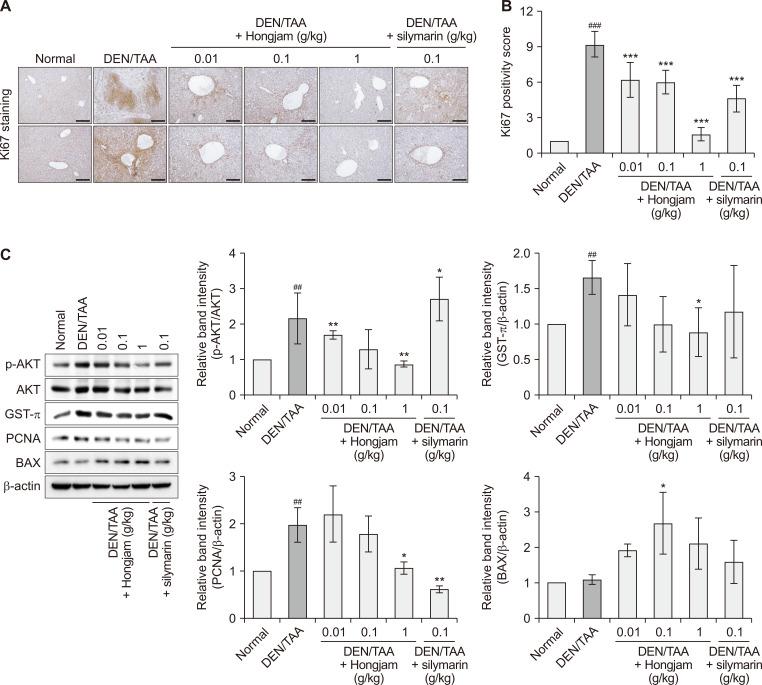
Hepatocellular carcinoma (HCC) is the most common and lethal type of primary liver cancer, frequently arising from chronic liver injury and inflammation. Despite treatment advancements, HCC prognosis remains poor, emphasizing the need for effective preventive and therapeutic strategies. This study investigates the hepatoprotective and anti-tumor effects of Hongjam, a steamed freeze-dried silkworm powder, in a diethylnitrosamine (DEN) and thioacetamide (TAA)-induced HCC mouse model. Mice were administered DEN intraperitoneally for 8 weeks, followed by TAA in drinking water for 9 weeks, with Hongjam supplementation (0.01, 0.1, and 1 g/kg) provided daily through food. Hongjam markedly reduced the tumor incidence, the size, and the histological lesions compared to the DEN/TAA group. Serum biochemical analysis revealed reduction in liver damage markers, including alkaline phosphatase, alanine aminotransferase, aspartate aminotransferase, and total bilirubin, with a notable decrease in total bilirubin surpassing. Immunohistochemical and Western blot analyses demonstrated that Hongjam downregulated expression of proliferation markers, including Ki67, phosphorylation of protein kinase B, and proliferating cell nuclear antigen, while upregulating the pro-apoptotic protein Bcl-2-associated X protein, indicating its dual role in suppressing proliferation and promoting apoptosis. Furthermore, Hongjam inhibited angiogenesis by suppressing the expression of key markers, including interleukin 6, VEGF, hypoxia-inducible factor-1 subunit alpha, platelet-derived growth factor subunit beta, matrix metalloproteinase-2, and cluster of differentiation 31, thereby disrupting the tumor microenvironment. These findings suggest that Hongjam exerts multifaceted protective effects against HCC by targeting proliferation, apoptosis, and angiogenesis pathways, while also mitigating liver damage. This study highlights the potential of Hongjam as a functional food or a complementary therapeutic agent for HCC prevention and management.
肝细胞癌(HCC)是最常见且致命的原发性肝癌类型,常源于慢性肝损伤和炎症。尽管治疗取得了进展,但HCC的预后仍然很差,这凸显了有效预防和治疗策略的必要性。本研究在二乙基亚硝胺(DEN)和硫代乙酰胺(TAA)诱导的HCC小鼠模型中,研究了蒸制冻干蚕粉Hongjam的保肝和抗肿瘤作用。小鼠腹腔注射DEN 8周,随后饮用含TAA的水9周,同时通过食物每日补充Hongjam(0.01、0.1和1 g/kg)。与DEN/TAA组相比,Hongjam显著降低了肿瘤发生率、肿瘤大小和组织学病变。血清生化分析显示肝损伤标志物减少,包括碱性磷酸酶、丙氨酸转氨酶、天冬氨酸转氨酶和总胆红素,总胆红素显著降低。免疫组织化学和蛋白质印迹分析表明,Hongjam下调了增殖标志物的表达,包括Ki67、蛋白激酶B的磷酸化和增殖细胞核抗原,同时上调了促凋亡蛋白Bcl-2相关X蛋白,表明其在抑制增殖和促进凋亡方面的双重作用。此外,Hongjam通过抑制关键标志物的表达来抑制血管生成,这些标志物包括白细胞介素6,、血管内皮生长因子、缺氧诱导因子-1α亚基、血小板衍生生长因子β亚基、基质金属蛋白酶-2和分化簇抗原31,从而破坏肿瘤微环境。这些发现表明,Hongjam通过靶向增殖、凋亡和血管生成途径对HCC发挥多方面的保护作用,同时减轻肝损伤。本研究强调了Hongjam作为功能性食品或辅助治疗剂在HCC预防和管理中的潜力。


 Zotero 插件