
结构复杂的3D打印聚己内酯-纤维蛋白水凝胶半月板支架促进兔膝关节半月板原位再生。
Structurally sophisticated 3D-printed PCL-fibrin hydrogel meniscal scaffold promotes in situ regeneration in the rabbit knee meniscus.
作者信息
Ma Hebin, Xie Bowen, Chen Hongguang, Hao Lifang, Jia Haigang, Yu Dengjie, Zhou Yuanbo, Song Puzhen, Li Yajing, Liu Jing, Yu Kaitao, Zhao Yantao, Zhang Yadong
机构信息
Medical School of Chinese PLA, Beijing, 100853, PR China.
Department of Orthopedics, the Fourth Medical Center of PLA General Hospital, Beijing, 100048, PR China.
出版信息
Mater Today Bio. 2024 Dec 11;30:101391. doi: 10.1016/j.mtbio.2024.101391. eCollection 2025 Feb.
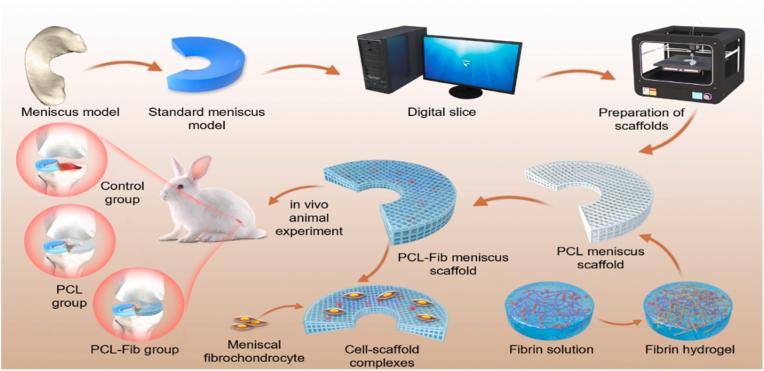
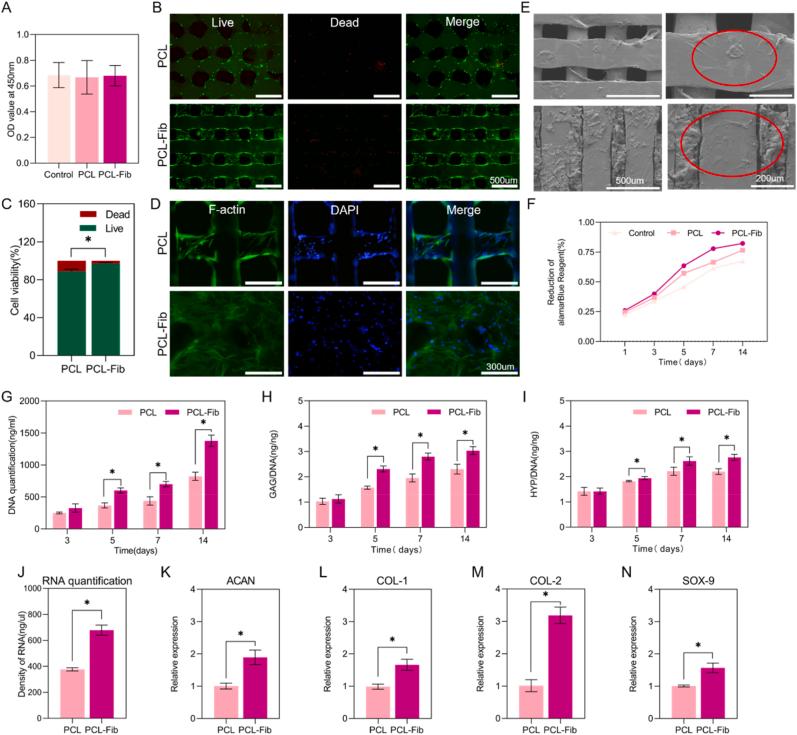
A meniscus injury is a common cartilage disease of the knee joint. Despite the availability of various methods for the treatment of meniscal injuries, the poor regenerative capacity of the meniscus often necessitates resection, leading to the accelerated progression of osteoarthritis. Advances in tissue engineering have introduced meniscal tissue engineering as a potential treatment option. In this study, we established the size of a standardized meniscal scaffold using knee Magnetic Resonance Imaging (MRI) data and created a precise Polycaprolactone (PCL) scaffold utilizing 3-Dimensional (3D) printing technology, which was then combined with Fibrin (Fib) hydrogel to form a PCL-Fib scaffold. The PCL scaffold offers superior biomechanical properties, while the Fib hydrogel creates a conducive microenvironment for cell growth, supporting chondrocyte proliferation and extracellular matrix (ECM) production. Physical and chemical characterization, biocompatibility testing, and in vivo animal experiments revealed the excellent biomechanical properties and biocompatibility of the scaffold, which enhanced in situ meniscal regeneration and reduced osteoarthritis progression. In conclusion, the integration of 3D printing technology and the Fib hydrogel provided a supportive microenvironment for chondrocyte proliferation and ECM secretion, facilitating the in situ regeneration and repair of the meniscal defect. This innovative approach presents a promising avenue for meniscal injury treatment and advances the clinical utilization of artificial meniscal grafts.
半月板损伤是膝关节常见的软骨疾病。尽管有多种治疗半月板损伤的方法,但半月板再生能力差常常需要进行切除,这会导致骨关节炎加速发展。组织工程学的进展使半月板组织工程成为一种潜在的治疗选择。在本研究中,我们利用膝关节磁共振成像(MRI)数据确定了标准化半月板支架的尺寸,并运用三维(3D)打印技术制作了精确的聚己内酯(PCL)支架,然后将其与纤维蛋白(Fib)水凝胶结合形成PCL-Fib支架。PCL支架具有优异的生物力学性能,而Fib水凝胶为细胞生长创造了有利的微环境,支持软骨细胞增殖和细胞外基质(ECM)生成。物理和化学表征、生物相容性测试以及体内动物实验表明,该支架具有优异的生物力学性能和生物相容性,可促进半月板原位再生并减缓骨关节炎的发展。总之,3D打印技术与Fib水凝胶的结合为软骨细胞增殖和ECM分泌提供了支持性微环境,促进了半月板缺损的原位再生和修复。这种创新方法为半月板损伤治疗提供了一条有前景的途径,并推动了人工半月板移植物的临床应用。





 Zotero 插件