
调控血凝块纤维蛋白膜以操控生物材料介导的异物反应。
Regulating Blood Clot Fibrin Films to Manipulate Biomaterial-Mediated Foreign Body Responses.
作者信息
Zou Yang, Shan Zhengjie, Han Zongpu, Yang Jieting, Lin Yixiong, Gong Zhuohong, Xie Lv, Xu Jieyun, Xie Runlong, Chen Zhuofan, Chen Zetao
机构信息
Hospital of Stomatology, Guanghua School of Stomatology, Sun Yat-sen University and Guangdong Research Center for Dental and Cranial Rehabilitation and Material Engineering, Guangzhou 510055, China.
出版信息
Research (Wash D C). 2023 Sep 15;6:0225. doi: 10.34133/research.0225. eCollection 2023.
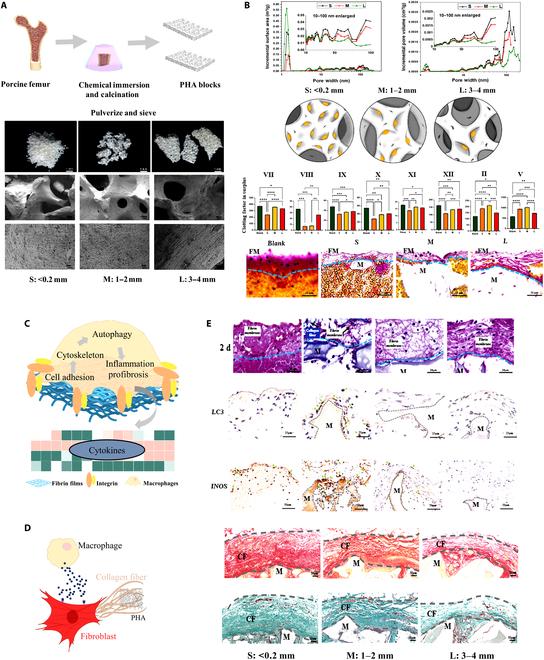
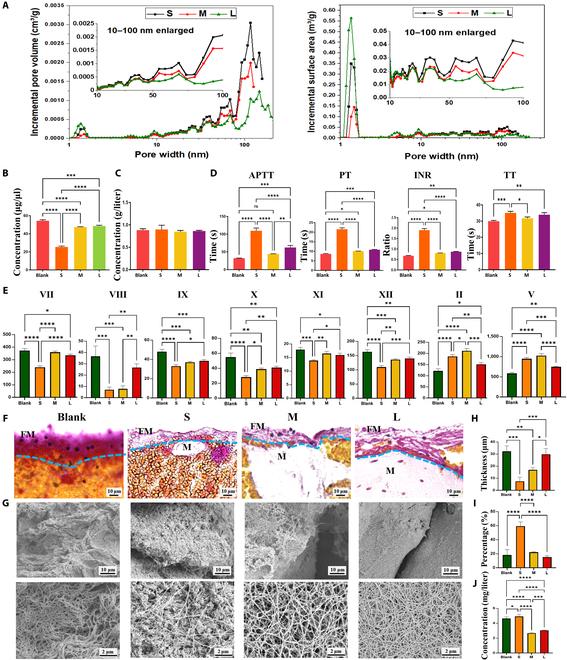
The clinical efficacy of implanted biomaterials is often compromised by host immune recognition and subsequent foreign body responses (FBRs). During the implantation, biomaterials inevitably come into direct contact with the blood, absorbing blood protein and forming blood clot. Many studies have been carried out to regulate protein adsorption, thus manipulating FBR. However, the role of clot surface fibrin films formed by clotting shrinkage in host reactions and FBR is often ignored. Because of the principle of fibrin film formation being relevant to fibrinogen or clotting factor absorption, it is feasible to manipulate the fibrin film formation via tuning the absorption of fibrinogen and clotting factor. As biological hydroxyapatite reserved bone architecture and microporous structure, the smaller particle size may expose more microporous structures and adsorb more fibrinogen or clotting factor. Therefore, we set up 3 sizes (small, <0.2 mm; medium, 1 to 2 mm; large, 3 to 4 mm) of biological hydroxyapatite (porcine bone-derived hydroxyapatite) with different microporous structures to investigate the absorption of blood protein, the formation of clot surface fibrin films, and the subsequent FBR. We found that small group adsorbed more clotting factors because of more microporous structures and formed the thinnest and sparsest fibrin films. These thinnest and sparsest fibrin films increased inflammation and profibrosis of macrophages through a potential signaling pathway of cell adhesion-cytoskeleton-autophagy, leading to the stronger FBR. Large group adsorbed lesser clotting factors, forming the thickest and densest fibrin films, easing inflammation and profibrosis of macrophages, and finally mitigating FBR. Thus, this study deepens the understanding of the role of fibrin films in host recognition and FBR and demonstrates the feasibility of a strategy to regulate FBR by modulating fibrin films via tuning the absorption of blood proteins.
植入生物材料的临床疗效常常受到宿主免疫识别及随后的异物反应(FBRs)的影响。在植入过程中,生物材料不可避免地会与血液直接接触,吸附血液蛋白并形成血凝块。许多研究致力于调节蛋白吸附,从而控制FBR。然而,由凝血收缩形成的血凝块表面纤维蛋白膜在宿主反应和FBR中的作用常常被忽视。由于纤维蛋白膜的形成原理与纤维蛋白原或凝血因子的吸附有关,通过调节纤维蛋白原和凝血因子的吸附来控制纤维蛋白膜的形成是可行的。作为保留骨结构和微孔结构的生物羟基磷灰石,较小的粒径可能会暴露出更多的微孔结构并吸附更多的纤维蛋白原或凝血因子。因此,我们设置了具有不同微孔结构的3种尺寸(小,<0.2毫米;中,1至2毫米;大,3至4毫米)的生物羟基磷灰石(猪骨衍生羟基磷灰石),以研究血液蛋白的吸附、血凝块表面纤维蛋白膜的形成以及随后的FBR。我们发现,小尺寸组由于更多的微孔结构而吸附了更多的凝血因子,并形成了最薄且最稀疏的纤维蛋白膜。这些最薄且最稀疏的纤维蛋白膜通过细胞黏附 - 细胞骨架 - 自噬这一潜在信号通路增强了巨噬细胞的炎症和纤维化,导致更强的FBR。大尺寸组吸附的凝血因子较少,形成了最厚且最致密的纤维蛋白膜,减轻了巨噬细胞的炎症和纤维化,最终减轻了FBR。因此,本研究加深了对纤维蛋白膜在宿主识别和FBR中作用的理解,并证明了通过调节血液蛋白吸附来调控纤维蛋白膜从而控制FBR这一策略的可行性。



 Zotero 插件