
生物炭在水体有机污染物修复中的应用:多环芳烃和农药去除研究综述
Biochar in the Remediation of Organic Pollutants in Water: A Review of Polycyclic Aromatic Hydrocarbon and Pesticide Removal.
作者信息
Beljin Jelena, Đukanović Nina, Anojčić Jasmina, Simetić Tajana, Apostolović Tamara, Mutić Sanja, Maletić Snežana
机构信息
Faculty of Sciences, University of Novi Sad, 21000 Novi Sad, Serbia.
出版信息
Nanomaterials (Basel). 2024 Dec 27;15(1):26. doi: 10.3390/nano15010026.
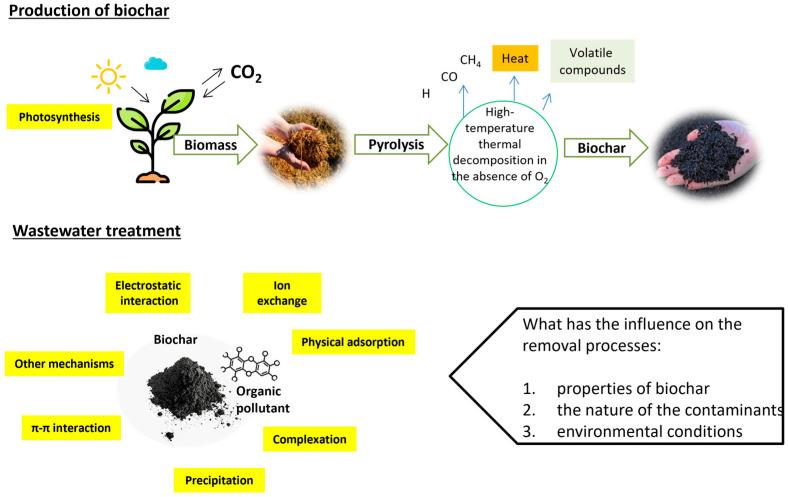
This review explores biochar's potential as a sustainable and cost-effective solution for remediating organic pollutants, particularly polycyclic aromatic hydrocarbons (PAHs) and pesticides, in water. Biochar, a carbon-rich material produced from biomass pyrolysis, has demonstrated adsorption efficiencies exceeding 90% under optimal conditions, depending on the feedstock type, pyrolysis temperature, and functionalization. High surface area (up to 1500 m/g), porosity, and modifiable surface functional groups make biochar effective in adsorbing a wide range of contaminants, including toxic metals, organic pollutants, and nutrients. Recent advancements in biochar production, such as chemical activation and post-treatment modifications, have enhanced adsorption capacities, with engineered biochar achieving superior performance in treating industrial, municipal, and agricultural effluents. However, scaling up biochar applications from laboratory research to field-scale wastewater treatment poses significant challenges. These include inconsistencies in adsorption performance under variable environmental conditions, the high cost of large-scale biochar production, logistical challenges in handling and deploying biochar at scale, and the need for integration with existing treatment systems. Such challenges impact the practical implementation of biochar-based remediation technologies, requiring further investigation into cost-effective production methods, long-term performance assessments, and field-level optimization strategies. This review underscores the importance of addressing these barriers and highlights biochar's potential to offer a sustainable, environmentally friendly, and economically viable solution for large-scale wastewater treatment.
本综述探讨了生物炭作为一种可持续且具有成本效益的解决方案,用于修复水中有机污染物,特别是多环芳烃(PAHs)和农药的潜力。生物炭是一种通过生物质热解产生的富含碳的材料,在最佳条件下,其吸附效率超过90%,这取决于原料类型、热解温度和功能化。高比表面积(高达1500 m/g)、孔隙率和可修饰的表面官能团使生物炭能够有效地吸附多种污染物,包括有毒金属、有机污染物和营养物质。生物炭生产的最新进展,如化学活化和后处理改性,提高了吸附能力,工程生物炭在处理工业、城市和农业废水方面表现出卓越的性能。然而,将生物炭应用从实验室研究扩大到现场规模的废水处理面临重大挑战。这些挑战包括在可变环境条件下吸附性能的不一致、大规模生物炭生产的高成本、大规模处理和部署生物炭的后勤挑战,以及与现有处理系统集成的需求。这些挑战影响了基于生物炭的修复技术的实际应用,需要进一步研究具有成本效益的生产方法、长期性能评估和现场级优化策略。本综述强调了解决这些障碍的重要性,并突出了生物炭为大规模废水处理提供可持续、环境友好且经济可行的解决方案的潜力。
 Zotero 插件