
绿色合成银纳米颗粒和ATCBRA杀虫剂对[植物名称]根系的细胞遗传毒性效应评估
An Assessment of the Cyto-Genotoxicity Effects of Green-Synthesized Silver Nanoparticles and ATCBRA Insecticide on the Root System of .
作者信息
Al-Saleh May A, Al-Harbi Hanan F, Al-Humaid L A, Awad Manal A
机构信息
Botany and Microbiology Department, College of Science, King Saud University, Riyadh 11451, Saudi Arabia.
King Abdullah Institute for Nanotechnology, King Saud University, P.O. Box 2455, Riyadh 11451, Saudi Arabia.
出版信息
Nanomaterials (Basel). 2025 Jan 6;15(1):77. doi: 10.3390/nano15010077.
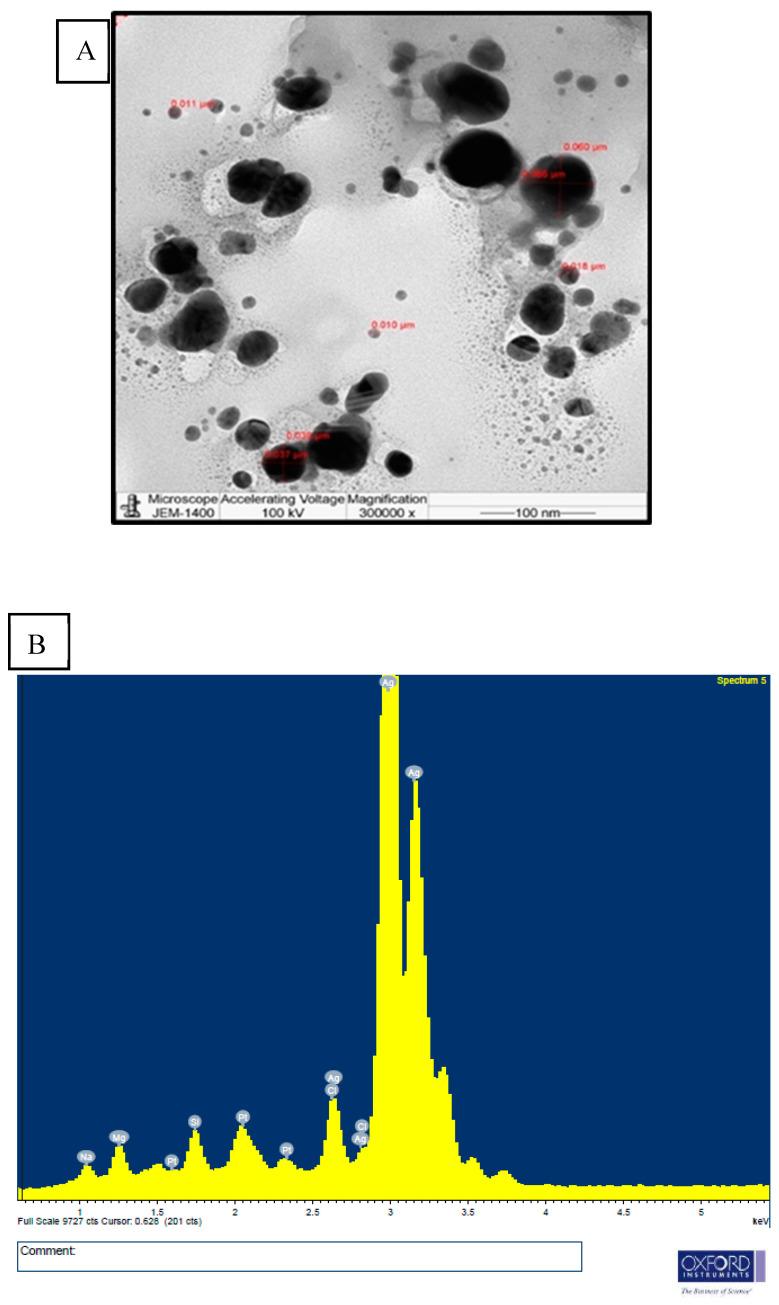
We aimed to synthesize silver nanoparticles (AgNPs) using (cardamom) extracts and assess the cytotoxicity and genotoxicity of the cardamom extract, -AgNPs, and the insecticide ATCBRA-commonly used for pest control-on the root system of (broad bean). The chemical composition of the aqueous cardamom extract was identified and quantified using GC-MS, revealing a variety of bioactive compounds also present in cardamom essential oil. These included α-terpinyl acetate (21.3-44.3%), 1,8-cineole (10.7-28.4%), and linalool (6.4-8.6%). The successful green synthesis of AgNPs was confirmed through various micro-spectroscopic techniques, including UV-Vis spectroscopy, transmission electron microscopy (TEM), and energy-dispersive spectroscopy (EDS). UV-Vis analysis showed a strong peak between 420 and 430 nm, indicating the presence of AgNPs. TEM imaging revealed that the synthesized -AgNPs were monodispersed, primarily spherical, and semi-uniform in shape, with minimal aggregation. EDS analysis further confirmed the composition of the nanoparticles, with -AgNPs comprising around 60.5% by weight. Cytotoxicity was evaluated by measuring the mitotic index (MI), and genotoxicity was assessed by observing chromosomal aberrations (CAs). The roots of were treated for 24 and 48 h with varying concentrations of ATCBRA pesticide (0.1%, 0.3%, 0.5%, and 0.7%), aqueous cardamom extract (3%, 4%, 5%, and 6%), and green-synthesized -AgNPs (12, 25, and 60 mg). The cytogenetic analysis of MI and CA in the meristematic root tips indicated an improvement in the evaluated parameters with the cardamom extract. However, a marked reduction in mitotic activity was observed with both ATCBRA and -AgNP treatments across both time points, highlighting potential cytotoxic and genotoxic effects.
我们旨在利用小豆蔻提取物合成银纳米颗粒(AgNPs),并评估小豆蔻提取物、-AgNPs以及常用于害虫防治的杀虫剂ATCBRA对蚕豆根系的细胞毒性和遗传毒性。使用气相色谱-质谱联用仪(GC-MS)对小豆蔻水提取物的化学成分进行了鉴定和定量,结果显示小豆蔻精油中也存在多种生物活性化合物。这些化合物包括乙酸α-萜品酯(21.3 - 44.3%)、1,8-桉叶素(10.7 - 28.4%)和芳樟醇(6.4 - 8.6%)。通过紫外-可见光谱、透射电子显微镜(TEM)和能量色散光谱(EDS)等多种微观光谱技术证实了AgNPs的成功绿色合成。紫外-可见分析显示在420至430纳米之间有一个强峰,表明存在AgNPs。TEM成像显示合成的-AgNPs呈单分散状态,主要为球形,形状半均匀,聚集极少。EDS分析进一步证实了纳米颗粒的组成,其中-AgNPs的重量占比约为60.5%。通过测量有丝分裂指数(MI)评估细胞毒性,通过观察染色体畸变(CAs)评估遗传毒性。用不同浓度的ATCBRA农药(0.1%、0.3%、0.5%和0.7%)、小豆蔻水提取物(3%、4%、5%和6%)以及绿色合成的-AgNPs(12、25和60毫克)对蚕豆根进行24小时和48小时的处理。对分生组织根尖中MI和CA的细胞遗传学分析表明,小豆蔻提取物使评估参数有所改善。然而,在两个时间点上,ATCBRA和-AgNP处理均观察到有丝分裂活性显著降低,突出了潜在的细胞毒性和遗传毒性作用。




 Zotero 插件