
重组人生长激素对重症神经外科患者的影响:一项单中心回顾性研究。
Effects of recombinant human growth hormone in severe neurosurgical patients: A single center, retrospective study.
作者信息
Liao Xixian, Huang Haorun, Qiu Binghui, Chen Jiaping, Zhang An, Liang Haoxin, Huang Chuanping, Mei Fen, Mao Jian, Liu Fan, Jin Ming, Peng Xiaojie, Ma Haidie, Ding Wenjie, Qi Songtao, Bao Yun
机构信息
Department of Neurosurgery, Nanfang Hospital, Southern Medical University, Guangzhou, Guangdong, China.
Department of Stomatology, Nanfang Hospital, Southern Medical University, Guangzhou, Guangdong, China.
出版信息
PLoS One. 2025 Jan 10;20(1):e0317219. doi: 10.1371/journal.pone.0317219. eCollection 2025.
PURPOSE
To explore the effects of recombinant human growth hormone (r-hGH) on inflammatory mediators, immune cells and prognosis in severe neurosurgical patients.
METHODS
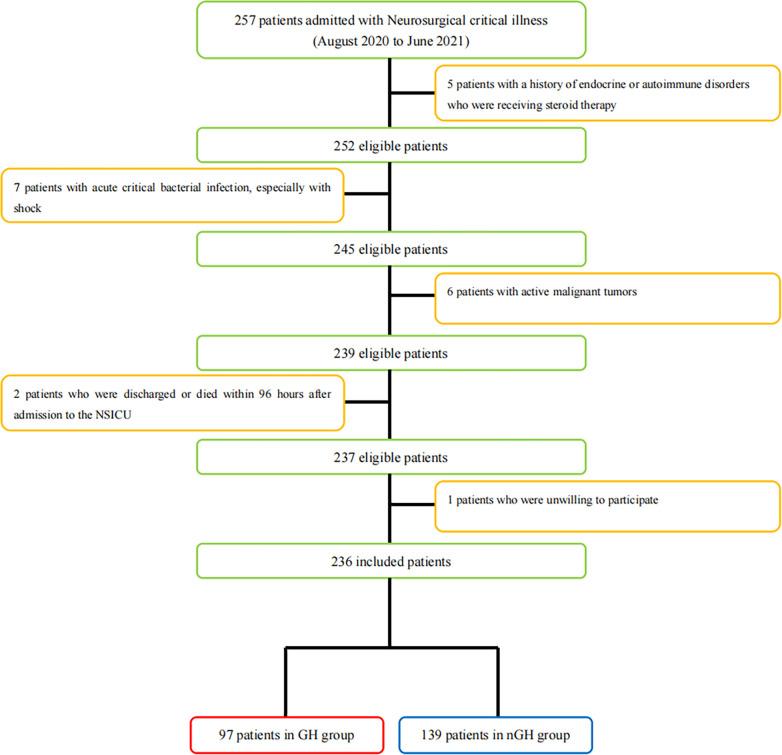
From August 2020 to June 2021, a total of 236 patients who admitted to the neurosurgical intensive care unit (NSICU) were retrospectively analyzed. The patients were divided into GH group (97 cases) and nGH group (139 cases) according to whether they received r-hGH treatment. Parameters including CD4+ T cell counts, inflammatory mediators and prognosis were recorded and assessed.
RESULTS
The results showed that the cure time of pneumonia and intracranial infection in GH group patients was significantly shorter than in the nGH group (24.25 ± 4.89 days and 21.33 ± 1.53 days versus 29.13 ± 7.43 days and 25.17 ± 2.32 days, respectively). However, there was no significant difference in GOS scores between two groups (31.96% ≤ 3 and 68.04% > 3 vs 39.57% ≤ 3 and 60.43% > 3) (P = 0.232). Furthermore, the number of CD4+ T cells and CD8+ T cells in the GH group showed a significant upward trend. Last but not least, significant differences were also observed in IL-6 and IL-10 levels between two groups at days 1, 3, and 7.
CONCLUSION
The application of r-hGH in severe neurosurgical patients was effective in increasing the number of CD4+ T cells, down-regulating inflammatory mediators, shortening the cure time of pneumonia, intracranial infections and urinary tract infections, and improving patients' prognosis.
目的
探讨重组人生长激素(r-hGH)对重症神经外科患者炎症介质、免疫细胞及预后的影响。
方法
回顾性分析2020年8月至2021年6月期间收治于神经外科重症监护病房(NSICU)的236例患者。根据是否接受r-hGH治疗将患者分为生长激素组(97例)和非生长激素组(139例)。记录并评估包括CD4+T细胞计数、炎症介质及预后等参数。
结果
结果显示,生长激素组患者肺炎及颅内感染的治愈时间显著短于非生长激素组(分别为24.25±4.89天和21.33±1.53天,对比29.13±7.43天和25.17±2.32天)。然而,两组之间的格拉斯哥预后评分(GOS)无显著差异(31.96%≤3分和68.04%>3分,对比39.57%≤3分和60.43%>3分)(P=0.232)。此外,生长激素组中CD4+T细胞和CD8+T细胞数量呈显著上升趋势。最后但同样重要的是,两组在第1、3和7天的白细胞介素-6(IL-6)和白细胞介素-10(IL-10)水平也存在显著差异。
结论
r-hGH应用于重症神经外科患者可有效增加CD4+T细胞数量,下调炎症介质,缩短肺炎、颅内感染及尿路感染的治愈时间,并改善患者预后。


 Zotero 插件