
微囊化丁酸钠、益生菌和低聚果糖混合物治疗肠易激综合征患者的疗效和安全性——一项随机、双盲、安慰剂对照研究
Efficacy and Safety of a Mixture of Microencapsulated Sodium Butyrate, Probiotics, and Short Chain Fructooligosaccharides in Patients with Irritable Bowel Syndrome-A Randomized, Double-Blind, Placebo-Controlled Study.
作者信息
Gąsiorowska Anita, Romanowski Marek, Walecka-Kapica Ewa, Kaczka Aleksandra, Chojnacki Cezary, Padysz Milena, Siedlecka Marta, Banasik Julia, Sobolewska-Włodarczyk Aleksandra, Wiśniewska-Jarosińska Maria, Bierła Joanna B, Otaru Nize, Cukrowska Bożena, Steinert Robert E
机构信息
Gastroenterology Department, Medical University of Lodz, Pomorska 251, 92-213 Łódź, Poland.
Department of Microbiology and Clinical Immunology, The Children's Memorial Health Institute, Aleja Dzieci Polskich 20, 04-730 Warsaw, Poland.
出版信息
J Clin Med. 2024 Dec 24;14(1):6. doi: 10.3390/jcm14010006.
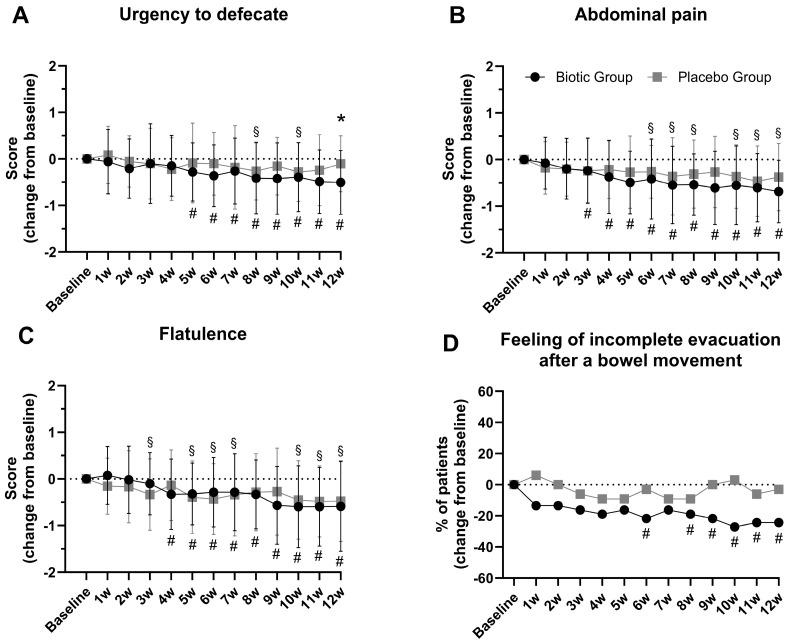
Biotics are increasingly being used in the treatment of irritable bowel syndrome (IBS). This study aimed to assess the efficacy and safety of a mixture of microencapsulated sodium butyrate, probiotics ( DSM 26357, DSM 32418, DSM 32946, DSM 32403, and DSM 32269), and short-chain fructooligosaccharides (scFOSs) in IBS patients. This was a randomized, double-blind, placebo-controlled trial involving 120 adult participants with IBS. The primary outcome of the 12-week intervention was the improvement in IBS symptoms and quality of life (QOL), assessed with the use of IBS-Adequate Relief (IBS-AR), IBS-Global Improvement Scale (IBS-GIS), IBS-Symptom Severity Score (IBS-SSS), and IBS-QOL. Secondary outcomes were the number and type of stools (assessed via the Bristol Stool Form scale), patient-recorded symptoms, anthropometric parameters, and levels of selected inflammatory cytokines. As early as at 4 weeks, there was a higher percentage of patients in the biotic group reporting adequate relief of symptoms (based on IBS-AR) than in the placebo group (64.7% vs. 42.0%, respectively, = 0.023). At 12 weeks, fewer patients in the biotic group reported a 'worsening of symptoms' (based on IBS-GIS) than in the placebo group (5.9% vs. 16.0% respectively, = 0.015). There were no significant differences between groups in IBS-QOL or IBS-SSS or any of the secondary outcome measures except the patient-recorded 'urgency to defecate' ( = 0.015) at week 12, which was significantly lower in the biotic group. The intervention was safe and well tolerated. A biotic mixture consisting of microencapsulated butyrate, probiotics, and small amounts of scFOSs is safe and effective in improving gastrointestinal symptoms in patients with IBS.
生物制剂越来越多地用于治疗肠易激综合征(IBS)。本研究旨在评估微囊化丁酸钠、益生菌(DSM 26357、DSM 32418、DSM 32946、DSM 32403和DSM 32269)以及短链低聚果糖(scFOSs)混合物对IBS患者的疗效和安全性。这是一项随机、双盲、安慰剂对照试验,涉及120名成年IBS患者。12周干预的主要结局是IBS症状和生活质量(QOL)的改善,使用IBS充分缓解(IBS-AR)、IBS全球改善量表(IBS-GIS)、IBS症状严重程度评分(IBS-SSS)和IBS-QOL进行评估。次要结局包括大便的数量和类型(通过布里斯托大便形态量表评估)、患者记录的症状、人体测量参数以及选定炎症细胞因子的水平。早在4周时,生物制剂组报告症状充分缓解(基于IBS-AR)的患者百分比高于安慰剂组(分别为6


 Zotero 插件