
休眠卵母细胞中胞外分泌复合体成分1(Exoc1)缺失会破坏c-KIT和生长分化因子(GDF9)的亚细胞定位,并导致小鼠雌性不育。
Exocyst complex component 1 (Exoc1) loss in dormant oocyte disrupts c-KIT and growth differentiation factor (GDF9) subcellular localization and causes female infertility in mice.
作者信息
Nguyen Chi Lieu Kim, Kuba Yumeno, Le Hoai Thu, Shawki Hossam Hassan, Mikami Natsuki, Aoki Madoka, Yasuhara Nanako, Suzuki Hayate, Mizuno-Iijima Saori, Ayabe Shinya, Osawa Yuki, Fujiyama Tomoyuki, Dinh Tra Thi Huong, Ishida Miyuki, Daitoku Yoko, Tanimoto Yoko, Murata Kazuya, Kang Woojin, Ema Masatsugu, Hirao Yuji, Ogura Atsuo, Takahashi Satoru, Sugiyama Fumihiro, Mizuno Seiya
机构信息
Ph.D. Program in Human Biology, School of Integrative and Global Majors, University of Tsukuba, 1-1-1 Tennodai, Tsukuba, Ibaraki, 305-8575, Japan.
Master's Program in Medical Sciences, Graduate School of Comprehensive Human Sciences, University of Tsukuba, 1-1-1 Tennodai, Tsukuba, Ibaraki, 305-8575, Japan.
出版信息
Cell Death Discov. 2025 Jan 20;11(1):17. doi: 10.1038/s41420-025-02291-5.
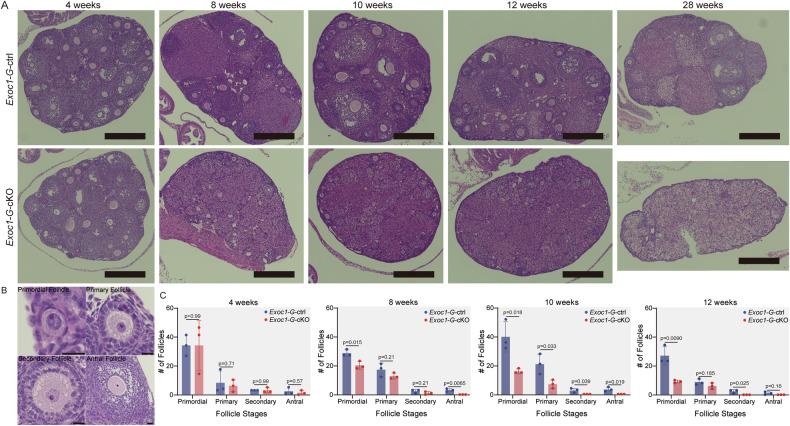
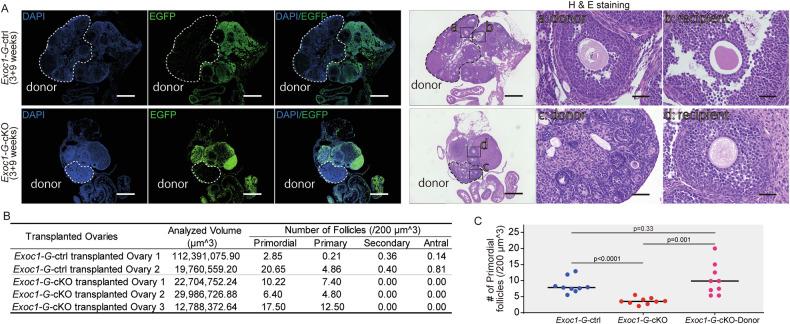
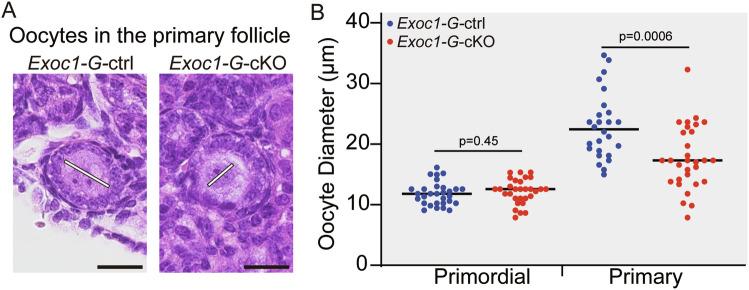
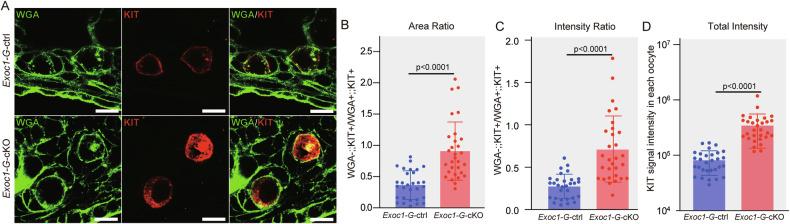
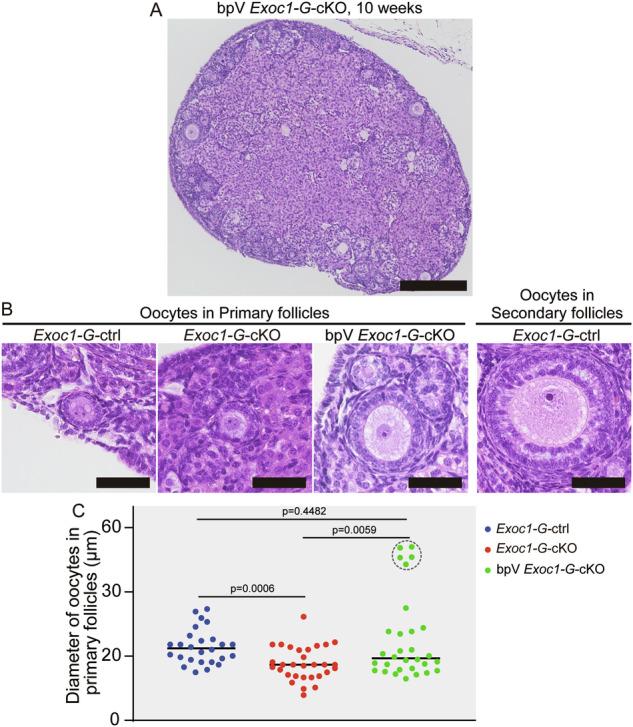
A limited number of female germ cells support reproduction in many mammals. The follicle, composed of oocytes and supporting granulosa cells, forms the basis of oogenesis. Crosstalk between oocytes and granulosa cells is essential for the formation, dormancy, re-awakening, and maturation of oocytes. The oocyte expresses c-KIT and growth differentiation factor-9 (GDF-9), which are major factors in this crosstalk. The downstream signalling pathways of c-KIT and GDF-9 have been well-documented; however, their intra-oocyte trafficking pathway remains unclear. Our study reveals that the exocyst complex, a heterotetrameric protein complex important for tethering in vesicular transport, is important for proper intra-oocyte trafficking of c-KIT and GDF9 in mice. We found that depletion of oocyte-specific EXOC1, a component of the exocyst complex, impaired oocyte re-awakening and cyst breakdown, and inhibited granulosa cell proliferation during follicle growth. The c-KIT receptor is localised on the oocyte plasma membrane. The oocyte-specific Kit conditional knockout mice were reported to exhibit impaired oocyte re-awakening and reduced oocyte cyst breakdown. GDF9 is a protein secreted extracellularly in the oocyte. Previous studies have shown that Gdf9 knockout mice impaired proliferation and granulosa cell multilayering in growing follicles. We found that both c-KIT and GDF9 abnormally stuck in the EXOC1-depleted oocyte cytoplasm. These abnormal phenotypes were also observed in oocytes depleted of exocyst complex members EXOC3 and EXOC7. These results clearly show that the exocyst complex is essential for proper intra-oocyte trafficking of c-KIT and GDF9. Inhibition of this complex causes complete loss of female fertility in mice. Our findings build a platform for research related to trafficking mechanisms of vital crosstalk factors for oogenesis.
在许多哺乳动物中,数量有限的雌性生殖细胞维持着生殖功能。由卵母细胞和支持性颗粒细胞组成的卵泡是卵子发生的基础。卵母细胞与颗粒细胞之间的相互作用对于卵母细胞的形成、休眠、重新激活和成熟至关重要。卵母细胞表达c-KIT和生长分化因子9(GDF-9),它们是这种相互作用中的主要因子。c-KIT和GDF-9的下游信号通路已有充分记载;然而,它们在卵母细胞内的运输途径仍不清楚。我们的研究表明,外泌体复合物是一种对囊泡运输中的拴系很重要的异源四聚体蛋白复合物,对小鼠卵母细胞内c-KIT和GDF9的正常运输很重要。我们发现,外泌体复合物的一个成分、卵母细胞特异性的EXOC1缺失会损害卵母细胞的重新激活和囊肿破裂,并在卵泡生长过程中抑制颗粒细胞增殖。c-KIT受体定位于卵母细胞质膜上。据报道,卵母细胞特异性Kit条件性敲除小鼠表现出卵母细胞重新激活受损和卵母细胞囊肿破裂减少。GDF9是一种在卵母细胞中分泌到细胞外的蛋白质。先前的研究表明,Gdf9基因敲除小鼠的生长卵泡中颗粒细胞增殖和多层化受损。我们发现,c-KIT和GDF9在EXOC1缺失的卵母细胞细胞质中异常滞留。在缺失外泌体复合物成员EXOC3和EXOC7的卵母细胞中也观察到了这些异常表型。这些结果清楚地表明,外泌体复合物对于c-KIT和GDF9在卵母细胞内的正常运输至关重要。抑制该复合物会导致小鼠完全丧失雌性生育能力。我们的研究结果为卵子发生中重要相互作用因子运输机制的研究搭建了一个平台。



 Zotero 插件