
秘鲁中部地区饮用水源中的 出现情况及抗菌药物耐药性概况 (注:原文中“Occurrence of in drinking water sources”这里“of”后面缺少具体内容,翻译只能根据现有完整部分进行)
Occurrence of in drinking water sources and antimicrobial resistance profile in the central region of Peru.
作者信息
Custodio María, Montalvo-Otivo Raúl, Crispín-Ayala Jhonatan, Bendezu-Meza Jeampier, Herrera-Quintana Pilar, De la Cruz Heidi, Huarcaya Javier
机构信息
Facultad de Medicina Humana, Universidad Nacional del Centro del Perú, Av. Mariscal Castilla N° 3989-4089, Huancayo, Peru.
Laboratorio de Investigación de Aguas, Universidad Nacional del Centro del Perú, Av. Mariscal Castilla N° 3989-4089, Huancayo, Peru.
出版信息
Heliyon. 2024 Dec 26;11(1):e41533. doi: 10.1016/j.heliyon.2024.e41533. eCollection 2025 Jan 15.
INTRODUCTION
Contamination of drinking water by can cause serious diseases, including cancer. The determinants of the infection rate are socioeconomic status, low standard of living and overcrowding. In addition, exposure to environmental sources contaminated with feces, such as water and vegetables, is another risk factor for infection. We analyzed the occurrence of in drinking water sources and the antimicrobial resistance profile in central Peru.
METHODS
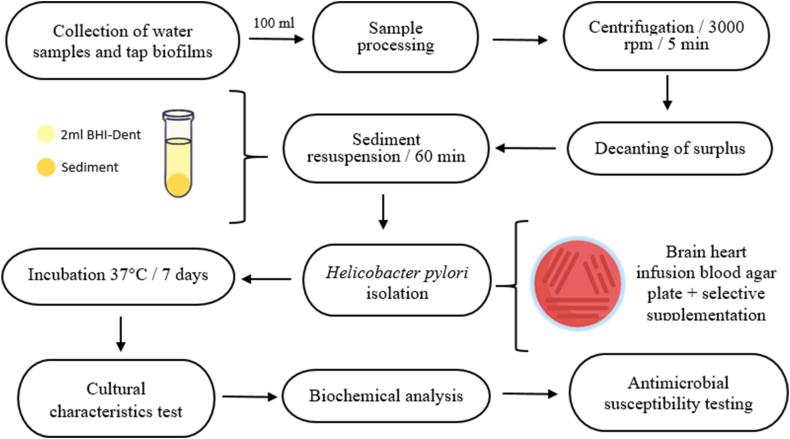
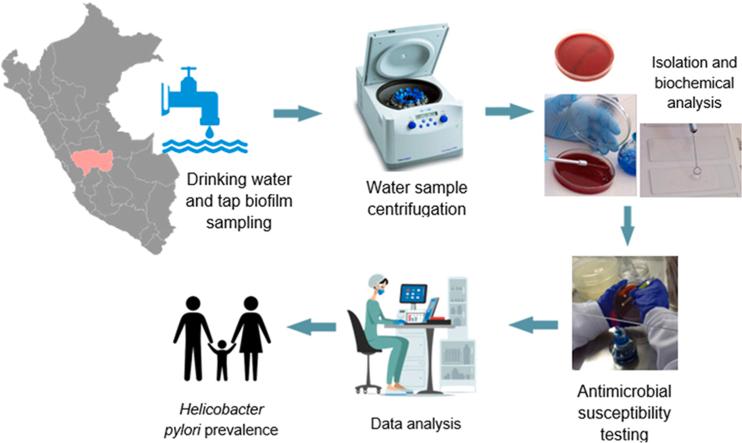
Water samples were collected from taps in four provinces of the Junín region. Previously, biofilm sampling was performed from the internal surface of the taps. The samples were cultured on modified brain heart infusion blood agar at 37 °C under microaerophilic conditions for seven days. Antibiotic sensitivity of was determined by the Kirby Bauer diffusion method.
RESULTS
The results revealed that pH (9.25) and turbidity (5.15 NTU) exceeded the Peruvian environmental quality standards for drinking water. The amount of free chlorine residual in the positive water samples ranged from 0.02 to 0.12 mg/L. was present in 2/192 tap water samples (1.04 %) and in 3/192 tap biofilm samples (1.56 %). It was observed that 100 % of isolates from water samples from the Chilca district showed resistance to nalidixic acid and 66.67 % to both amoxicillin and chloramphenicol. Resistance to nalidixic acid of isolates obtained from biofilm samples from taps in the El Tambo district ranged from 66.67 % to 100 %.
CONCLUSION
The study findings reveal that water samples and tap biofilms in the Chilca, El Tambo and Huamancaca chico districts in the Junín region harbor . They also reveal variability in the pattern of resistance to more than one antibiotic tested from one district to another.
引言
[某种病菌名称]污染饮用水可导致包括癌症在内的严重疾病。感染率的决定因素包括社会经济地位、低生活水平和过度拥挤。此外,接触受粪便污染的环境源,如水和蔬菜,是另一个感染风险因素。我们分析了秘鲁中部饮用水源中[某种病菌名称]的出现情况以及抗菌药物耐药性特征。
方法
从胡宁地区四个省份的水龙头采集水样。此前,已从水龙头内表面进行生物膜采样。将样品在改良脑心浸液血琼脂上于37°C微需氧条件下培养7天。通过 Kirby Bauer 扩散法测定[某种病菌名称]的抗生素敏感性。
结果
结果显示,pH值(9.25)和浊度(5.15 NTU)超过了秘鲁饮用水环境质量标准。[某种病菌名称]阳性水样中的游离氯残留量在0.02至0.12毫克/升之间。在192份自来水样品中有2份(1.04%)以及192份水龙头生物膜样品中有3份(1.56%)检测到[某种病菌名称]。观察到,来自奇尔卡区水样的[某种病菌名称]分离株100%对萘啶酸耐药,66.67%对阿莫西林和氯霉素均耐药。从埃尔坦博区水龙头生物膜样品获得的[某种病菌名称]分离株对萘啶酸的耐药率在66.67%至100%之间。
结论
研究结果表明,胡宁地区奇尔卡、埃尔坦博和小瓦曼卡卡区的水样和水龙头生物膜中存在[某种病菌名称]。研究结果还揭示了从一个区到另一个区,对一种以上测试抗生素的耐药模式存在差异。

 Zotero 插件