
针对患有芳香化酶抑制剂相关肌肉骨骼症状的乳腺癌患者的自我指压疗法:AcuAIM随机试点试验方案
Self-acupressure for patients with breast cancer experiencing aromatase inhibitor-associated musculoskeletal symptoms: Protocol for the AcuAIM randomized pilot trial.
作者信息
Henry N Lynn, Kidwell Kelley M, Kozar Stephanie, Snyder Sara, Zick Suzanna M
机构信息
University of Michigan Medical School, Ann Arbor, MI, United States of America.
University of Michigan School of Public Health, Ann Arbor, MI, United States of America.
出版信息
PLoS One. 2025 Jan 22;20(1):e0311044. doi: 10.1371/journal.pone.0311044. eCollection 2025.
BACKGROUND
Aromatase inhibitors (AI) reduce hormone receptor-positive breast cancer recurrence risk by about 50%. However, half of AI-treated postmenopausal women report new or worsened musculoskeletal symptoms (AIMSS), and 20% discontinue therapy prematurely. Acupuncture is effective for reducing symptoms, but many women are not able to access acupuncture therapy. We hypothesize that self-administered acupressure will reduce AIMSS.
MATERIALS AND METHODS
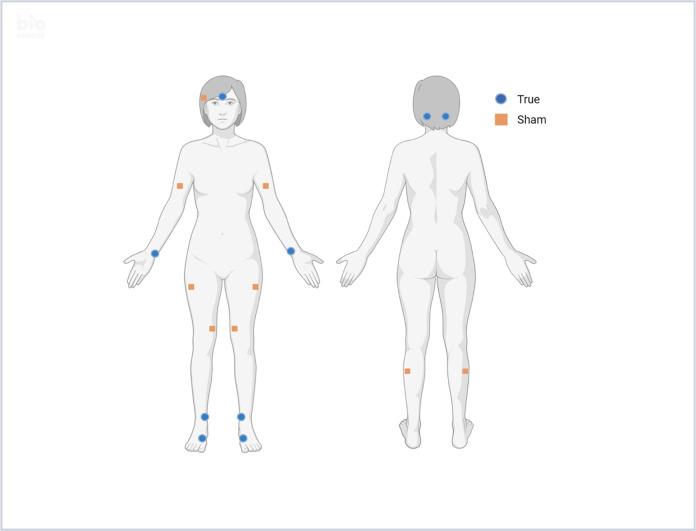
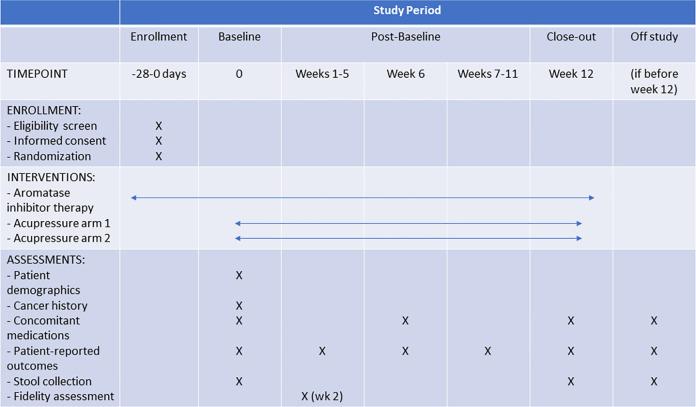
Postmenopausal women who have been receiving treatment with an AI for more than 3 weeks but less than 2 years, and who report new or worsened joint pain or myalgias since starting AI therapy with worst pain of at least 4 out of 10 on a numerical rating scale, are eligible. Fifty participants will be enrolled and randomized 1:1 to treatment with true or sham acupressure for 12 weeks. Participants will self-apply pressure for 3 minutes to each of the 9 acupoints daily. All participants will complete a pain assessment weekly, and a battery of symptom questionnaires every 6 weeks. Optional stool samples will be collected after 0 and 12 weeks of acupressure to examine changes in the gut microbiome. The primary endpoint is change in worst pain on the Brief Pain Inventory-Short Form with 12 weeks of the acupressure intervention, evaluated with generalized estimating equations.
CONCLUSION
Determination that self-administered acupressure reduces AIMSS in this randomized phase 2 pilot trial will lead to a larger randomized phase 3 clinical trial to confirm the efficacy of self-acupressure. Reduction of AI-related arthralgias may improve persistence with breast cancer therapy, breast cancer outcomes, and quality of life for AI-treated patients.
TRIAL REGISTRATION
Clinicaltrials.gov NCT06228768.
背景
芳香化酶抑制剂(AI)可将激素受体阳性乳腺癌的复发风险降低约50%。然而,接受AI治疗的绝经后女性中有一半报告出现了新的或加重的肌肉骨骼症状(芳香化酶抑制剂引起的肌肉骨骼症状,AIMSS),20%的女性过早停药。针灸对减轻症状有效,但许多女性无法获得针灸治疗。我们假设自我实施的指压疗法将减轻AIMSS。
材料与方法
接受AI治疗超过3周但少于2年,且自开始AI治疗以来报告出现新的或加重的关节疼痛或肌痛,数字评分量表上最严重疼痛至少为10分中的4分的绝经后女性符合条件。将招募50名参与者,并按1:1随机分为接受真指压或假指压治疗12周。参与者每天对9个穴位中的每个穴位施加压力3分钟。所有参与者将每周完成一次疼痛评估,每6周完成一系列症状问卷。在指压治疗0周和12周后将收集可选的粪便样本,以检查肠道微生物群的变化。主要终点是在指压干预12周后,简明疼痛量表简表中最严重疼痛的变化,采用广义估计方程进行评估。
结论
在这项随机2期试点试验中确定自我实施的指压疗法可减轻AIMSS,将导致开展更大规模的随机3期临床试验,以确认自我指压疗法的疗效。减轻与AI相关的关节痛可能会提高AI治疗患者对乳腺癌治疗的依从性、改善乳腺癌治疗效果及生活质量。
试验注册
Clinicaltrials.gov NCT06228768。
 Zotero 插件