
多维综合分析确定BCL2L1甲基化是小儿恶性肿瘤中MCL1依赖性的预测指标。
Multidimensional, integrative profiling identifies BCL2L1 methylation as a predictor of MCL1 dependency in pediatric malignancies.
作者信息
Adjumain Shazia, Daniel Paul, Sun Claire Xin, Bradshaw Gabrielle, Chew Nicole J, Tsui Vanessa, Lee Hanbyeol, Loi Melissa, Zhukova Nataliya, Habarakada Dilru, Yoel Abigail, Vaghjiani Vijesh G, Game Shaye, Ludlow Louise E, Neeman Naama, Sweet-Cordero E Alejandro, Eisenstat David D, Cain Jason E, Firestein Ron
机构信息
Centre for Cancer Research, Hudson Institute of Medical Research, and.
Department of Molecular and Translational Science, Faculty of Medicine, Nursing and Health Sciences, Monash University, Clayton, Victoria, Australia.
出版信息
JCI Insight. 2025 Jan 23;10(2):e184601. doi: 10.1172/jci.insight.184601.
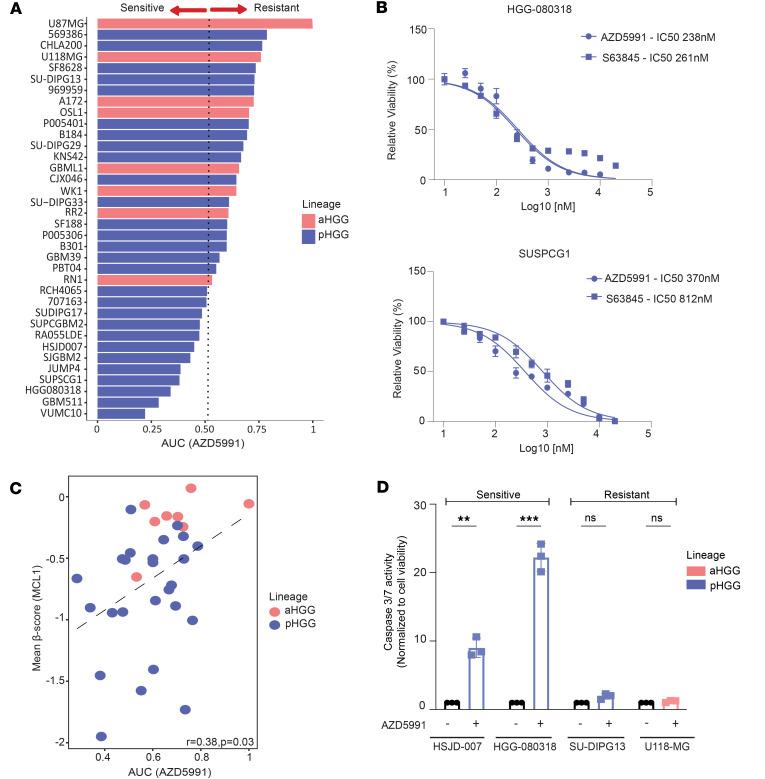
Pediatric high-grade gliomas (pHGGs) are the most aggressive brain tumors in children, necessitating innovative therapies to improve outcomes. Unlike adult gliomas, recent research reveals that childhood gliomas have distinct biological features, requiring specific treatment strategies. Here, we focused on deciphering unique genetic dependencies specific to childhood gliomas. Using a pooled CRISPR/Cas9 knockout screening approach on 65 pediatric and 10 adult high-grade glioma (HGG) cell lines, myeloid cell leukemia 1 (MCL1) emerged as a key antiapoptotic gene essential in pediatric but not adult gliomas. We demonstrated that MCL1 is targetable using current small molecule inhibitors, and its inhibition leads to potent anticancer activity across pediatric HGG cell lines irrespective of genotype. Employing predictive modeling approaches on a large set of childhood cancer cell lines with multiomics data features, we identified a potentially previously unreported cluster of CpG sites in the antiapoptotic BCL-xL/BCL2L1 gene, which predicted MCL1 inhibitor response. We extended these data across multiple pediatric tumor types, showing that BCL2L1 methylation is a broad predictor of MCL1 dependency in vitro and in vivo. Overall, our multidimensional, integrated genomic approach identified MCL1 as a promising therapeutic target in several BCL2L1-methylated pediatric cancers, offering a translational strategy to identify patients most likely to benefit from MCL1 inhibitor therapy.
儿童高级别胶质瘤(pHGGs)是儿童中最具侵袭性的脑肿瘤,需要创新疗法来改善治疗结果。与成人胶质瘤不同,最近的研究表明儿童胶质瘤具有独特的生物学特征,需要特定的治疗策略。在此,我们专注于解读儿童胶质瘤特有的独特基因依赖性。通过对65个儿童和10个成人高级别胶质瘤(HGG)细胞系采用汇集的CRISPR/Cas9基因敲除筛选方法,髓系细胞白血病1(MCL1)成为儿童而非成人胶质瘤中至关重要的关键抗凋亡基因。我们证明MCL1可使用当前的小分子抑制剂靶向,并且其抑制作用在儿童HGG细胞系中不论基因型如何都能产生强大的抗癌活性。利用具有多组学数据特征的大量儿童癌细胞系的预测建模方法,我们在抗凋亡的BCL-xL/BCL2L1基因中鉴定出一组可能先前未报道的CpG位点,其可预测MCL1抑制剂反应。我们将这些数据扩展到多种儿童肿瘤类型,表明BCL2L1甲基化是体外和体内MCL1依赖性的广泛预测指标。总体而言,我们的多维、综合基因组方法确定MCL1是几种BCL2L1甲基化儿童癌症中有前景的治疗靶点,为识别最有可能从MCL1抑制剂治疗中受益的患者提供了一种转化策略。




 Zotero 插件