
通过睡眠昼夜节律干预计划改善与慢性疼痛相关的焦虑:一项初步研究。
Improving Anxiety Related to Chronic Pain Through a Sleep Circadian Intervention Program: A Pilot Study.
作者信息
López-Monzoni Sonia, Hernando Benito Gloria, Romero-Peralta Sofía, Silgado-Martínez Laura, Viejo-Ayuso Maria Esther, Álvarez-Balado Leticia, Rodríguez Matarranz Enrique, Forné Izquierdo Carles, Sánchez-de-la-Torre Manuel, Masa Juan Fernando, Barbé Ferrán, García-Río Francisco, Martínez-Nicolás Antonio, García-Mediano Belén, Solano-Pérez Esther, Mediano Olga
机构信息
Sleep Unit, Pneumology Department, Hospital Universitario de Guadalajara, 19002 Guadalajara, Spain.
Group of Precision Medicine in Chronic Diseases, Hospital Nacional de Parapléjicos, Instituto de Investigación Sanitaria de Castilla La Mancha (IDISCAM), 45071 Toledo, Spain.
出版信息
Behav Sci (Basel). 2025 Jan 3;15(1):40. doi: 10.3390/bs15010040.
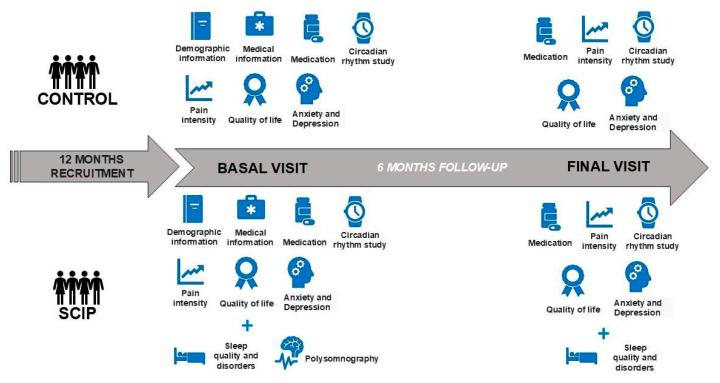
The limitations of pharmacological treatments for chronic pain have become increasingly evident: dependency, side effects, resistance, and diminishing efficacy. The urgent need for innovative solutions has become a compelling focus for improving patient outcomes. Innovative non-pharmacological approaches, such as sleep management, as a strategy to reduce opioid consumption and pain control are needed. The aim was to evaluate the impact of a Sleep and Circadian Intervention Program (SCIP) in the control of chronic musculoskeletal pain (CMP). This was a randomized clinical trial (NCT03646084), in which 49 CMP patients were assigned to SCIP ( = 15, mean age 51 years and 40% women) or non-SCIP groups ( = 26, 53 years and 61.5% women). Outcomes were evaluated after 6 months through self-reported questionnaires (pain intensity, physical function, depression/anxiety, and quality of life (QoL)). The SCIP group was assessed by polysomnography and specific questionnaires and was treated for diagnosed sleep disorders according to clinical guidelines. This population showed a moderate pain intensity at baseline, important deterioration of QoL and pathological anxiety/fear related to pain. Fifty percent of them presented restless leg syndrome, 60% moderate/severe insomnia, and 62.5% sleep apnea. During the follow-up, the SCIP group presented a greater reduction in the abnormal risk group for anxiety (from 73.3% to 46.7%) and depression (from 53.3% to 33.3%) on the Hospital Anxiety and Depression Scale compared to the non-SCIP group (from 40% to 29.2% and 33.3% to 29.2%, respectively). Also, a positive significant effect on anxiety/fear related to pain was found in the Pain Anxiety Symptoms Scale multivariable model, with an important improvement in symptoms. The application of SCIP in CMP patients improved anxiety and controlled associated sleep disorders, highlighting the impact on insomnia. Larger studies are needed for better understanding of the sleep intervention in CMP control.
慢性疼痛药物治疗的局限性日益明显
依赖性、副作用、耐药性以及疗效递减。对创新解决方案的迫切需求已成为改善患者治疗效果的一个引人关注的焦点。需要创新的非药物方法,如睡眠管理,作为减少阿片类药物消费和控制疼痛的一种策略。目的是评估睡眠与昼夜节律干预计划(SCIP)对慢性肌肉骨骼疼痛(CMP)控制的影响。这是一项随机临床试验(NCT03646084),其中49例CMP患者被分配到SCIP组(n = 15,平均年龄51岁,40%为女性)或非SCIP组(n = 26,53岁,61.5%为女性)。6个月后通过自我报告问卷(疼痛强度、身体功能、抑郁/焦虑和生活质量(QoL))评估结果。SCIP组通过多导睡眠图和特定问卷进行评估,并根据临床指南对诊断出的睡眠障碍进行治疗。该人群在基线时疼痛强度中等,生活质量严重下降,且存在与疼痛相关的病理性焦虑/恐惧。其中50%的人出现不宁腿综合征,60%为中度/重度失眠,62.5%有睡眠呼吸暂停。在随访期间,与非SCIP组相比,SCIP组在医院焦虑抑郁量表上焦虑异常风险组(从73.3%降至46.7%)和抑郁异常风险组(从53.3%降至33.3%)的降幅更大(非SCIP组分别从40%降至29.2%和33.3%降至29.2%)。此外,在疼痛焦虑症状量表多变量模型中发现对与疼痛相关的焦虑/恐惧有显著的积极影响,症状有重要改善。SCIP应用于CMP患者可改善焦虑并控制相关睡眠障碍,突出了对失眠的影响。需要开展更大规模的研究以更好地了解睡眠干预对CMP控制的作用。


 Zotero 插件