
动物病毒对抗宿主抗病毒天然免疫的策略:开发减毒活疫苗(LAVs)的新线索
The Strategies Used by Animal Viruses to Antagonize Host Antiviral Innate Immunity: New Clues for Developing Live Attenuated Vaccines (LAVs).
作者信息
Chen Na, Zhang Baoge
机构信息
MOE Joint International Research Laboratory of Animal Health and Food Safety, Engineering Laboratory of Animal Immunity of Jiangsu Province, College of Veterinary Medicine, Nanjing Agricultural University, Nanjing 210095, China.
College of Veterinary Medicine, Nanjing Agricultural University, Nanjing 210095, China.
出版信息
Vaccines (Basel). 2025 Jan 8;13(1):46. doi: 10.3390/vaccines13010046.
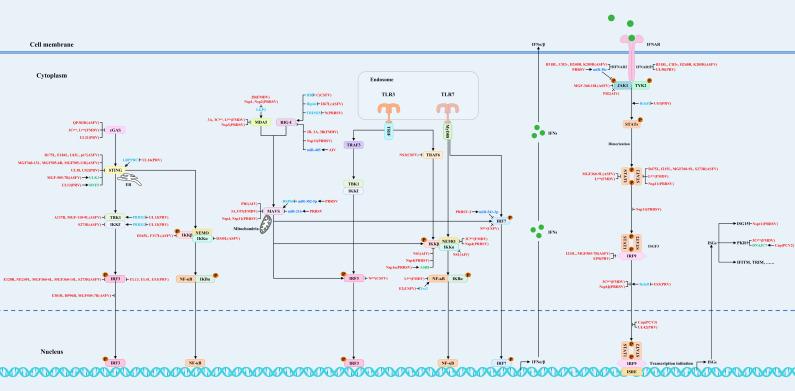
As an essential type of vaccine, live attenuated vaccines (LAVs) play a crucial role in animal disease prevention and control. Nevertheless, developing LAVs faces the challenge of balancing safety and efficacy. Understanding the mechanisms animal viruses use to antagonize host antiviral innate immunity may help to precisely regulate vaccine strains and maintain strong immunogenicity while reducing their pathogenicity. It may improve the safety and efficacy of LAVs, as well as provide a more reliable means for the prevention and control of infectious livestock diseases. Therefore, exploring viral antagonistic mechanisms is a significant clue for developing LAVs, which helps to explore more viral virulence factors (as new vaccine targets) and provides a vital theoretical basis and technical support for vaccine development. Among animal viruses, ASFV, PRRSV, PRV, CSFV, FMDV, PCV, PPV, and AIV are some typical representatives. It is crucial to conduct in-depth research and summarize the antagonistic strategies of these typical animal viruses. Studies have indicated that animal viruses may antagonize the antiviral innate immunity by directly or indirectly blocking the antiviral signaling pathways. In addition, viruses also do this by antagonizing host restriction factors targeting the viral replication cycle. Beyond that, viruses may antagonize via regulating apoptosis, metabolic pathways, and stress granule formation. A summary of viral antagonistic mechanisms might provide a new theoretical basis for understanding the pathogenic mechanism of animal viruses and developing LAVs based on antagonistic mechanisms and viral virulence factors.
作为一种重要的疫苗类型,减毒活疫苗(LAVs)在动物疾病预防和控制中发挥着关键作用。然而,开发减毒活疫苗面临着平衡安全性和有效性的挑战。了解动物病毒用于对抗宿主抗病毒天然免疫的机制,可能有助于精确调控疫苗毒株,在降低其致病性的同时保持强大的免疫原性。这可能会提高减毒活疫苗的安全性和有效性,并为预防和控制家畜传染病提供更可靠的手段。因此,探索病毒的拮抗机制是开发减毒活疫苗的重要线索,有助于探索更多病毒毒力因子(作为新的疫苗靶点),并为疫苗开发提供重要的理论基础和技术支持。在动物病毒中,非洲猪瘟病毒(ASFV)、猪繁殖与呼吸综合征病毒(PRRSV)、伪狂犬病病毒(PRV)、猪瘟病毒(CSFV)、口蹄疫病毒(FMDV)、猪圆环病毒(PCV)、猪细小病毒(PPV)和禽流感病毒(AIV)是一些典型代表。深入研究并总结这些典型动物病毒的拮抗策略至关重要。研究表明,动物病毒可能通过直接或间接阻断抗病毒信号通路来对抗抗病毒天然免疫。此外,病毒还通过拮抗靶向病毒复制周期的宿主限制因子来实现这一点。除此之外,病毒可能通过调节细胞凋亡、代谢途径和应激颗粒形成来进行拮抗。对病毒拮抗机制的总结可能为理解动物病毒的致病机制以及基于拮抗机制和病毒毒力因子开发减毒活疫苗提供新的理论基础。
 Zotero 插件