
微藻作为生物活性肽的可持续来源:蛋白质组学和计算机模拟方法
Microalga as a Sustainable Source of Bioactive Peptides: A Proteomic and In Silico Approach.
作者信息
Paterson Samuel, Alonso-Pintre Laura, Morato-López Esperanza, González de la Fuente Sandra, Gómez-Cortés Pilar, Hernández-Ledesma Blanca
机构信息
Department of Bioactivity and Food Analysis, Institute of Food Science Research (CIAL, CSIC-UAM, CEI UAM+CSIC), Nicolás Cabrera 9, 28049 Madrid, Spain.
Proteomics Core Facility, Centro de Biología Molecular Severo Ochoa (CBM), CSIC-Universidad Autónoma de Madrid, Nicolás Cabrera 1, 28049 Madrid, Spain.
出版信息
Foods. 2025 Jan 14;14(2):252. doi: 10.3390/foods14020252.
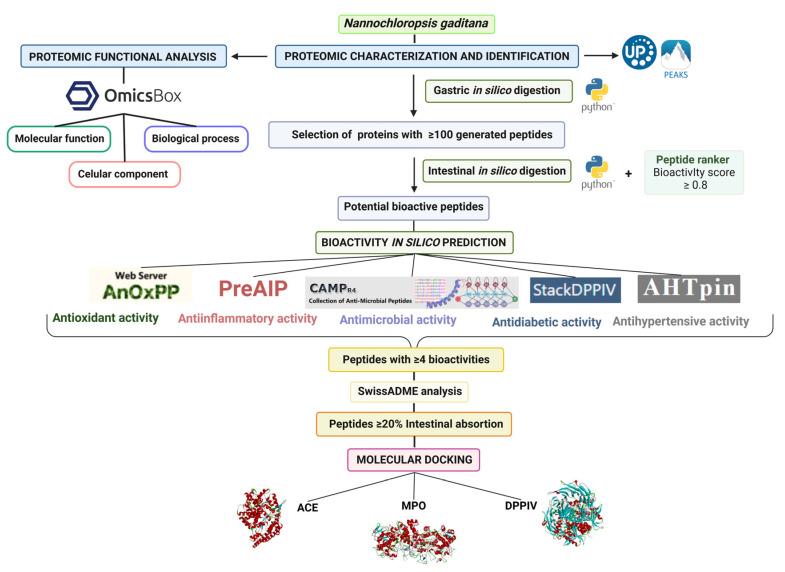
The impact of the world's growing population on food systems and the role of dietary patterns in the management of non-communicable diseases underscore the need to explore sustainable and dietary protein sources. Although microalgae have stood out as alternative sources of proteins and bioactive peptides, some species such as remain unexplored. This study aimed to characterize 's proteome and evaluate its potential as a source of bioactive peptides by using an in silico approach. A total of 1955 proteins were identified and classified into functional groups of cellular components, molecular functions, and biological processes. In silico gastrointestinal digestion of identified proteins demonstrated that 202 hydrophobic and low-molecular-size peptides with potential bioactivity were released. Among them, 27 exhibited theorical antioxidant, antihypertensive, antidiabetic, anti-inflammatory, and/or antimicrobial activities. Seven of twenty-seven peptides showed ≥20% intestinal absorption, suggesting potential systemic effects, while the rest could act at local level. Molecular docking demonstrated strong affinities with key enzymes such as MPO, ACE, and DPPIV. Resistance to the digestion, capacity to be absorbed, and multifunctionality were demonstrated for peptide FIPGL. This study highlights 's potential as a sustainable source of novel potential bioactive peptides with promising local and systemic biological effects.
世界人口增长对粮食系统的影响以及饮食模式在非传染性疾病管理中的作用,凸显了探索可持续饮食蛋白质来源的必要性。尽管微藻已成为蛋白质和生物活性肽的替代来源,但仍有一些物种(如 )未被探索。本研究旨在通过计算机模拟方法对 的蛋白质组进行表征,并评估其作为生物活性肽来源的潜力。共鉴定出1955种蛋白质,并将其分类为细胞成分、分子功能和生物学过程的功能组。对已鉴定蛋白质进行的计算机模拟胃肠道消化表明,释放出了202种具有潜在生物活性的疏水低分子量肽。其中,27种表现出理论上的抗氧化、抗高血压、抗糖尿病、抗炎和/或抗菌活性。27种肽中有7种显示出≥20%的肠道吸收率,表明具有潜在的全身效应,而其余的可能在局部发挥作用。分子对接显示与MPO、ACE和DPPIV等关键酶具有很强的亲和力。肽FIPGL表现出对消化的抗性、吸收能力和多功能性。本研究突出了 作为新型潜在生物活性肽可持续来源的潜力,这些肽具有有前景的局部和全身生物学效应。



 Zotero 插件