
丛枝菌根真菌与根际促生细菌联合接种对幼苗生长及根际微生态的影响
Effects of combined inoculation of arbuscular mycorrhizal fungi and plant growth-promoting rhizosphere bacteria on seedling growth and rhizosphere microecology.
作者信息
Zeng Wanli, Xiang Dan, Li Xuemei, Gao Qian, Chen Yudong, Wang Kunmiao, Qian Yingying, Wang Luoping, Li Jing, Mi Qili, Huang Haitao, Xu Li, Zhao Mingfang, Zhang Yingzhen, Xiang Haiying
机构信息
Yunnan Academy of Tobacco Science, Kunming, China.
College of Resources and Environment, Qingdao Agricultural University, Qingdao, China.
出版信息
Front Microbiol. 2025 Jan 7;15:1475485. doi: 10.3389/fmicb.2024.1475485. eCollection 2024.
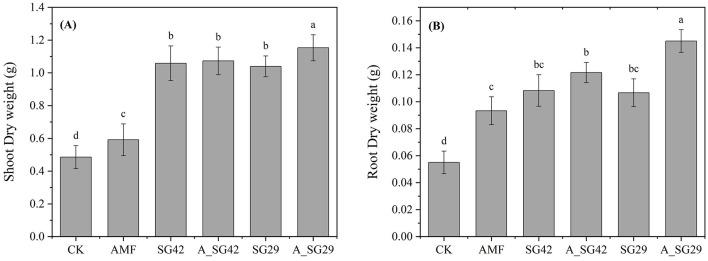
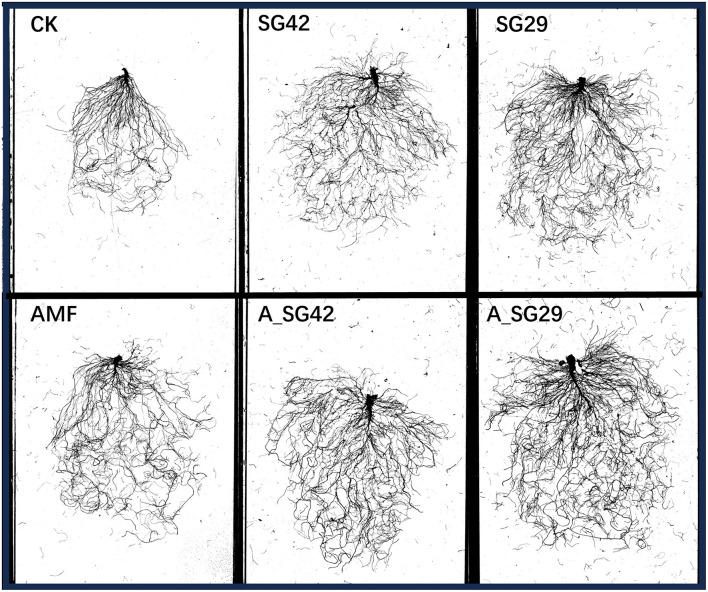
The effects of rhizosphere microorganisms on plant growth and the associated mechanisms are a focus of current research, but the effects of exogenous combined inoculation with arbuscular mycorrhizal fungi (AMF) and plant growth-promoting rhizobacteria (PGPR) on seedling growth and the associated rhizosphere microecological mechanisms have been little reported. In this study, a greenhouse pot experiment was used to study the effects of single or double inoculation with AM fungi () and two PGPR ( sp., sp.) on the growth of tobacco seedlings, together with high-throughput sequencing technology to reveal associated rhizosphere microecological mechanisms. All inoculation treatments significantly increased the aboveground dry weight; root dry weight; seedling nitrogen, phosphorus, and potassium uptake; plant height; stem thickness; maximum leaf area; chlorophyll content; total root length, surface area, and volume; and average root diameter. The highest values for these indices were observed in the combined treatment of . and sp. SG29 (A_SG29). Furthermore, the A_SG29 treatment yielded the highest diversity indexes and largest percentages of significantly enriched bacterial taxa, and significantly promoted the colonization of AMF in tobacco roots and in rhizosphere soil. Differential metabolic-pathway predictions using PICRUSt2 showed that the A_SG29 treatment significantly increased the metabolic pathway richness of tobacco rhizosphere microorganisms, and significantly up-regulated some metabolic pathways that may benefit plant growth. Co-inoculation with . and sp. SG29 promoted tobacco-seedling growth by significantly improving rhizosphere microbial communities' structure and function. In summary, the combined inoculation of AMF and SG29 promotes tobacco seedling growth, optimizes the rhizosphere microbial community's structure and function, and serves as a sustainable microbial co-cultivation method for tobacco seedling production.
根际微生物对植物生长的影响及其相关机制是当前研究的重点,但关于外生菌根真菌(AMF)与植物促生细菌(PGPR)联合接种对幼苗生长的影响及其相关根际微生态机制的报道较少。本研究采用温室盆栽试验,研究了AM真菌()和两种PGPR( 菌、 菌)单接种或双接种对烟草幼苗生长的影响,并利用高通量测序技术揭示相关的根际微生态机制。所有接种处理均显著增加了地上部干重、根干重、幼苗氮、磷、钾吸收量、株高、茎粗、最大叶面积、叶绿素含量、总根长、表面积和体积以及平均根径。这些指标的最高值出现在 菌和 菌SG29联合处理(A_SG29)中。此外,A_SG29处理产生了最高的多样性指数和显著富集的细菌类群的最大百分比,并显著促进了AMF在烟草根中的定殖以及在根际土壤中的定殖。使用PICRUSt2进行的差异代谢途径预测表明,A_SG29处理显著增加了烟草根际微生物的代谢途径丰富度,并显著上调了一些可能有益于植物生长的代谢途径。 菌和 菌SG29联合接种通过显著改善根际微生物群落的结构和功能促进了烟草幼苗生长。综上所述,AMF和SG29联合接种促进了烟草幼苗生长,优化了根际微生物群落的结构和功能,是一种可持续的烟草幼苗生产微生物共培养方法。




 Zotero 插件