
基于2018 - 2023年对中国西南部儿童和妇女侵袭性感染金黄色葡萄球菌全基因组测序的抗生素敏感性及分子特征分析
Antibiotic susceptibility and molecular characterization based on whole-genome sequencing of Staphylococcus aureus causing invasive infection in children and women living in Southwest China during 2018-2023.
作者信息
Liu Li, Yan Ziyi, He Fumei, Chen Jie, Kuang Linghan, Liu Xingxin, Cui Yali, Wang Xia, Miao Chenglin, Li Hong, Jiang Yongmei
机构信息
Department of Laboratory Medicine, West China Second University Hospital, Sichuan University, Chengdu, China.
College of Computer Science, Sichuan University, Chengdu, China.
出版信息
BMC Microbiol. 2025 Jan 27;25(1):47. doi: 10.1186/s12866-025-03758-2.
BACKGROUND
Staphylococcus aureus is one of the most common pathogens that colonizes human skin/mucous membranes, where it causes local infection that can progress to invasive infection, resulting in high morbidity and mortality worldwide. This study aimed to investigate the antibiotic susceptibility and molecular characteristics of invasive S. aureus in children and women in Southwest China from 2018 to 2023 to provide novel insights helpful in preventing and treating S. aureus infections.
METHODS
The demographic and clinical characteristics of patients with invasive S. aureus infection were collected and analyzed. Next-generation sequencing (NGS) and sequence analysis techniques were used to determine the molecular epidemiological characteristics of the S. aureus isolates, and the microdilution broth method was used for antimicrobial susceptibility testing.
RESULTS
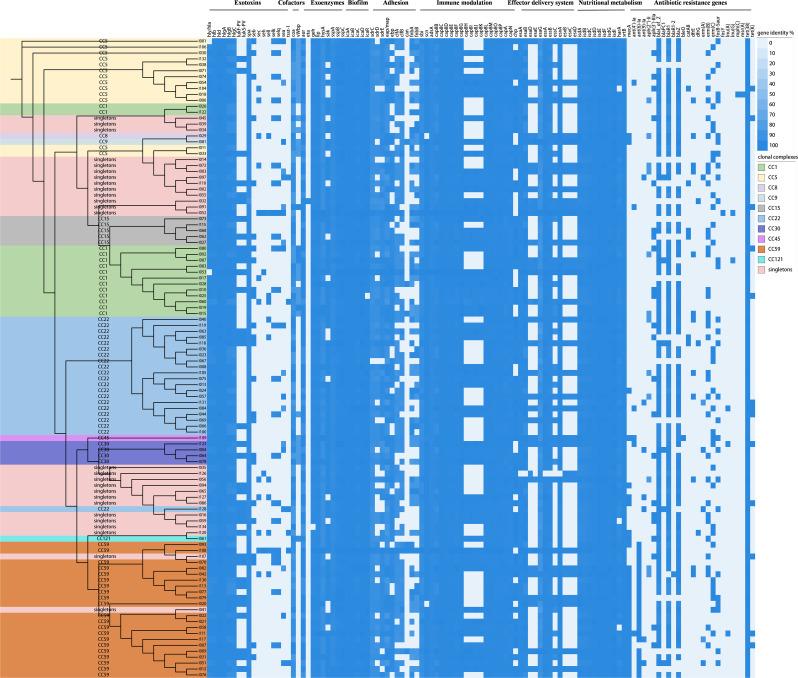
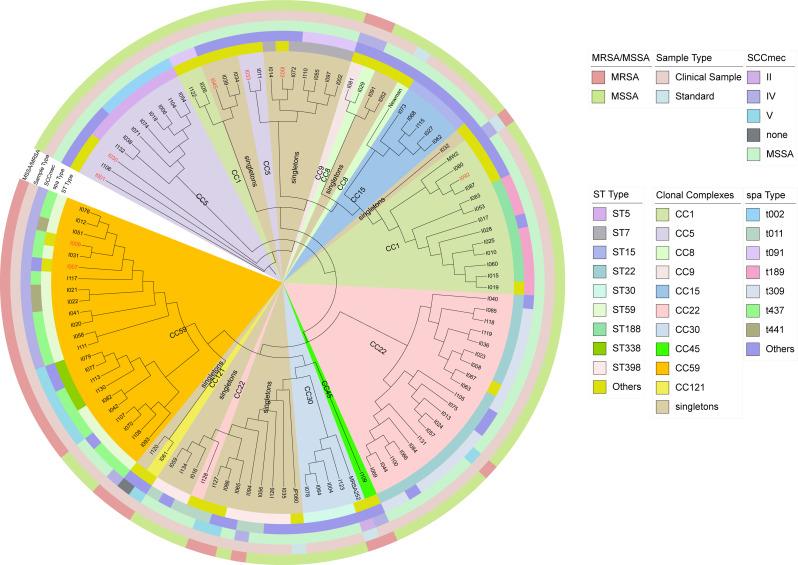
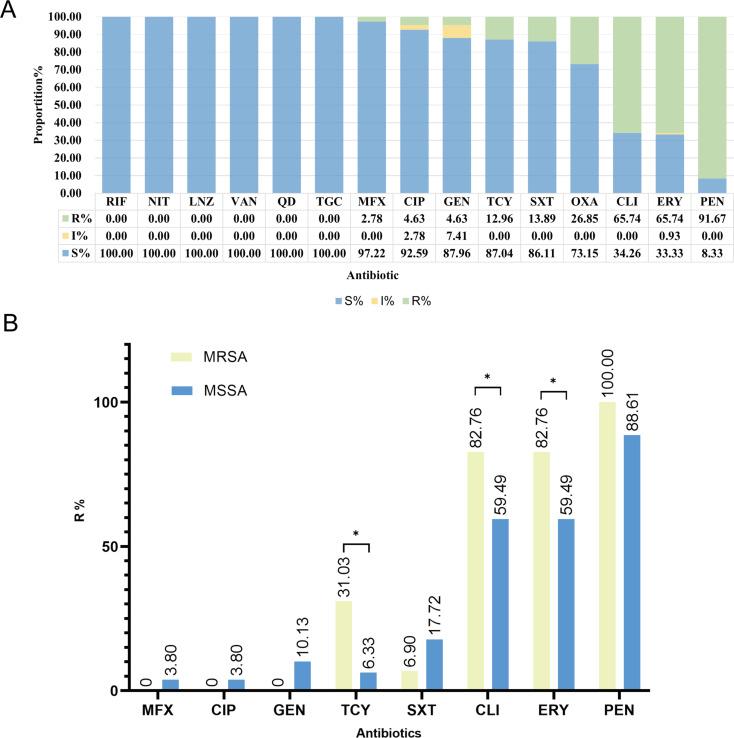
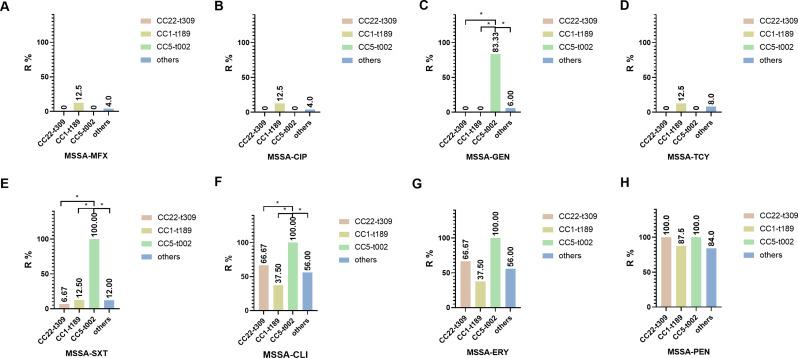
A total of 108 invasive S. aureus isolates, 29 methicillin-resistant S. aureus (MRSA) isolates and 79 methicillin- susceptible S. aureus (MSSA) isolates, were included. The isolates had the highest rate of resistance to PEN, at 91.67%, with all the MRSA isolates being resistant; the next highest resistance was to ERY and CLI, both at 65.74%. A total of 32 STs (including 8 novel STs) were detected and divided into 10 CCs. Moreover, 45 spa types were also detected. The main STs were ST22 (17.59%) and ST59 (15.74%), and the main CCs were CC59 (21.30%) and CC22 (19.44%). The most prevalent spa types were t309 and t437, both at 14.81%, and the SCCmec type could be assigned to two categories: IV (62.07%) and V (34.48%). Among the 29 MRSA isolates tested, CC59-IV-t437 (34.48%) and CC59-V-t437 (13.79%) were the main lineages, and among the 79 MSSA isolates, CC22-t309 (18.99%), CC1-t189 (10.13%), and CC5-t002 (7.60%) were the main lineages. Except for SXT, the resistance rates of the 29 MRSA isolates were greater than those of the MSSA isolates. Most isolates carried common virulence genes, among which the carriage rate of pvl reached 33.33%.
CONCLUSIONS
This study provides valuable information, including the prevalence, molecular characteristics and antimicrobial resistance of S. aureus isolates that cause invasive infectious diseases in Southwest China, and the findings may advance the prevention and treatment of S. aureus infections.
背景
金黄色葡萄球菌是定植于人类皮肤/黏膜的最常见病原体之一,可在局部引发感染,并可能进展为侵袭性感染,在全球范围内导致高发病率和死亡率。本研究旨在调查2018年至2023年中国西南部儿童和女性侵袭性金黄色葡萄球菌的抗生素敏感性及分子特征,为预防和治疗金黄色葡萄球菌感染提供新的见解。
方法
收集并分析侵袭性金黄色葡萄球菌感染患者的人口统计学和临床特征。采用二代测序(NGS)和序列分析技术确定金黄色葡萄球菌分离株的分子流行病学特征,采用微量肉汤稀释法进行药敏试验。
结果
共纳入108株侵袭性金黄色葡萄球菌分离株,其中29株耐甲氧西林金黄色葡萄球菌(MRSA)分离株和79株甲氧西林敏感金黄色葡萄球菌(MSSA)分离株。分离株对青霉素的耐药率最高,为91.67%,所有MRSA分离株均耐药;其次是对红霉素和克林霉素的耐药率,均为65.74%。共检测到32种序列型(STs)(包括8种新的STs),分为10个克隆复合体(CCs)。此外,还检测到45种葡萄球菌蛋白A(spa)分型。主要的STs为ST22(17.59%)和ST59(15.74%),主要的CCs为CC59(21.30%)和CC22(19.44%)。最常见的spa分型是t309和t437,均为14.81%,葡萄球菌染色体盒式甲氧西林耐药基因(SCCmec)分型可分为两类:IV型(62.07%)和V型(34.48%)。在检测的29株MRSA分离株中,CC59-IV-t437(34.48%)和CC59-V-t437(13.79%)是主要谱系,在79株MSSA分离株中,CC22-t309(18.99%)、CC1-t189(10.13%)和CC5-t002(7.60%)是主要谱系。除复方新诺明外,29株MRSA分离株的耐药率均高于MSSA分离株。大多数分离株携带常见毒力基因,其中杀白细胞素(pvl)携带率达33.33%。
结论
本研究提供了有价值的信息,包括中国西南部引起侵袭性传染病的金黄色葡萄球菌分离株的流行情况、分子特征和抗菌药物耐药性,研究结果可能推动金黄色葡萄球菌感染的预防和治疗。

 Zotero 插件