
线粒体作为铁死亡的多方面调节因子。
Mitochondria as multifaceted regulators of ferroptosis.
作者信息
Guo Jingyi, Zhou Yunhao, Liu Dingfei, Wang Mengfei, Wu Yi, Tang Daolin, Liu Xingguo
机构信息
CAS Key Laboratory of Regenerative Biology, Joint School of Life Sciences, Guangzhou Institutes of Biomedicine and Health, Chinese Academy of Sciences; Guangzhou Medical University, Guangzhou, Guangdong 510530, China.
Guangdong Provincial Key Laboratory of Stem Cell and Regenerative Medicine, China-New Zealand Joint Laboratory on Biomedicine and Health, CUHK-GIBH Joint Research Laboratory on Stem Cells and Regenerative Medicine, Institute for Stem Cell and Regeneration, Guangzhou Institutes of Biomedicine and Health, Chinese Academy of Sciences, Guangzhou, Guangdong 510530, China.
出版信息
Life Metab. 2022 Nov 25;1(2):134-148. doi: 10.1093/lifemeta/loac035. eCollection 2022 Oct.
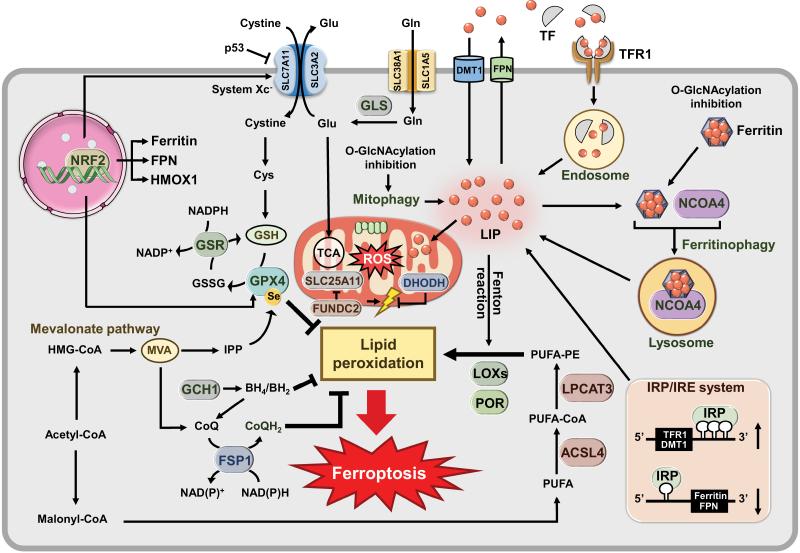
Mitochondria are well known to be "energy factories" of the cell as they provide intracellular ATP via oxidative phosphorylation. Interestingly, they also function as a "cellular suicidal weapon store" by acting as a key mediator of various forms of regulated cell death, including apoptosis, pyroptosis, necroptosis, and ferroptosis. Ferroptosis, distinct from the other types of regulated cell death, is characterized by iron-dependent lipid peroxidation and subsequent plasma membrane rupture. Growing evidence suggests that an impaired ferroptotic response is implicated in various diseases and pathological conditions, and this impaired response is associated with dramatic changes in mitochondrial morphology and function. Mitochondria are the center of iron metabolism and energy production, leading to altered lipid peroxidation sensitivity. Although a growing number of studies have explored the inextricable link between mitochondria and ferroptosis, the role of this organelle in regulating ferroptosis remains unclear. Here, we review recent advances in our understanding of the role of mitochondria in ferroptosis and summarize the characteristics of this novel iron-based cellular suicide weapon and its arsenal. We also discuss the importance of ferroptosis in pathophysiology, including the need for further understanding of the relationship between mitochondria and ferroptosis to identify combinatorial targets that are essential for the development of successful drug discovery.
线粒体作为细胞的“能量工厂”广为人知,因为它们通过氧化磷酸化提供细胞内ATP。有趣的是,它们还通过充当包括细胞凋亡、焦亡、坏死性凋亡和铁死亡在内的各种形式的程序性细胞死亡的关键介质,发挥“细胞自杀武器库”的作用。与其他类型的程序性细胞死亡不同,铁死亡的特征是铁依赖性脂质过氧化和随后的质膜破裂。越来越多的证据表明,铁死亡反应受损与各种疾病和病理状况有关,这种受损反应与线粒体形态和功能的显著变化有关。线粒体是铁代谢和能量产生的中心,导致脂质过氧化敏感性改变。尽管越来越多的研究探讨了线粒体与铁死亡之间千丝万缕的联系,但该细胞器在调节铁死亡中的作用仍不清楚。在此,我们综述了我们对线粒体在铁死亡中作用的理解的最新进展,并总结了这种新型铁基细胞自杀武器及其“武器库”的特征。我们还讨论了铁死亡在病理生理学中的重要性,包括需要进一步了解线粒体与铁死亡之间的关系,以确定成功药物研发必不可少的联合靶点。



 Zotero 插件