
来自一个亚洲队列的乳腺血管肉瘤的多组学特征揭示了血管生成信号通路和肿瘤浸润巨噬细胞的富集。
Multiomics characterization of breast angiosarcoma from an Asian cohort reveals enrichment for angiogenesis signaling pathway and tumor-infiltrating macrophages.
作者信息
Ko Tun Kiat, Guo Zexi, Kannan Bavani, Lim Boon Yee, Lee Jing Yi, Li Zhimei, Lee Elizabeth Chun Yong, Teh Bin Tean, Chan Jason Yongsheng
机构信息
Cancer Discovery Hub, National Cancer Centre Singapore, Singapore, Singapore.
Laboratory of Cancer Epigenome, National Cancer Centre Singapore, Singapore, Singapore.
出版信息
Front Immunol. 2025 Jan 13;15:1515935. doi: 10.3389/fimmu.2024.1515935. eCollection 2024.
INTRODUCTION
Recent epidemiological data suggests a rising incidence of breast angiosarcoma (AS-B) in the Western population, with over two-thirds related to irradiation or chronic lymphedema. However, unlike head and neck angiosarcoma (AS-HN), AS-B disease characteristics in Asia remain unclear.
METHODS
We examined clinical patterns of angiosarcoma patients (n = 176) seen in an Asiantertiary cancer center from 1999 to 2021, and specifically investigated the molecular and immune features of AS-B in comparison to AS-HN. Data from whole genome sequencing (WGS), NanoString gene expression profiling and 10x Genomics Visium spatial transcriptomics were analyzed.
RESULTS
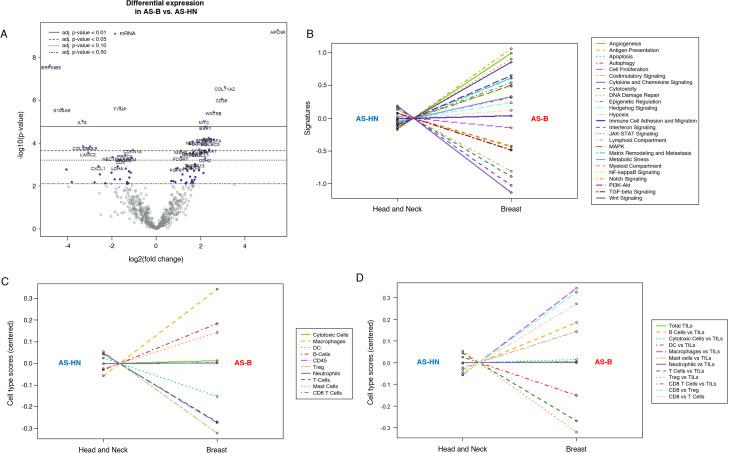
Majority of cases were AS-HN (n = 104; 59.1%), while AS-B (n = 16, all females) accounted for 9.1% of the cases. The median age at diagnosis was 43 years (range, 26 to 74). Based on WGS, 4 of the 7 AS-B had non-synonymous somatic variants in 47 genes (range, 2 to 28 per case). These genes were functionally annotated and were enriched in cancer-related pathways such as regulation of cell differentiation, VEGFR and receptor tyrosine kinases signaling pathways. By NanoString gene expression profiling, ASB, compared to AS-HN, were enriched for angiogenesis, notch signaling and metastasis-associated matrix remodeling pathways. Additionally, AS-B were enriched for macrophages and CD8+ T cells expression signatures. Similarly, Visium spatial transcriptomics showed that AS-B were enriched for macrophages and T-cells.
DISCUSSION
In conclusion, in our AS-B cases, we observed a convergence of both mutational and expression signatures on angiogenic-related pathways. Thus, anti-angiogenic therapy could be an option to treat AS-B.
引言
最近的流行病学数据表明,西方人群中乳腺血管肉瘤(AS-B)的发病率呈上升趋势,其中超过三分之二与放疗或慢性淋巴水肿有关。然而,与头颈部血管肉瘤(AS-HN)不同,亚洲AS-B的疾病特征仍不清楚。
方法
我们研究了1999年至2021年在一家亚洲三级癌症中心就诊的血管肉瘤患者(n = 176)的临床模式,并特别研究了AS-B与AS-HN相比的分子和免疫特征。分析了全基因组测序(WGS)、NanoString基因表达谱和10x Genomics Visium空间转录组学的数据。
结果
大多数病例为AS-HN(n = 104;59.1%),而AS-B(n = 16,均为女性)占病例的9.1%。诊断时的中位年龄为43岁(范围为26至74岁)。基于WGS,7例AS-B中有4例在47个基因中存在非同义体细胞变异(每例范围为2至28个)。这些基因经过功能注释,富集于癌症相关途径,如细胞分化调节、VEGFR和受体酪氨酸激酶信号通路。通过NanoString基因表达谱分析,与AS-HN相比,AS-B在血管生成、Notch信号和转移相关基质重塑途径中富集。此外,AS-B在巨噬细胞和CD8+ T细胞表达特征方面富集。同样,Visium空间转录组学显示AS-B在巨噬细胞和T细胞方面富集。
讨论
总之,在我们的AS-B病例中,我们观察到血管生成相关途径上的突变和表达特征存在趋同。因此,抗血管生成治疗可能是治疗AS-B的一种选择。


 Zotero 插件